Christian Sorensen on Understanding the War Industry
Remember Seymour Melman?
Very few people do.
Melman was the author of the 1970 classic – Pentagon Capitalism: The Political Economy of War.
In that book, Melman analyzed how the headquarters of the U.S. Armed Forces coordinated and administered the businesses that make weapons of war.
Christian Sorensen says that in the fifty plus years since Melman wrote that book, the playing field has changed.
President Dwight D. Eisenhower warned us about the military-industrial-congressional triangle (MIC) in his famous farewell address in January 1961. He referred to it as the military-industrial complex, omitting the congressional side, which had been present in earlier drafts of his address.
Eisenhower warned:
We must never let the weight of this combination [the military-industrial-congressional complex] endanger our liberties or democratic processes. … Only an alert and knowledgeable citizenry can compel the proper meshing of the huge industrial and military machinery of defense with our peaceful methods and goals.
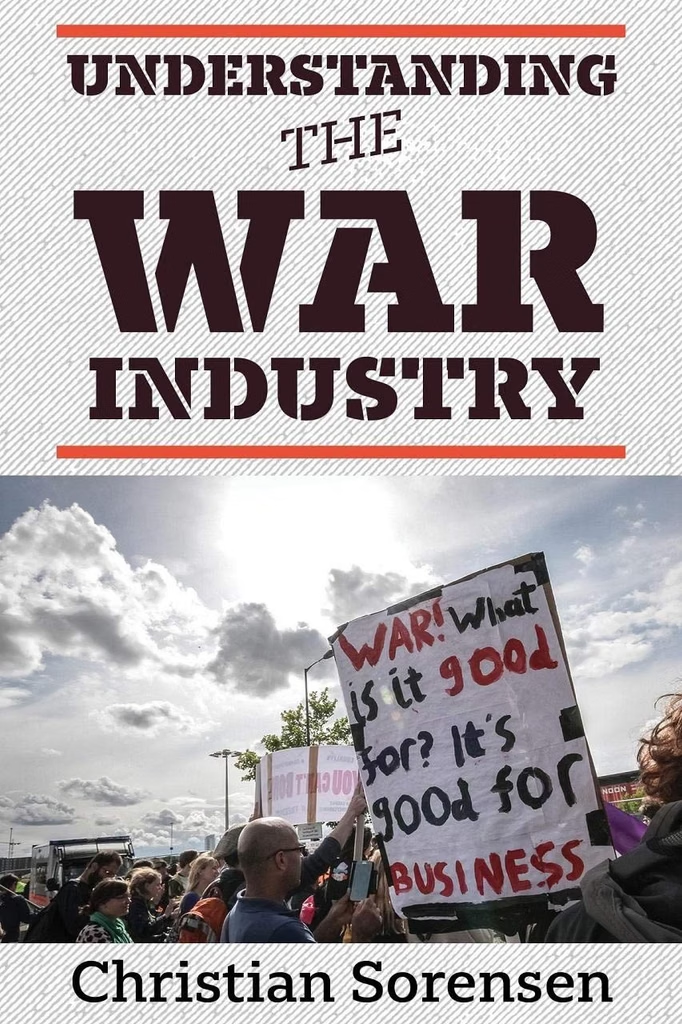
“Clearly, the warning has gone unheeded,” Sorensen writes in the introduction to his book Understanding the War Industry (Clarity Press, 2020).
“Today, in the twenty-first century, the MIC, rather than being curtailed, has demonstrably further penetrated the institutions of U.S. government. The MIC may be viewed as an insulated war-promoting configuration comprised of the Pentagon, the headquarters of the U.S. Armed Forces; industry, the corporations that develop and sell goods and services to the U.S. and allied governments; and the U.S. Congress, which implements policies and authorizes the funding for the Pentagon.”
“The change from Melman’s time is this: war corporations – the industrial part of the MIC – now hold the most power in the trifecta. The Pentagon no longer controls the U.S. war industry. Industry runs the show. Industry employs expansive, sometimes pernicious, operations in order to dominate political processes and military functions. What has happened in the Department of Defense has happened across the U.S. government.”
Sorensen is an associate director at the Eisenhower Media Network, a remarkable group of former military and intelligence officers who are free of ties to weapons, technology and services corporations that profit from war – people like Lawrence Wilkerson, William Hartung, Matthew Hoh, Josephine Guilbeau, Ann Wright, Karen Kwiatkowski, Coleen Rowley and Ray McGovern
The network as an organization receives no funding from the U.S. government, foreign governments or military contractors. This differentiates the network from the majority of U.S. foreign policy-focused think tanks that receive governmental, military-industrial or dark money funding.
Network fellows have extensive military, intelligence, diplomatic and national security backgrounds.
Almost all network fellows held senior positions, had direct combat experience or were posted overseas.
Tell us about the big corporations that are that represent the military industrial complex. How many are there?
“Let’s first define this term, the military industrial complex,” Sorensen told Corporate Crime Reporter in an interview month. “The military-industrial complex is the bundling of government authority centered in the Pentagon, with big business, huge corporations, and some medium-sized and some smaller corporations. The term military-industrial complex was coined by Eisenhower back in the 1960s in his farewell address, and he originally, in his early draft, had it as military-industrial congressional complex because he knew that Congress is very easily corruptible.”
“We have two political parties and both of them are beholden to big business. In his earlier drafts he wanted to say military industrial congressional complex. Many people quite accurately still use that term today. The industrial side dominates the military side and dominates the congressional side.”
“There are about seven corporations that are at the top of the military-industrial complex in terms of industrial capacity and revenue, and these seven are – Lockheed Martin, RTX, Northrop Grumman, General Dynamics, Boeing, L3 Harris Technologies, and Huntington Ingalls Industries, also known as HII. Their revenue in 2024 was something like $245 billion and in 2025 I think it was around $260 billion dollars. These are just enormous corporations, and most of their revenues come from the $1 trillion military budget.”
“Some corporations, like Lockheed Martin, are very heavily reliant on military contracting. Lockheed Martin gets something like 96 or 97% of its total corporate revenue from military contracting.”
“Other corporations, like Boeing or RTX are a little more diversified, and they sell a little more to civilian industries. Half of Boeing is what we know as a commercial aircraft manufacturer. So, Boeing only gets something like 40% of its total revenue from military contracting.”
“RTX is around 52% something like that. Then there are corporations like Northrop Grumman that get around 88%. Many of them are heavily reliant on the budget, which is why they put so much effort into corrupting Congress. That comes in the form of financing congressional campaigns and hiring an army of lobbyists in order to swamp Congress and indeed often help write some of the legislation that gets passed.”
What would be an ideal military budget?
“Part of the racket of war is inflating threats and sometimes even creating threats. A normal country that doesn’t have this kind of military-industrial complex relies on diplomacy or getting along with countries and trying to find a mutually agreeable position. Nobody gets everything they want in diplomacy, but there is something for everyone.”
“The U.S. government doesn’t do that. What big corporations do is swamp Congress. They will help write legislation, they will fund think tanks and even media outlets that then create threats and then hype threats, in order to then sustain and increase the military budget from which corporations make so much of their money.”
“And so it’s tough to answer your question. We look at other countries through the media lens that we are propagandized with, and we look at it through think tank pundits who are always quoted in the media and testifying before the U.S. Congress. We look at other prominent countries like China and Russia as enemies.”
“We are not taught about how these countries function. We are not given any sort of rational understanding of these countries. So we hear Russia, China, Iran, North Korea, Cuba, Venezuela, and we say – this is scary. We must have this huge military budget and that’s part of the game. That’s part of the racket.”
“The military budget starts with the National Defense Authorization Act, and then the budget is later appropriated through the Appropriations Committee. The National Defense Authorization Act (NDAA) will generally set the amount of money that the military gets, and then the appropriations committees later on appropriate it.”
“Under the current two-party system, both parties work together in order to work with the lobbyists and craft the NDAA, which inflates threats and buys all these weapons nobody actually needs. It’s basically a slush fund for profiteering, while at the same time deploying the troops all over the world where they’re not needed and often not wanted.”
“And so I would say the ideal military budget is one that brings the troops home, takes care of them and doesn’t use them as pawns all around the world. Troop safety would be the number one priority. And then, using all of that money – the trillions and trillions and trillions of dollars that go into war and go into militarism – take that money and invest it in the American public and invest it in diplomacy and creating a better world.”
Is there any movement in Congress to transition away from a war budget and toward a peace budget?
“No, I mean there’s not. We have a two-party system, and both parties are equally captured by corporate interests. One party, the Republican Party, basically uppercuts the American public to the jaw every day in their legislation. The other party, the Democratic Party, is a little more savvy. They use better language, but if you actually look at the legislation that they pass, they’re not that much different, and they agree, particularly on foreign policy, with the Republicans almost 99% of the time.”
Why isn’t there a strong anti-war movement in the United States?
“That’s the trillion-dollar question right there. The big answer is follow the money. Where money dominates U.S. politics, and the two political parties are very good at divide and conquer. So they’ll get progressive-minded people and funnel them into the Democratic Party. But the Democratic Party will then pass legislation that has nothing to do with peace, nothing to do with ending the wars. You get your choice of two parties, and those two parties help break up the country, keep us divided, keep us fighting against one another. Meanwhile, corporate greed runs roughshod over the country.”
“That’s part of the answer. The other answer is that it’s bread and circus. People are exhausted. People are overworked. People are hurting in the United States, and when they get a little bit of free time to come up and breathe, they want to just sort of relax. They want to zone out. They want to take care of themselves. They want to binge. They want to do something, but they don’t have the time and often the inclination to go out and march or protest or hold a seminar at their local library. It’s not to say that there is not a peace movement in the United States. There are many good people. You have Lisa Savage and Bruce Gagnon up in Maine, to name just two.”
“But it’s scattered and it’s piecemeal. And I would be remiss if I didn’t mention that every time a peace movement gets going, the federal government is very good at infiltrating and breaking them up, as we saw in the 1960s and 1970s. And it wasn’t just the Black Panther movement, which was very strongly a peace movement, but also everyone left of center from the Students of Democratic Society on down.”
“The major news outlets have former military people on to talk about various wars and military strategy. But where are the peace voices?”