WPIDE ≤ 3.6.4 — CSRF Nonce Bypass Leading to Unauthenticated RCE (CVE-2026-124251)
- Product: WPIDE – File Manager & Code Editor for WordPress
- Affected: 3.6.0 – 3.6.4 (bypass verified against 3.6.0–3.6.2)
- Fixed: 3.6.5 (3.6.4 + 3.6.5, both released 2026-11-08)
- Severity: CVSS 8.8 — CVSS:3.1/AV:N/AC:L/PR:N/UI:R/S:U/C:H/I:H/A:H
- CVE: CVE-2026-124251 (Patchstack CNA, published 2026-11-10) — incomplete fix for CVE-2026-57766
- Reporter: Greg Otto, via Patchstack
Summary
This technical report has been generated with the help of GLM-5.3-Flash.
WPIDE’s 3.6.0 release attempted to remediate CVE-2026-57766 (unauthenticated CSRF, ≤ 3.5.6) by introducing a nonce check, but the check is scoped too narrowly: a security service validates the nonce only when the page URL parameter equals wpide exactly (App/Services/Security/Security.php). The plugin registers seven submenu pages whose slugs contain a #/ fragment — wpide#/file-manager, wpide#/file-editor, wpide#/image-editor, wpide#/db-manager, wpide#/config-manager, wpide#/snippets, wpide#/settings — so none match, and requests naming any submenu slug reach the plugin’s internal router with no CSRF validation.
WordPress core accepts the URL-encoded #/ (%23%2F) in the page parameter, and core’s capability gate passes because the CSRF victim is by definition a logged-in administrator. The 3.6.2 release rebuilt the mechanism as an X-CSRF-Token header scheme but kept the same slug-scoped gate, so the bypass persisted.
An unauthenticated attacker can therefore CSRF a logged-in administrator into any plugin action. The code-execution path is the Snippets feature introduced in 3.6.0: via req=/snippets/save, saving a PHP snippet with status: "active" executes attacker-controlled PHP server-side during the save request itself — the activation probe writes the snippet to uploads/wpide-snippets/php/0-<hash>.php and executes it via include (falling back to eval() when the directory is not writable) before the snippet is stored. The feature’s capability checks (e.g. wpide_snippets_edit_php) are granted to administrators by default and always pass for a CSRF victim. req=/snippets/execute re-runs any stored snippet on demand, making execution persistent and re-triggerable.
Affected Versions
- WPIDE 3.6.0 – 3.6.2: bypass verified against 3.6.0 with live tests; source review confirms 3.6.2 affected (no 3.6.3 release exists)
- The official CVE-2026-124251 record lists all versions through 3.6.4 as affected; the plugin is marked unaffected from 3.6.5
- The underlying CSRF exposure additionally spans all versions ≤ 3.5.6, as published in CVE-2026-57766
- The attacker needs no account; the victim is any logged-in administrator
Technical Details
1. CSRF protection scoped to one slug. All eight plugin admin pages share one bootstrap that runs a security service and then an internal router. The service’s gate (in 3.6.2, isProtectedRequest()) requires a strict, character-for-character match between the page parameter and the main slug, instead of matching any plugin page (a prefix match would have sufficed). The seven submenu slugs each contain the literal characters #/, so validation is skipped entirely for all of them. The router dispatches actions via a req GET parameter (for example /createnew or /snippets/save).
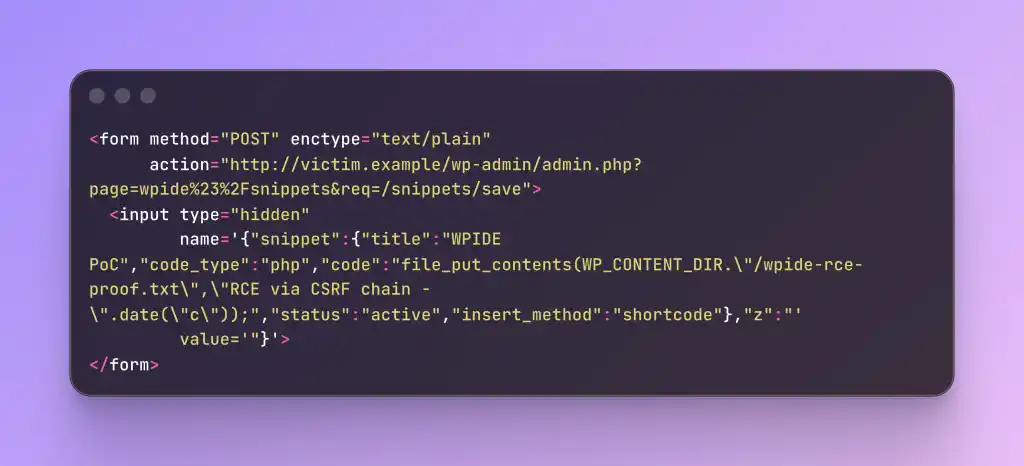
2. Code execution on save. The Snippets controllers read their input with json_decode($request->getContent()), parsing the raw request body as JSON regardless of its Content-Type. This restores the CVE-2026-57766 delivery primitive: a plain HTML form with enctype="text/plain" controls most of a cross-site request body, and the stray = introduced by form encoding is absorbed into an unused JSON key. Saving an “active” snippet triggers the activation probe described above; the /snippets/execute route then re-runs any stored snippet on demand.
Proof of Concept
Auto-submitting form on any attacker-controlled page, while an administrator is logged in. Verified against 3.6.0: the injected PHP wrote a timestamped proof file during the save request (its mtime matched the response’s snippet created_at field to the exact second), and a second forged request 21 minutes later re-executed the stored snippet and refreshed the file:
Detection
- POST requests to
/wp-admin/admin.phpwhose page parameter containswpide%23%2F(URL-encoded#/) or a raw #/ - POST requests with
Content-Type: text/plainand a JSON-looking body - Requests with
req=/snippets/saveorreq=/snippets/executecarrying an externalOrigin/Refererheader - Unexpected files in
uploads/wpide-snippets/php/(e.g.0-<hash>.php) or unknown.php/.txtartifacts inwp-content/ - Snippets in the WPIDE Snippets interface that no administrator created knowingly
Mitigation
Update to WPIDE 3.6.5 or later — 3.6.4 (2026-11-08) enforces request verification across all plugin admin pages, and 3.6.5 additionally refuses text/plain and form-encoded bodies on state-changing requests, removing the cross-site delivery vector. Sites that cannot update immediately should deactivate the plugin. If exploitation is suspected: audit wp-content/ and uploads/wpide-snippets/ for unexpected files, delete unknown snippets, and rotate administrator credentials.
Timeline
- July 2, 2026 — CVE-2026-57766 published: unauthenticated CSRF in WPIDE ≤ 3.5.6
- October 30, 2026 — Incomplete fix identified and verified against 3.6.0 (negative control, file creation, single-request RCE, re-execution); reported via Patchstack
- October 31, 2026 — WPIDE 3.6.2 released; source review confirms the slug-scoped gate remains
- November 7, 2026 — CVE-2026-124251 reserved by Patchstack
- November 8, 2026 — WPIDE 3.6.4 released (“Enforced request verification across all WPIDE admin pages to prevent cross-site request forgery. Reported by Greg Otto.”); 3.6.5 released the same day, refusing plain-text/form-encoded bodies
- November 10, 2026 — CVE-2026-124251 published (CVSS 8.8, CWE-352)