GOP Goes Scorched-Earth on Abdul El-Sayed
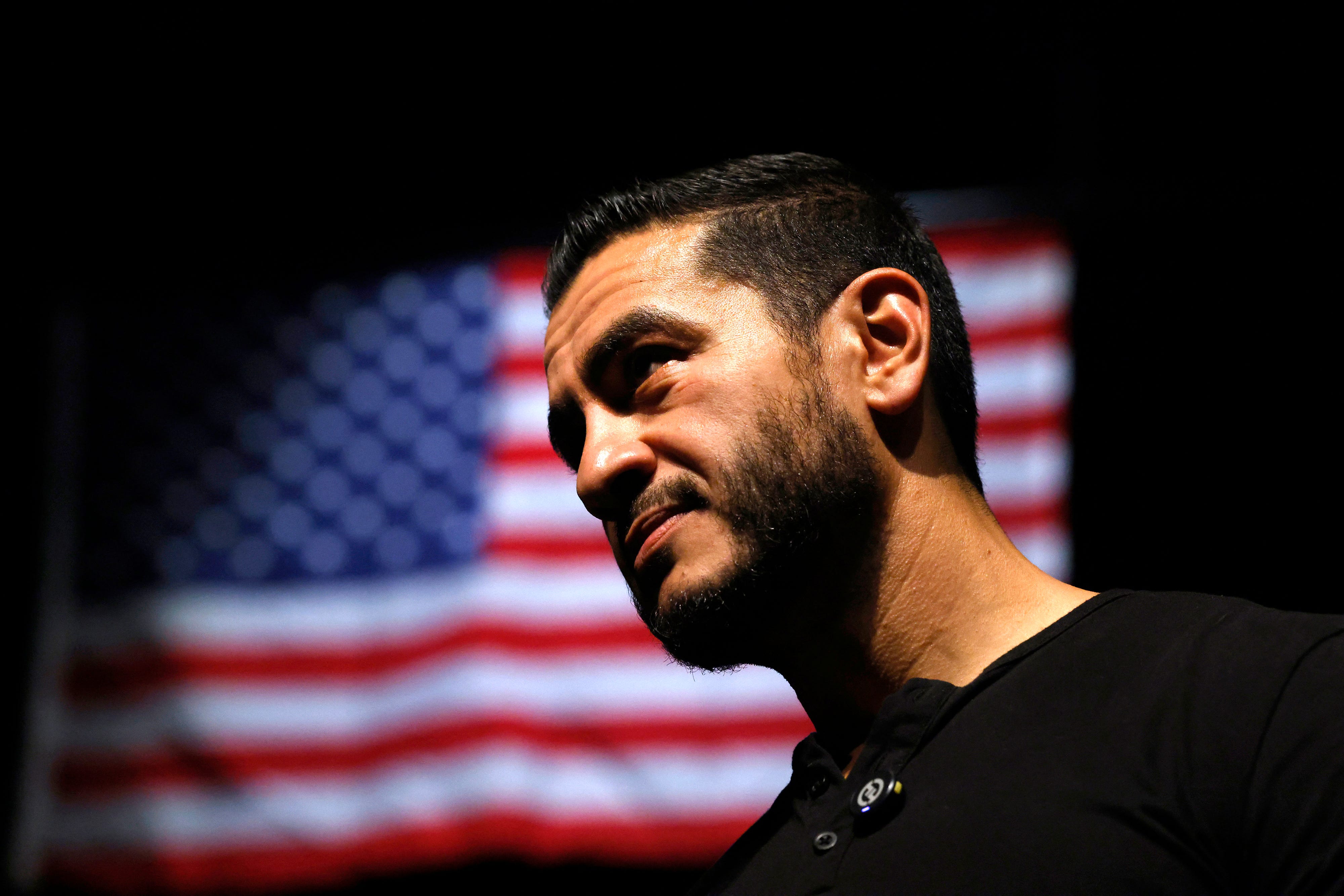
Mount Pleasant, Michigan
A NEW CAMPAIGN AD FROM MIKE ROGERS says a lot about the kind of senator he would be for Michigan.
I don’t think it’s the message he wants to be sending.
The ad is about the tariffs that Donald Trump has imposed on Canada since taking office, and the trade war that’s unfolding as a result. The tariffs are already damaging Michigan’s economy, especially the auto industry where—according to one estimate—the extra charges on parts crisscrossing the Michigan–Ontario border have saddled carmakers with more than $4 billion in extra costs.
The tariffs are super unpopular too. I have heard it in my conversations with voters across the state. But it’s evident in the polls as well, which show voters here oppose the tariffs by a two-to-one margin—quite possibly because they have heard (correctly) that Canadian tariffs will raise the prices of everything from cosmetics to skating gear.
Rogers’s new ad leans hard into the local anxiety. It places him at a pub, sitting at a barstool while a hockey game plays on the television, a Canadian beer right there on the bar.
“Drinking a Labatt and watching the Red Wings—man, it just doesn’t get any more Michigan than that,” Rogers says, speaking in what I am guessing is some political consultant’s idea of how real Michiganders talk. Then Rogers waxes indignant about the tariffs: “We know that Canada is not our enemy. We need to end this tariff war. Now.”
The indignation would have been perfectly natural coming from the version of Rogers that represented Michigan in Congress from 2001 to 2015. Back then, he was a fairly typical, pro-business Republican—the type who would reliably stand alongside the Chamber of Commerce and the “Detroit Three” in condemning the tariffs threatening a supply chain that has largely benefited both Americans and Canadians.
But that’s not the version of Rogers that has been running for Senate this year. Rogers 2.0 stands by Trump, and until about five minutes ago he stood by Trump’s tariffs too—rationalizing them as “necessary” because “the Canadians have not been good partners.” His flip-flop drew instant attention from the state’s local outlets, including the Detroit Free Press and the Detroit News, in part because it followed a similar reversal on the war in Iran—which, after praising it for months, Rogers is now saying must end.
Still, Rogers has been consistent about one thing: He won’t take on Trump directly. Whether talking about the “war” with tariffs or the war with bombs, he won’t blame the president. And it’s no mystery why. Breaking with Trump is not something you can do in modern Republican politics.
That explains the precarious political position of Rogers and so many other Republicans, both here in Michigan and in the rest of the country as well. They can’t separate themselves from Trump without antagonizing him and his most rabid supporters. But if they don’t make a clean break from Trump, they are stuck leaving the impression that they support his policies or, maybe even worse, that they are afraid to confront him when they don’t.
Here in Michigan, Rogers’s solution has been to make the debate about El-Sayed—and then, to make El-Sayed seem as scary as possible—in hopes voters will forget about everything Trump has done to the state. The strategy has been obvious from the get-go, when Rogers and his allies started airing attack ads painting El-Sayed as extreme literally hours after he won the bitterly contested Democratic nomination in early August. But it may never have been more obvious than it was on Thursday night, when the two candidates met in a televised debate.
Upgrade Today at 30% OFF & Join Our Member-Only Livestream with Pete Buttigieg
The midterms are coming. The surprises are inevitable. Get the reporting, analysis, and conversations you won’t get anywhere else.
🔓 Unlock everything: articles, newsletters and ad-free shows
💬 Go deeper: live chats and conversations with a community built on good faith
📺 Hear what others don’t: access member-only shows including our October 18 livestream featuring Pete Buttigieg with Sarah, Tim, and JVL—live from Charlotte
Join Bulwark+ — Save 30% for the next year
THURSDAY’S DEBATE WAS ACTUALLY supposed to be the second faceoff between Rogers and El-Sayed. The first was scheduled to take place in September. Rogers refused to participate, saying that the host—a well-respected local anchor for the Detroit Fox affiliate named Roop Raj—was biased. El-Sayed showed up anyway and answered questions, standing opposite an empty chair.
It was emblematic of how this campaign has gone. I’ve been attending El-Sayed events ever since he declared his candidacy early last year. He holds several a week and generally takes reporters’ questions afterwards, including from outlets he knows will be hostile. During those sessions he holds forth confidently on an array of topics, from industrial policy to childcare. This week, while discussing artificial intelligence, he talked about China’s progress—and how its development is “drafting” on America’s—in a nuanced way that suggests he’s been reading up on the topic (or at least listening to some good podcasts).
El-Sayed can get ornery: When he thinks a question is dumb or redundant, he’ll turn it around on the reporter and interrogate them. But mostly he mixes it up enthusiastically, as he did recently in two marquee appearances on Fox News—one of which left host Martha MacCallum fumbling for facts, and the other of which left Jesse Watters with what his Fox colleagues likened to a man crush. Even Trump noticed, according to Axios, and complained to Fox brass that they were not giving El-Sayed a hard enough time.
Rogers came to Thursday’s debate determined not to let that happen. But engaging with scrutiny is like any other campaign skill: It takes practice. And Rogers, having coasted through an uncontested primary, has held far fewer events than El-Sayed. He’s also limited his media appearances mostly to friendly outlets. To veteran Michigan pols like Jeff Timmer, who served as executive director of the state GOP before breaking with the Trumpified party, the failure to engage with tough audiences earlier left Rogers ill-prepared for what he faced on Thursday night.
“I’ve known Mike Rogers for a long time. I could read the body language,” Timmer, now serving as an adviser to the Lincoln Project, told me. “He didn’t seem sure of himself. He’s never had to run like this. He’s always been large and in charge, and I think the fact that he’s being questioned really gets under his skin.”
PART OF THE PROBLEM was that the substantive, fair-minded questions from moderator Rick Albin kept forcing Rogers to defend unpopular positions or an unpopular president. And not just on trade. A telling episode came when Albin, a veteran news anchor from Grand Rapids, asked about the cuts Trump and the Republicans enacted to Medicaid last year.
The cuts were part of the “One Big Beautiful Bill,” which Rogers has said he supported and would have voted to approve had he been in Congress. The Medicaid cuts could mean 260,000 Michiganders lose coverage by 2034, according to projections from the health policy research organization KFF. Hospitals have warned they may have to cut back services or shutter altogether, especially in rural areas where they were already struggling.
Rogers started out by mentioning the law also included a new $50 billion investment in rural health care, which is true—but not especially consequential in the context of a law that will take a trillion dollars out of the system. But eventually, he moved off the topic entirely, shifting gears to El-Sayed’s supposed ties to Muslim terrorists.
“He has taken money from groups associated in support [of] the Muslim Brotherhood,” Rogers said. “He has taken money from individuals on his campaign who openly support Hamas, Hezbollah, al Qaeda.” Later Rogers brought El-Sayed’s mother into the conversation, saying “What your mom was working at—I was going after that organization that was indicted for funneling money to al Qaeda.”
The statements were a milder version of what Trump himself has been serving up in the past few weeks, when he began referring to El-Sayed by his middle name “Mohamed” in speeches and social media posts—and calling him a “jihadist.” But as fact-checkers at organizations like Bridge Michigan and PolitiFact have now written countless times, most of the accusations amount to—at worst—guilt by association.1
Behind all the innuendo are some serious foreign policy arguments, like whether to supply Israel with defensive weapons. (El-Sayed wouldn’t.) But while Rogers made those arguments, it was hard not to notice his frequently contorted attempts to work in the words “Muslim” (five times), “terrorism” or “terrorist” (eight times), “Hamas” (four times), and “Hezbollah” (three times).
EL-SAYED DIDN’T TAKE KINDLY to the invocation of his mother while on the debate stage. But during a town hall the next evening in Mount Pleasant, about an hour north of Lansing, El-Sayed turned Trump’s invocation of “Mohamed” into a joke.
“He doesn’t say my whole name because he knows he doesn’t know how to say it without holding on to the ‘l’ a little bit too long,” said El-Sayed, drawing laughter from a packed crowd of more than a thousand people. He went on to point out that the name Mohamed means “praised one.”
“He thinks he’s attacking me and he calls me ‘the praised one,’” El-Sayed said.
Mount Pleasant was one of the first stops on a weekend trip that would send him “Up North”—that is, the predominantly rural and more Republican-leaning portion of the state (the upper portion of the Michigan “mitten”).2 El-Sayed has spent plenty of time there, going back to the beginning of his campaign, and next week he’ll go even farther north—across the Mackinac Bridge to the Upper Peninsula, which is among the most Republican-leaning parts of the state.
It’s yet another example of El-Sayed playing on Rogers’s turf, metaphorically and literally, and one more sign that his campaign—like Rogers’s—puts stock in the polls showing El-Sayed ahead. But nobody is under the delusion that the margin is large: The RealClearPolitics polling average has El-Sayed leading by a bit more than 3 points; MS NOW has him ahead 4. Both figures put him behind the state’s partisan lean, which is a fancy way of saying he’s running behind where a generic Democrat would.
Any combination of a modest polling error, a modest shift in the dynamics, or a modest change in the mood nationally could put Rogers back in front. And on Friday night, while El-Sayed was making his way up north, Rogers drew a crowd of 800 to an event in Oakland County northwest of Detroit. That’s a big turnout, especially for somebody who has been addressing mostly small, private gatherings.
However far behind Rogers is or isn’t right now, he still has a few cards to play. This week, the independent political action committee that calls itself “Democrats for Mike Rogers” rolled out a new advertisement that’s nothing like the over-the-top, anti-Islamic attack ads from Rogers and his allies that have absolutely saturated the airwaves and social media here. (They seem especially ubiquitous during college football broadcasts.)
The new ad features a Jewish woman whose child was at Temple Israel this past March on the day a terrorist drove a truck into the synagogue, intending to blow it up, before security guards—one of whom was injured—shot at him and he then killed himself. The ad references El-Sayed’s now-infamous comments the day following the attack, when after condemning the violence for the second time he also said it needed to be understood in the context of the long-running conflict between Israelis and Palestinians, and the anger of the latter. “Hurt people hurt people,” El-Sayed said.
El-Sayed later apologized for the comments, publicly and in a meeting with Jewish Democrats. But the ad is likely to resonate with the many who have said his apology was insincere or simply came too late. At least some will vote for Rogers. Others may just leave the Senate line on the ballot blank.
There are plenty of Jewish Democrats who will still vote for El-Sayed enthusiastically, more still who will vote for him simply because they think handing Trump one more Senate vote would be catastrophic. And from a purely strategic standpoint, whatever votes El-Sayed loses in the Jewish community he could easily win back in the Arab community, which had swung toward the Republicans in both 2022 and 2024.
But the ad, with its sympathetic narrator, could cut through the noise in a way a hundred new airings of the more aggressive, anti-Islamic advertising might not. Even if it’s not enough to create new doubts about El-Sayed, it might be enough to keep the focus on him.
NOT THAT ROGERS is giving up on the more incendiary approach. At that Friday event in Oakland County, he appeared alongside John Kennedy, the Republican senator from Louisiana, and chuckled when Kennedy said that El-Sayed “sleeps in a bin Laden jersey.”
El-Sayed on Saturday clapped back at Kennedy with a tweet of his own: “That’s rich coming from someone who wears his bed sheets out at night.” Then, speaking to reporters following another packed appearance in the small city of Cadillac, he said the ongoing attacks were just one more reminder that Rogers can’t compete on issues—that he has no answers for high gas prices and a faltering health care system, except to say that El-Sayed is scary.3
That’s also the theme of a new ad put out by El-Sayed’s campaign, highlighting Rogers’s support of the war in Iran and lack of support for spending on domestic needs. “Mike Rogers has been advocating for war after war my entire adult life,” El-Sayed says in the ad. “I’m running to invest our tax dollars here, in Michigan. Rebuilding schools in Michigan, rebuilding roads and bridges and infrastructure in Michigan.”
The ad has the virtue of being consistent with what El-Sayed has said since the start of his campaign—and, really, throughout his political career. That alone distinguishes it from what Rogers has been trying to sell.
1According to PolitiFact, the real story about El-Sayed’s mother is that after divorcing his father she worked at the Islamic American Relief Agency between 1999 and 2004. The Treasury Department designated the organization as terrorist-supporting. Court records showed that her name appeared on payments that violated sanctions on Iraq, but there was no evidence that the money supported terrorism—and there seems to be no evidence that El-Sayed’s mother had a role beyond processing the forms.
2The precise boundary defining “Up North” is a subject of perennial debate in Michigan. After one of his events on Saturday, I asked El-Sayed where he puts the line. He said Gratiot County, which is in the middle of the state, though he acknowledged that’s a bit farther south than commonly understood. He said it’s because that’s where his family would go to the lakes in the summer—and for him, that made it feel like “Up North.”
3Another exchange of tweets over the weekend is worth noting. It started when Barstool Sports mogul and social influencer Dave Portnoy said El-Sayed “really is a terrorist.” Portnoy’s tweet appeared to be in jest; he was referring to something El-Sayed had said about the University of Michigan football team. (Both Portnoy and El-Sayed are alums and well-known fans.) Rogers quote-tweeted Portnoy’s tweet, saying Portnoy was “exactly right.” This suggests that Rogers either didn’t realize Portnoy was joking—or did, and was looking to troll El-Sayed anyway. El-Sayed, for his part, responded to Portnoy with mockery, tweeting out a clip of Portnoy stumbling through a running race. “Meanwhile, here’s [Portnoy] committing an act of athletic terrorism,” El-Sayed tweeted. “Less pizza, more gym, habibi.”