The Next Paramedic: The Jobs We Need to Build the Democracy We Want
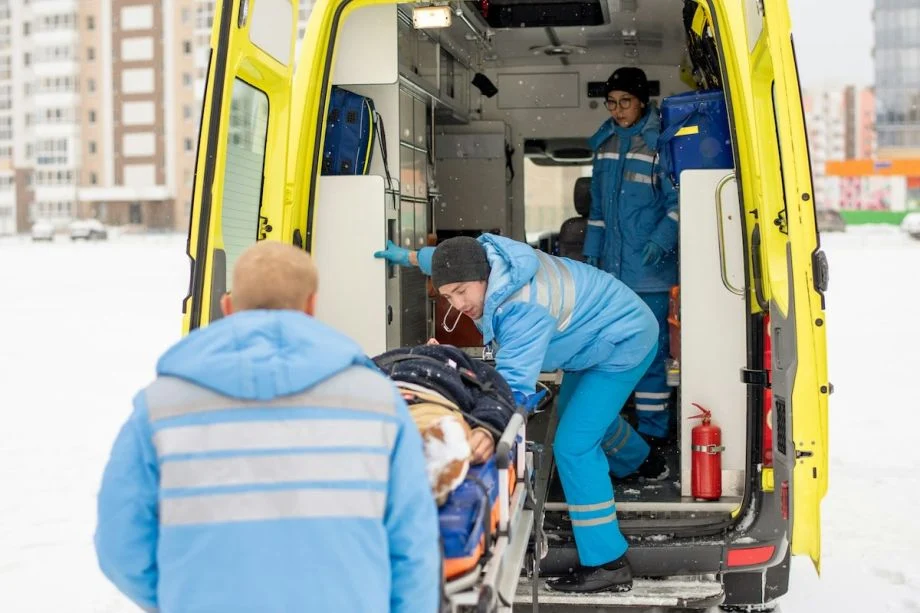
(Photo by Getty Images / Unsplash)
Every time a person emerges from an ambulance to receive care, it’s because we collectively decided that the role of paramedic was a job that needed doing.
In the 1950s, having a severe medical crisis outside of a hospital predicted likely death. The ambulances of the time were operated by funeral homes, given that hearses were the perfect size to transport gurneys. The morose irony didn’t end there. Given that no medical training was required to operate this emergency care, people regularly died in transit from survivable injuries.
The crisis required a new system, one that our country hadn’t yet imagined. Today, a similar breaking-point is forming, as AI threatens jobs and livelihoods – and we face a looming crisis that requires a response.
The future, brought to you by AI
Brookings projects 6.1 million workers face the highest risk of AI-driven displacement, as private business forecasts reach as high as 10.4 million jobs. These projections outpace the Great Recession, impacting 6% of the workforce.
Those impacts won’t be evenly distributed. Given the fields at highest risk and factors associated with low-adaptability, 86% of the most vulnerable group are women.
As AI companies design blueprints for our future, they’re not stopping at the design of agentic chatbots and personal assistant tools to rearrange how we engage digitally. Internally, they’re also investing in plans to shift our economy and democracy.
Public documents boast construction jobs as well as 4,000 new employees for each data center. These claims lay groundwork for an economy mapped to market, sell, and maintain the commercial products they’ve brought to global sale.
Of course, none of this is possible without a government that allows it. And AI companies are intent on ensuring that ours does.
Despite Americans’ rising anxiety over the future of their jobs, shared across 67% of Democrats and 62% of Republicans, few political leaders can stand up to the ferocious imaginations of these tech oligarchs. That’s no coincidence. Election spending from AI- and data center-focused super-PACs has already crossed $400 million this midterm cycle, nearing the total spent by all corporations in the 2024 election cycle, according to the corporate accountability nonprofit Public Citizen.
That spending is strategic. The two leading AI companies, Anthropic and OpenAI, have funneled $52.6 million into 46 races in primary elections, spending to influence the type of Democrat or Republican candidate who will show up on voters’ ballots this November. Given how gerrymandered these seats are, they’ve likely influenced the overall winner, without mentioning AI in the political ads being bought.
AI companies are fully invested in ensuring a governing architecture designed to maximize their power. That task is made much easier given the anemic state of our democracy.
In decades past, the debates about looming changes to our economy were debated in union halls, rotary clubs, and activated through networks of precinct and block captains. Today, that local democratic infrastructure has been replaced with a consultant class that advises on candidates’ hairstyles and messages – fueling the atrophy of our democratic muscle.
Now, when only 15% of Americans trust AI companies to make decisions about how the technology is developed and used, we need the ability to deliberate and decide what our future will look like – locally, and in relationship with one another.
As practitioners who have spent careers trying to democratize journalism and policymaking, we believe Americans should have the ability to decide the future of our economic lives. And we recognize that won’t be possible without an investment in our democratic ones.
We have to build the democracy we need, to ensure we can live the life we want.
Jobs for the democracy we need
We see Americans craving a future that expands democratic relationships — rooted in mutualism, in care for ourselves, our neighbors, and the planet.
Among many surveys about the future, people were asked about their top hopes for AI. Uses like “therapy and reducing loneliness” — or hopes that AI might substitute for human contact — were the lowest-ranked options. Whether in survey data or everyday life, it’s clear that people don’t want AI to replace human connection – they want to invest in it themselves.
What better way to do that than to put more humans to work, deepening our connection to each other, and strengthening our democracy?
Even before AI, our democratic infrastructure has been desperately in need of an upgrade. Participation hinges on unevenly distributed access – discretionary time to start block clubs or attend public meetings, discretionary funds to buy subscriptions to verified reporting, or membership in the types of civic networks invited to share ideas with policymakers.
This is the infrastructure of democracy. And just like emergency infrastructure in the 1950s, this infrastructure requires workers.
We’ve been told AI will automate away whole categories of work. That may be true for tasks that are transactional, repetitive, or purely informational. But the work democracy needs most depends on exactly what makes us most human: connection, trust, accompaniment, and memory.
Imagine these as the jobs of the future – designed around a compass aimed to fortify our democracy, strengthening the people-power necessary to bend the future to our will.
These jobs of the future — Resource Navigator, Information Steward, Community Convener, Community Anchor, Wellbeing Worker — could each be the next paramedic role in a community. Each job is rooted in part on the Social Change Ecosystem Map.
Like the paramedic, many of these roles already exists in pockets around our country:
-
Resource Navigators: In New York City, the 200 members of the City’s Public Engagement Unit doorknock communities with highest needs, identifying challenges facing residents – and then immediately helping them access city services and resources to meet those challenges. Like a human 311 directory, their expertise isn’t just the information they have, it’s in the ability to earn the trust of people, demonstrate the human face of government, and help meet real material needs in real time.
-
Wellbeing Workers: In Chicago, Baltimore, New York, and D.C., violence interrupters work to de-escalate conflicts in their communities as peers, not authorities. Eugene, Oregon piloted the idea of mental health responders in 1989, developing a model that has seen national replication. These models show how far public investment can go to mitigate violent emergencies, but could they also offer a blueprint for foundational community wellness? How might relational counseling, conflict resolution, and stress-reducing therapies be provided by well-trained local teams, as a modernized public workforce?
-
Information Stewards: In over 20 cities across the country, members of the public can get paid to attend public meetings as public Documenters, making access to everyday democracy no longer a privilege of just those who can afford to engage in civic life without a concern for money. In New Jersey, a publicly-funded statewide consortium supports jobs in local journalism, ensuring that there is an economy that supports this critical input in our democracy. How might public dollars make the time and cost of accessing information, possible as a public good for all?
-
Community Conveners: In St. Louis, local residents are trained to lead Community Solutions Teams, where they connect knowledge of government systems with local needs to develop ground-up policy solutions. In cities like Birmingham, Alabama, public training programs like the six-week Academy of Civic Engagement use City Hall as a civic classroom, training residents on the knowledge, skills, and relationships to meaningfully engage on policy issues affecting their lives. After this training, they design projects to bring their communities’ voices into government policy. Kindred spirits in Philadelphia government lead participatory budgeting projects, where they lead civic education and participation workshops to ensure that public dollars are invested with public input. How might we cultivate a public workforce to expand applied, experiential civic learning, connecting more of the public directly with their local governments?
A new future, designed by us
Despite the need for an emergency medical infrastructure, it took many key moments for the role of the paramedic to emerge.
A 1966 report from the National Academy of Sciences, clinically titled “Accidental Death and Disability: The Neglected Disease of Modern Society,” named the need and was soon followed by federal legislation. The paramedic emerged as a distinct role, with training programs, equipment standards, and protocols developed over years of trial and research. The federal government had acknowledged the need – and crucially, invested in the solution.
But federal policy was only possible because of local innovation. Even as policymakers debated what that role should look like, a group of Black men from Pittsburgh’s Hill District had already started building it. In 1967, trained by Dr. Peter Safar (who also developed modern CPR protocols), they launched Freedom House Ambulance Service. They built the model before the federal government had one of its own — expanding imagination by showing it in practice.
Today, we can see the models for a new democracy taking shape all over the country – even as policymakers prepare stump speeches for a crowded presidential primary where they’ll be asked how to “fix” democracy, if Democrats are allowed the chance at civic restoration. But we have to go beyond reforming courts and restoring federal agencies if we are to meet the infection point we are facing today.
Funded in fits and bursts by philanthropy, the models that exist demonstrate what’s possible. In the next presidential administration, a real commitment to protecting democracy will take investing in federal civic revival, shoring up the local democracies that build the ability of all people – in all walks of life – to build their civic muscles.
Without it, we’re defenseless to a future pre-designed for us.
Darryl Holliday is co-founder of Commoner Company, a civic design studio, and lead steward of New Futures, a ‘do-ocracy’ and community of practice made up of journalists, organizers, educators, artists and public servants working together toward social change, information equity and access for all. In 2015, he co-founded City Bureau in Chicago, a Pulitzer Prize-winning civic media lab, and led its Documenters network to 11 cities.
Niketa Brar coined the concept of “civic trauma” and has spent the past decade building the infrastructure to address it in Chicago government. As the founding executive director of Chicago United for Equity, she built the Vote Equity Project, People’s Budget Chicago, and introduced public Racial Equity Impact Assessments to Chicago – all methods designed to repair civic distrust through direct, collaborative governance with communities harmed by legacies of democratic disenfranchisement.
She now chairs the City of Chicago’s Equity Advisory Council and leads national collaborative governance efforts through For the Many Strategies, a national practice building responsive and trustworthy governments.