‘The worst COP ever’: UN climate summit on brink of failure
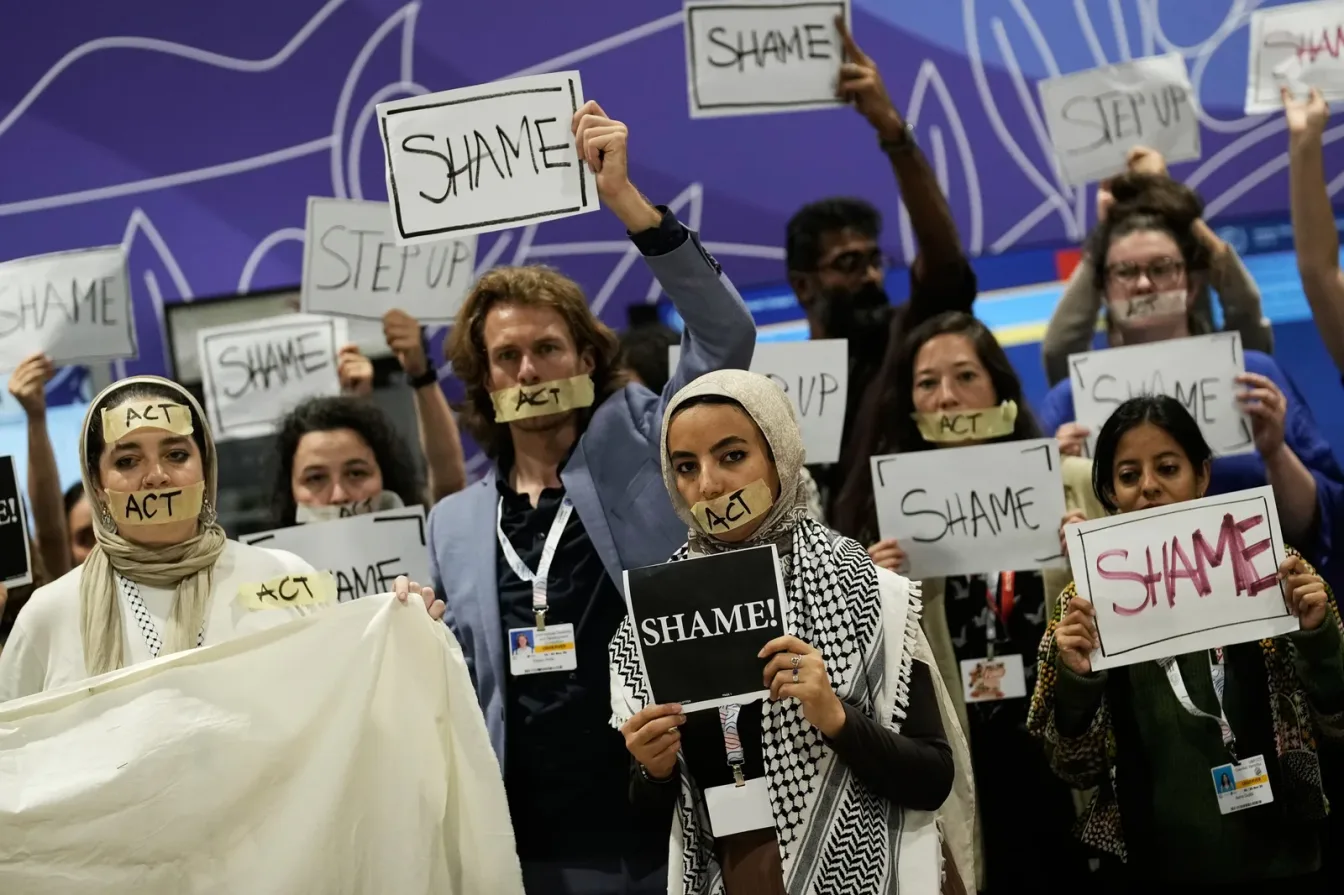
(CN) — With the United States a climate-denying no-show and the European Union retreating on climate leadership, the annual United Nations climate summit veered toward failure Friday.
The summit, known as COP31, was on the brink of becoming a massive disappointment with civil society groups calling it the worst U.N. climate summit in history and Panama’s negotiator saying the world was “being held hostage by the petroleum mafia.”
The two-week summit — held this year in Antalya, Turkey — formally ended Friday, but negotiations on the wording of a final declaration were set to stretch into the weekend.
Huge divisions opened up Thursday after richer nations, led by the European Union, offered paltry sums to help developing countries fight climate change and oil-producing countries managed to strip language about phasing out fossil fuels from a draft text of a final declaration.
“Without any doubt, this has been the worst COP ever,” said Mohamed Adow, the head of Power Shift Africa, at a news conference Friday held by the Climate Action Network, a global civil society coalition.
Tasneem Essop, the executive director of Climate Action Network, said there was “nothing on the table that protects people or addresses the priorities of the Global South.”
Anger was directed at the EU for backing away from pledges to provide poorer countries with large sums of money to deal with climate change.
On the eve of the summit, Wopke Hoekstra, the EU’s climate commissioner, said new financial commitments were “dead in the water.”
“Think about that,” Essop, a South African, said. “Dead in the water. For us in the Global South, dead in the water is very literal.”
By Friday, richer countries had pledged only about $50 million into a fund to help countries adapt to climate change.
But that amounted to only one-sixth of an annual target of $300 million agreed to at last year’s climate summit in Belém, Brazil, and fell well short of a broader goal to mobilize $1.2 billion from 2026 to 2029.
The EU rejected the criticism with its officials arguing the bloc provides the lion’s share of global climate finance. Last year, the EU and its 27 member states provided about $35 billion in public sources to support developing countries deal with climate change, according to an EU news release.
But developing nations blasted the lack of new commitments at the summit from wealthier countries.
“We didn’t come here to beg,” said Zanetor Agyeman-Rawlings, the lead negotiator for African nations. “We came here to claim what is rightfully ours for our people who are suffering the brunt of anthropogenic activities of developed countries.”
Many delegates and activists blamed European countries for blocking progress in other areas too.
In recent years, the EU has backed away from leading on climate issues in the face of domestic backlash against its ambitious climate goals.
Europe’s retreat on climate stems from weak industrial output, the rise of far-right parties, a cost-of-living crisis and the climate skepticism of U.S. President Donald Trump.
For a second year in a row, the U.S. did not send a delegation to the climate summit, a move that severely undermined the talks.
Upon returning to the White House in 2025, Trump removed the U.S. from the 2015 Paris climate accord, and thereby withdrew one of the world’s top emitters from the international framework to reduce carbon emissions.
In Turkey, delegations and activists were dismayed at the removal of language calling for the phase-out of fossil fuels.
Instead, the draft declaration put emphasis on boosting electrification around the world and supporting technologies to remove carbon from the atmosphere.
The draft text called for increasing electricity’s share of global energy use from 23% to 35% by 2035. This pledge was almost certain to remain in the final text and become the summit’s main theme.
But even this pledge was criticized for not saying renewable energy sources should be favored over fossil fuels in this electrification drive.
The final text likely will include support for carbon capture and storage technology, but critics said it remains an unproven means of reducing greenhouse gases.
Australia and Turkey jointly presided over the negotiations and argued the summit had made progress.
Murat Kurum, Turkey’s environment minister and summit co-president, said it was not necessary to call for a phase-out of fossil fuels because that language had been included in previous COP declarations. In 2023, a climate summit in Dubai called for phasing out fossil fuels, but since then the climate talks largely have avoided the topic.
“I do not think we are taking a step back,” Kurum said. “I think the determined steps we have taken need to be supported. It is clear we cannot get anywhere by repeating the same discussions.”
Courthouse News reporter Cain Burdeau is based in the European Union.