Loss and damage fund agrees $20m for Nepal but rich nations warn it should not set precedent
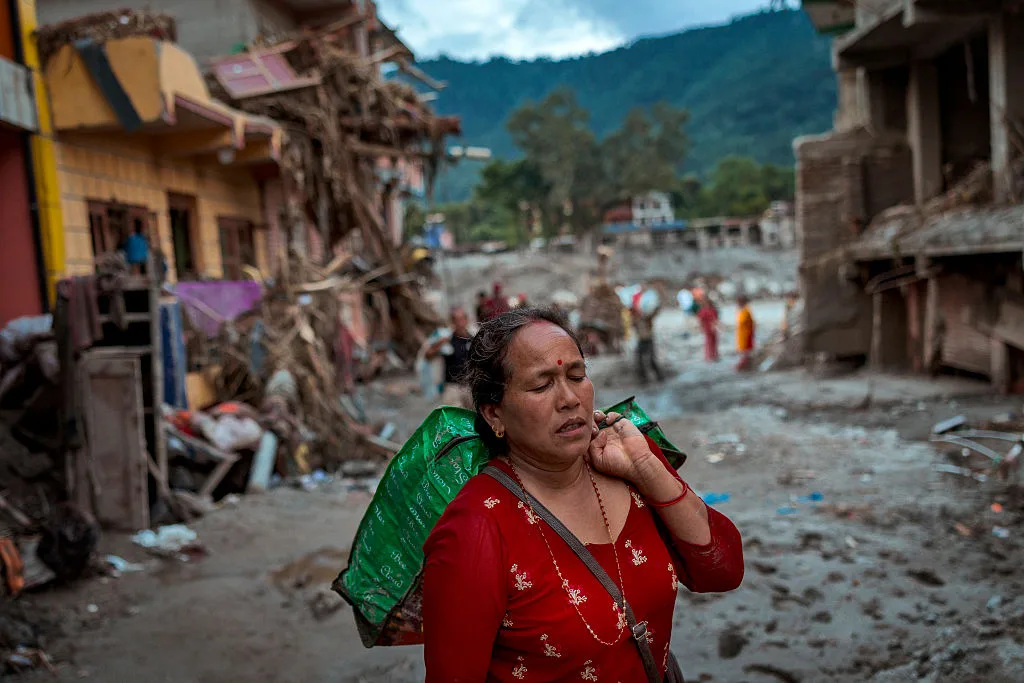
The board of the UN’s Fund for Responding to Loss and Damage agreed on Thursday to set aside $20 million to help Nepal recover from the devastating climate-driven flood it suffered in August.
At an extraordinary online meeting, board members unanimously invited Nepal’s government to submit a proposal for how to use the money, which will be considered at a future board meeting.
The board’s co-chair Camila Minerva Rodriguez described the decision as “truly historic” as it is the first time the new fund has allocated any money since it was set up three years ago. It is expected to approve its first set of projects at its next board meeting in December.
Maheshwar Dhakal, a senior official at Nepal’s climate ministry, told the meeting the decision was “a powerful expression of humanity, compassion, solidarity and hope” and, for the flood victims, a “recognition of their suffering, respect for their dignity and hope that they are not alone in their darkest hour”.
While board members were united in approving the $20 million, plus $1.6 million of administrative costs, representatives of developed and developed countries were divided over the extent to which the decision should set a precedent for the fund’s long-term way of operating.
Germany and Czechia’s board members said it should not set a “precedent” while Japan’s representative said the decision is “truly exceptional” and that the fund’s support must be “in accordance with established rule and procedure”.
Learning the lessons?
Responding, Pakistan’s Ali Sheikh said the lessons from the Nepal case should “feed the long-term model and its work on rapid disbursement” of funds.
He added that he had heard Jan Dusik, Czechia’s board member saying that “we are open for learning but not in setting precedent”. “Please do not define the boundaries for learning,” he emphasised.
Sheikh complained that the decision approved by the board – the result of negotiations between a group of four developed and four developing-country representatives – was narrower than developing countries had hoped for.
“We are saying it is a one-time and Nepal-only window, a sentiment against which many developed countries have raised their voice,” he said, adding there had been no time to review the decision.
Walter Schuldt from Ecuador echoed Sheikh, saying “we should not put limits on lesson learning”. He said the decision, which he was involved in negotiating through “intense exchanges”, tells the fund’s staff to assess the lessons learned.
The fund is currently in a start-up phase and the board will debate its long-term model – including whether and how to rapidly disburse funds in response to climate-driven disasters – at its next board meeting in the Philippines in December.
At Thursday’s meeting, several developing-country board members called for wealthy nations to put more money into the fund. Recovery and reconstruction from Nepal’s flood alone is estimated to cost $4.8 billion – in comparison, the fund has only around $350 million available to allocate to countries, with a current cap of $20 million per project.
Climate justice experts welcomed the decision to allocate money to Nepal as a sign of solidarity but lamented that it came only after significant pressure and is a tiny amount compared with the country’s recovery needs.
“Setting aside millions is not the same as delivering billions,” said Lien Vandamme, a climate justice campaigner with the Centre for International Environmental Law. “What’s clear is that a fund that is desperately under-resourced will remain toothless in the face of escalating climate disasters.”
Editor’s Desk: Nepal’s disaster has laid bare the world’s adaptation accountability gap
Communities on the frontline of those disasters are owed reparations “as a matter of legal obligation”, she added, referring to last year’s advisory opinion from the International Court of Justice which made clear that states most responsible for the climate crisis have a duty to repair the harm it causes.
Brandon Wu, director of policy and campaigns with ActionAid USA, noted that three years after being established, the loss and damage fund has yet to send any money to countries hit by climate impacts and has not provided a concrete timeline for paying out the money it reserved for Nepal this week.
“If the fund were adequately resourced, an immediate disbursement to Nepal would be an absolute no-brainer. But it seems rich countries are terrified that the fund – which has received a paltry $500 million to date – will run dry, thus putting more pressure on them to provide the money they owe,” he added.
This story was updated after publication to add comment from climate justice campaigners.
The post Loss and damage fund agrees $20m for Nepal but rich nations warn it should not set precedent appeared first on Climate Home News.