With a New Memorial, Chicago Is Reckoning With Its Troubled History. Other Cities Should Follow.
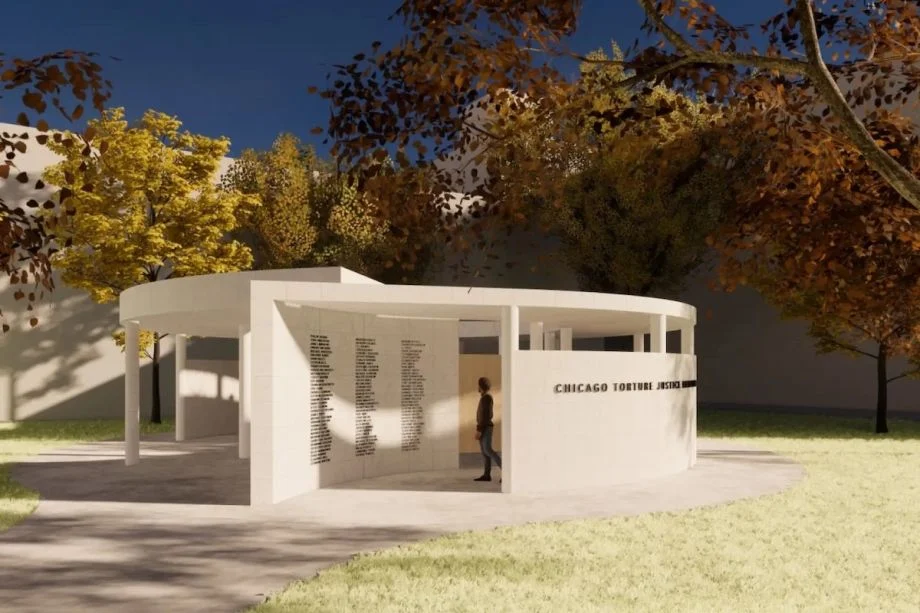
The design selected for the Chicago Torture Justice Memorial, created by Patricia Nguyen in collaboration with John Lee.
The Chicago Torture Justice Memorial broke ground this summer in the city’s Washington Park neighborhood. A 22-foot-high concrete open spiral, which I co-designed with architect John Lee, it honors survivors of police torture under Chicago police commander Jon Burge.
Trained by the CIA to assassinate and torture Vietnamese people during the Vietnam War, Burge then brought those techniques of brutal beatings, suffocation, electrocution, and racial epithets to predominantly Black communities in Chicago. From 1972 to 1991, he led and trained a so-called “midnight crew” of police officers to force people into confessions that resulted in over 125 mostly Black and Latino men and Black women incarcerated for 30 to 40 years, with 10 on death row.
Burge torture survivors bravely testified against Burge at his criminal trial in federal court, and in 2010 he was convicted of perjury and obstruction of justice for denying his team had engaged in torture and sentenced to four and a half years in federal prison. The public memorial, which includes a timeline of the movement for reparations in Chicago and is projected to open in 2027, is part of a historic reparations ordinance the city passed in 2015, the first in the country to address racially motivated law enforcement.
The city’s decision to build it is bucking a wave of countervailing actions by the federal government. Just a few years after the tearing down of racist memorials across the nation during the Black Lives Matter protests, the second Trump administration is working overtime to resurrect these memorials and reinstate the racist values they symbolize. In the context of book bans, rewritten histories on official U.S. government platforms, the dismantling of the Department of Education, and the targeting of curriculum on race, gender, and sexuality, who and what we remember is increasingly important in the battle over our nation’s narrative.
Monuments are at the center of how history is understood and passed down. They concretize memory into our built environment, shaping who and what deserves to be honored, commemorated, celebrated, and solidified into our cultural and social landscape.
The National Capital Planning Commission, a federal panel for the Washington D.C. area stacked with key Trump appointees, in May approved the “Arc de Trump” right outside Washington, D.C., which would block sightlines of key sites in Arlington and Washington, D.C., and the National Park Service came out in support of it. This year the Trump administration installed 13 new statues at Freedom Plaza in Washington, D.C., including one of Caesar Rodney, a founding father who enslaved hundreds.
Such monuments are more than symbolic gestures; the financial investment in them, and the physical space they take up in major cities, are a testament to what is remembered and what is erased. They pave the way for major policy changes such as the recent takedown of the Voting Rights Act and the disenfranchisement of historically marginalized communities.
The good news is there are many ways to fight back against racist monuments. Each level of government, from federal to state to local, requires a different strategy. Chicago offers an important example of what a major city can do.
In 2020, amid the Black Lives Matter protests and international calls to dismantle racist monuments, the city launched the Chicago Monuments Project to “confront inequities in the City’s collection of monuments and memorials,” according to its statement, which also called for the removal of racist monuments including three of Christopher Columbus and allocated funding for “new ways to memorialize Chicago’s history.”
When designing memorials and monuments, artists and architects envision them entering into conversation with one another and with the people who visit them. For educators, monuments like this can become field trip destinations where students explore contested sites, narratives, and perspectives and consider how to imagine and build a more just world. They can also inspire other jurisdictions: Four years after Chicago passed its reparations ordinance, Evanston, Illinois, also passed one, and last year the state of Maryland passed a Reparations Commission law that will investigate the impacts of slavery and inequitable government policies to recommend remedies.
It is high time that local, state, and federal leaders across the country earmark money for educational projects and monuments that address this country’s racist history. Local residents can push them to do so by investigating their own city or town’s past and current traumas. They can read history books, talk to witnesses, and cultivate relationships with organizations that focus on justice to learn what needs to be memorialized. They can demand support for community-led projects, and then, like the mothers of the Burge survivors, demand that municipal leaders acknowledge the past and support efforts to commemorate it.
That is the best way to acknowledge and uplift descendants and survivors of slavery, genocide, war, and other state violence and work toward a better future.
Patricia Nguyen, Ph.D. is an assistant professor in American Studies at the University of Virginia and a co-designer of the Chicago Torture Justice Memorial. She is also a fellow with the Op-Ed Project’s Public Voices Fellowship with the Paul and Daisy Soros Fellowships for New Americans.