Outcome pending on polysilicon action
China’s polysilicon output fell to around 105,000 metric tons (MT) in October, according to the Silicon Branch of the China Nonferrous Metals Industry Association. This was down from 120,400 MT in September, following three consecutive months of growth. Industry sources expect monthly output to decline to around 80,000 MT from December through February, reflecting deeper production cuts and Lunar New Year-related shutdowns. This would align with production-control targets and the minimum operating level existing producers can sustain.
Tighter supply expectations have supported a gradual polysilicon price recovery. The China Mono Premium assessment stood at CNY 38.786 ($5.80)/kg, or CNY 0.081/Wp, on Oct. 13, according to OPIS, up 21.6% from its year-to-date low in July and at its highest level since the second quarter began. However, actual transactions are still limited. Market sources said higher-priced deals mainly involved export-linked production or special commercial arrangements, such as suppliers selling polysilicon to long-term customers and subsequently purchasing wafers from them.
Producers have pushed for prices closer to the estimated full production cost of around CNY 43/kg, but downstream buyers continue to resist higher offers. Inventory reduction, sustained production discipline and stronger prices across downstream PV products will be needed to support a more durable recovery.
Price disconnect
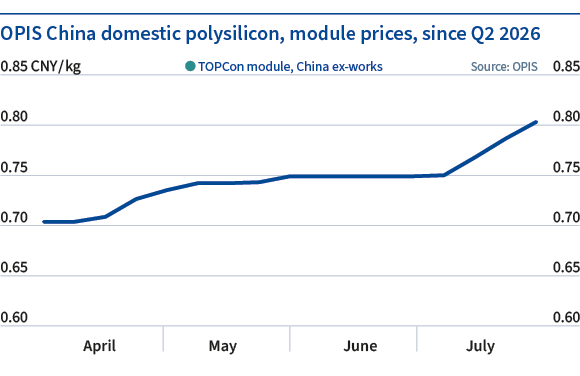
The disconnect between upstream costs and downstream pricing is particularly evident in the module market. The ex-works China tunnel oxide passivated contact (TOPCon) 645 Wp module assessment fell to CNY 0.703/Wp on Oct. 13, marking its third straight weekly decline and approaching the year-to-date low of CNY 0.698/Wp recorded in early August. FOB China mainstream TOPCon 645 Wp module prices also fell 0.93% to $0.107/Wp, from $0.108/Wp in September.
By contrast, FOB China n-type M10 wafer and cell prices rose 23.14% and 18.41% respectively between early August and Oct. 13, while module prices remained within a narrow range of $0.105 to $0.108/Wp. The divergence indicates that module manufacturers have struggled to pass on higher upstream costs amid weak demand and persistent overcapacity.
Market sources attributed subdued module demand to weak domestic installations and softer exports. China added 11.04 GW of solar capacity in August, down 21.6% month on month, bringing installations in the first eight months of 2026 to 97.19 GW, a 57.86% decline year on year, according to the National Energy Administration.
Changes to China’s module efficiency requirements scheduled for 2027 could trigger a fourth-quarter installation rush for lower-efficiency modules below 630 Wp, as developers seek to deploy these products before stricter specifications take effect. However, surplus low- to mid-efficiency modules could increasingly be redirected to overseas markets in 2027 as domestic demand becomes more restricted, adding pressure to FOB China prices and further limiting manufacturers’ ability to pass on upstream cost increases.
Global picture
The global polysilicon market remains broadly stable in September and October 2026, with limited high-priced transactions failing to shift the overall market. OPIS heard of spot deals approaching $27/kg, but volumes were small, reducing the share of higher-priced transactions in the market and putting slight downward pressure on the weekly assessment.
The Global Polysilicon Marker (GPM), the benchmark for polysilicon produced outside China, was assessed at $19.234/kg on Oct. 13, slightly below the $19.312/kg level that prevailed throughout September. With the Dec. 4 implementation of Section 232 approaching, much of the polysilicon required by US-focused supply chains has reportedly already been secured, leaving new orders increasingly price-sensitive.
US-made polysilicon remains a potential source of upside, as some downstream buyers have shown interest in securing small volumes at relatively high prices. This interest partly reflects expectations that domestically produced material could offer additional value to manufacturers with approved US onshoring plans. However, uncertainty over policy implementation continues to delay firm procurement commitments, limiting the impact on broader demand.
Outside the United States, producers continue to face weak demand and financial pressure. One market participant did not rule out legal disputes over difficulties fulfilling long-term supply contracts, while another said cautious procurement could prompt more production cuts at higher-cost facilities and plants unable to secure long-term orders.
US procurement
US trade barriers have dampened interest in global polysilicon, particularly as compliant Chinese material could, in principle, compete on an equal footing under the Section 232 framework. A trade source said certain non-US polysilicon producers were exploring alternative outlets, including manufacturers establishing overseas facilities with Chinese investment and producers in India.
US procurement changes are also reshaping the module market. Expectations of higher import costs are affecting the relative competitiveness of fully imported and US-assembled products.
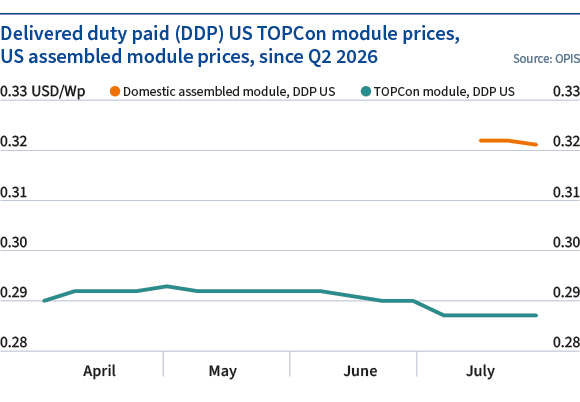
Imported TOPCon module spot prices were assessed at $0.293/W on Oct. 13, according to OPIS data, slightly above the $0.290/W level that prevailed throughout September. Forward indications rose more sharply, with first- and second-quarter 2027 prices reaching around $0.372/W, reflecting expectations of substantially higher import costs after Dec. 4.
Despite these higher forward prices, near-term trading remains subdued. Market participants said many developers had already secured 2027 supply during the earlier safe-harbor rush, while higher project costs and weaker power purchase agreement economics have constrained new development.
Importers increasingly expect fully imported utility-scale modules to cost around $0.40/W to $0.42/W after Dec. 4, compared with current landed prices in the high-$0.20s/W to low-$0.30s/W range. This widening gap is encouraging a shift toward modules assembled in the United States using imported cells. OPIS assessed prices for these modules at $0.330/W on Oct. 13, with market participants expecting them to rise toward the high-$0.30s/W or low-$0.40s/W range.
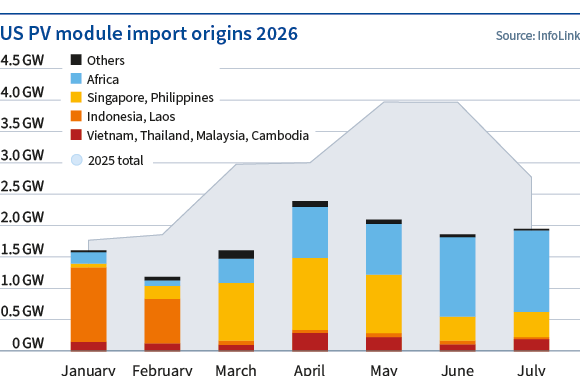
Modules incorporating US-made cells command a further premium, generally at $0.42/W to $0.50/W or above, according to sources, while available capacity remains limited. This leaves a potential supply gap for buyers seeking domestic-content products, particularly smaller customers unable to commit to large volumes.
The key question is whether US manufacturing capacity can expand quickly enough to replace displaced imports without creating new supply bottlenecks, sources said. If domestic module and cell supply fail to keep pace with shifting procurement, tighter availability could push module costs higher and further weaken project economics. This could also translate policy-driven demand for US-compliant supply chains into stronger demand for lower-cost polysilicon, as higher downstream costs and subdued project development continue to constrain the market.