Poly pricing and potential expansion
Recent industry checks in the United States suggest that an increase in US minimum import prices (MIPs) under the polysilicon Section 232 framework may not occur until after Dec. 4, with implementation potentially moving into early 2027.
The delay appears to reflect the Department of Commerce’s desire to observe how the initial Section 232 proclamation operates in practice. Commerce also appears to be seeking additional feedback from investors before adjusting the MIPs. For US solar manufacturers, a later increase would be an incremental negative that could delay intended pricing support for domestic production.
Enforcement critical
A central question is how the government will enforce the MIP, particularly when importers declare merchandise at that threshold. Under standard customs practice, most importers use the transaction value, which is the price actually paid or payable for the merchandise. The Section 232 framework does not, by itself, prevent an importer from using that method. If transaction value cannot be used, other established methods are available.
The more important issue is whether the declared value reflects the true economics of the transaction. Commerce and US Customs and Border Protection (CBP) are expected to scrutinize imports declared at the minimum price, including transactions involving companies without a history of importing at that level. Shipments may also be detained while Commerce or CBP verifies the underlying transaction. If the documentation does not support the declared value, authorities could take further action, potentially including the suspension of import licenses.
The administration appears prepared to take compliance seriously from the outset. Ultimately, the success of the Section 232 framework will depend on whether regulators can prevent circumvention and consistently enforce the rules.
Generation equipment
The administration is also considering a broader Section 232 action covering power-generation equipment. US dependence on imports is a key consideration: approximately 80% of equipment required for power generation is reportedly sourced from outside the country.
Power and energy infrastructure are foundational to other industries the administration has prioritized, including aluminum, steel, and copper. As a result, reshoring power-generation manufacturing appears to be viewed as both an energy-security objective and an essential component of the broader domestic industrial strategy.
Rather than applying a single tariff across all covered products, a power-generation Section 232 action could resemble the polysilicon framework. It could encompass multiple equipment categories, with separate tariff or pricing mechanisms tailored to each sector. Potentially covered products include high-voltage electrical equipment, main power transformers, gas turbines, inverters and batteries.
The objective would be to create an economic incentive for manufacturers to establish or expand production in the United States. Timing remains preliminary, but the current expectation is that a power-generation action could emerge during the first half of 2027.
Market access
A potential power-generation action would not necessarily prohibit imports from every foreign manufacturer, particularly companies operating outside China. Continued access to the US market could depend on whether a supplier has a credible plan to establish domestic manufacturing capacity.
The practical details will determine the policy’s impact. Sector-specific tariff levels, qualifying domestic-investment plans, and the time frame for bringing US capacity online will all influence which manufacturers retain market access and how quickly production shifts to the United States.
The direction of policy remains clear even if the timing and specific mechanisms are still developing. The administration is seeking to reduce US dependence on imported energy equipment and use trade policy to support domestic manufacturing.
For polysilicon, the near-term focus is likely to be enforcement. MIPs will provide limited support to domestic producers if importers can circumvent them through rebates, side agreements or inaccurate customs valuations.
For power-generation equipment, the emerging framework appears broader and more strategic. A sector-specific structure, combined with continued market access for foreign manufacturers that commit to US production, could encourage reshoring without immediately cutting off equipment needed to support rising power demand. The key question will be whether the policy can stimulate domestic capacity quickly enough while avoiding additional constraints on project development and equipment availability.
Solar stock performance
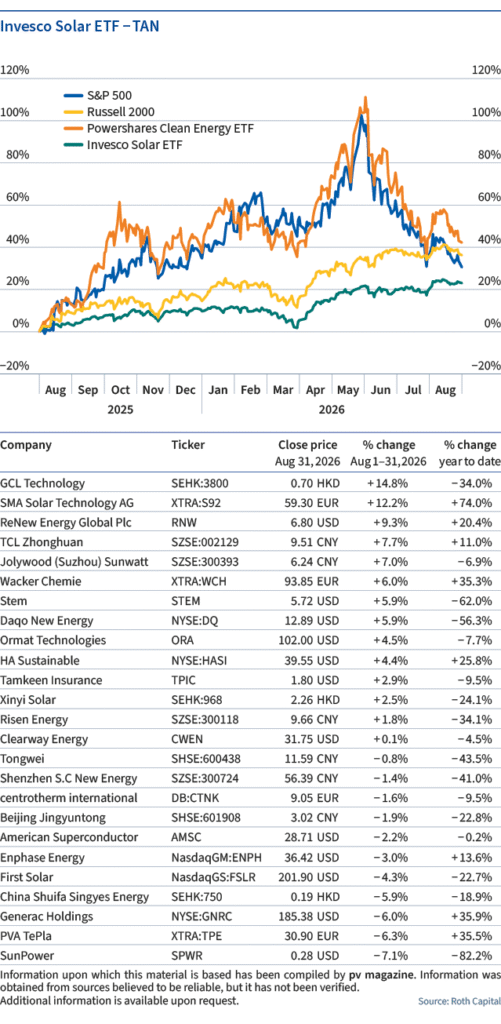
The Invesco Solar ETF (TAN) underperformed the S&P 500 and Dow Jones Industrial Average (DJIA) in August.
- The Invesco Solar ETF decreased by 3.6% for the month of August, while the S&P 500 increased by 2.6% and the DJIA rose by 1.3%.
- The top three US solar stocks for August were ReNew Energy Global Plc (9.3%), Stem Inc. (5.9%), and Daqo New Energy Corp. (5.9%).
- The three worst-performing US solar stocks in August were Zeo Energy Corp. (-52.5%), Tigo Energy Inc. (-44.0%), and Fluence Energy Inc. (-22.4%).
- Residential solar stocks decreased by 19.4% in August and 37.7% year to date. These companies include Enphase Energy Inc., SolarEdge Technologies Inc., SunPower Inc., Sunrun Inc., and Zeo Energy Corp.
- Utility-scale solar equipment stocks decreased by 12.7% in August and 35.5% year to date. The companies include Array Technologies Inc., First Solar Inc., FTC Solar Inc., Nextpower Inc., and Shoals Technologies Group Inc.
- Independent power producers (IPPs) fell by 1.9% in August and have risen by 14.5% year to date. The companies include Clearway Energy Inc., Enlight Renewable Energy Ltd., and Ormat Technologies Inc.