Microsoft’s Brad Smith on Trump’s data center tax threat: ‘You can’t support Helsinki from New Jersey’
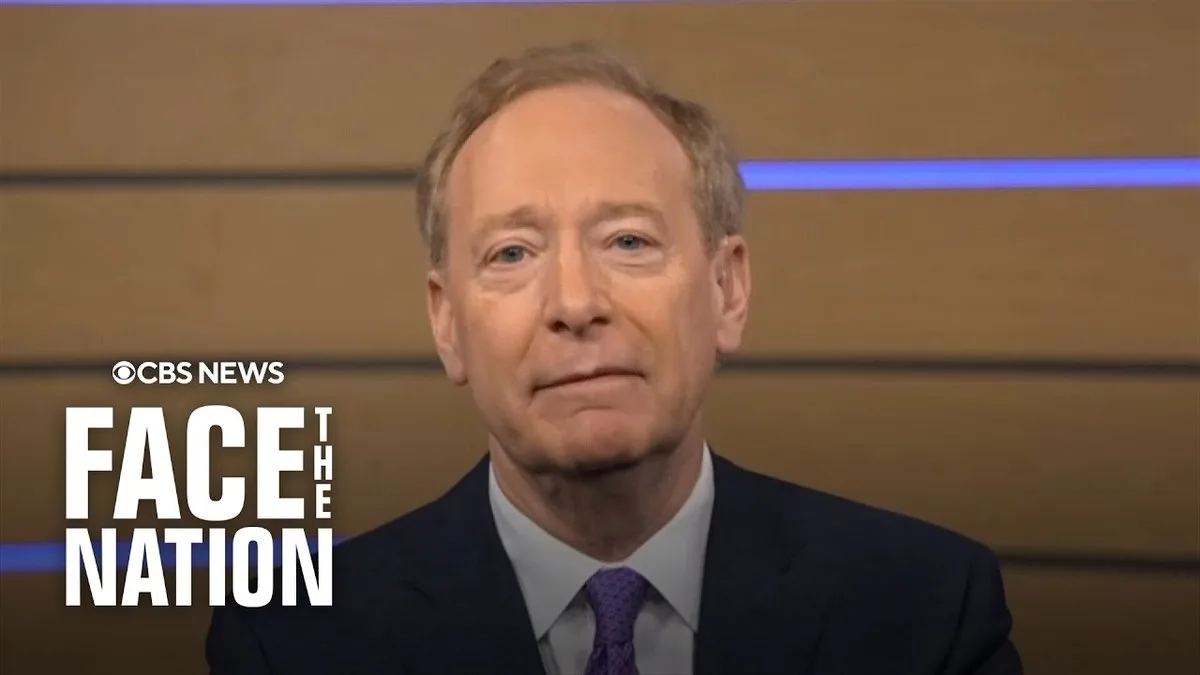
Microsoft Vice Chair and President Brad Smith offered a polite but pointed response to President Trump’s seemingly impromptu threat to tax U.S. companies that build data centers abroad: most of them have to be where their customers are.
Speaking on CBS News’ “Face the Nation” on Sunday morning, Smith said the president is “making an important point,” and that there’s room to talk about keeping the training of the most advanced AI models in the U.S., much like the push to make more chips here.
But he said most data centers run everyday cloud services, such as streaming video, video games and business software, and need to be close to the people using them.
“You can’t support Helsinki from New Jersey any more than you can keep the lights on in Helsinki from an electricity power plant in New Jersey,” he said.
A tax on foreign data centers could have significant financial implications for Microsoft, which says it has more than 600 data centers in 34 countries.
Trump made the statement Friday at a White House press conference, saying companies would face a “tremendous tax” if they build data centers outside the U.S.
His reason: “We’re not allowing data centers to go into other countries because China will take all of them, and we’re not allowing that to happen. And we’re going to put tremendous penalties on companies that try and do it.”
.@POTUS: "Whoever wins SI, wins… We're not allowing data centers to go into other countries — because China will take all of them, and we're not allowing that to happen." pic.twitter.com/FiH1LfAQDu
— Rapid Response 47 (@RapidResponse47) November 20, 2026
He gave no rate or timeline and acknowledged that he hadn’t told his own staff. “That’s a breaking story,” he said. “I haven’t even said that to my people. But I’m telling them now — they’re here.”
Trump had just returned from the Asia-Pacific Economic Cooperation summit in Shenzhen, China, where he met with Chinese President Xi Jinping and Russian President Vladimir Putin.
His one example was an unnamed company that wants to build in Finland. Google announced a €13 billion investment in Finland in September, covering data centers and clean energy projects. Margaret Brennan, host of the CBS program, said he might have meant a Chinese project.
Treasury Secretary Scott Bessent, who appeared earlier in the same CBS broadcast, said he hadn’t spoken with the president about the proposal, but added that Trump is “very concerned that we don’t do a big technology transfer offshore.”
Smith also fielded questions on other topics in his “Face the Nation” appearance.
TikTok’s owner: Brennan asked about TikTok’s Chinese owner, ByteDance, which is in advanced talks to spend about $500 million more on Microsoft’s Azure cloud, mostly to use OpenAI’s models, The Information reported last week.
Rep. John Moolenaar, R-Mich., chair of the House Select Committee on the Chinese Communist Party, said Microsoft should not sell AI tools to ByteDance, called it unacceptable for a Pentagon contractor, and asked the company for a briefing.
Smith noted that TikTok’s U.S. business is now a separate company, and said Microsoft expects to answer the committee’s questions on Capitol Hill.
White House ballroom: Microsoft committed $10 million to Trump’s ballroom project, according to an internal donor list reported by the Washington Post. Brennan asked why, and whether Microsoft is worried about scrutiny from a Democratic-controlled Congress.
Smith said Microsoft takes the same approach with every administration, regardless of party. “We partner where we can. We stand apart when we should,” he said.
He put the ballroom donation in the first category, and said the company “didn’t know, obviously,” that the project would involve tearing down the East Wing. In the second category, he pointed to lawsuits Microsoft has filed against the current administration, as it has against previous ones, to stand up for issues it considered important.
Outlook outage: Smith reiterated Microsoft’s apology for the Nov. 12 global Microsoft 365 and Outlook outage. He said the outage wasn’t caused by AI or a cyberattack.
Speaking more broadly, he said much of the recent wave of tech failures can be seen as “AI ripple effects” — the result of AI making software bugs easier to find, which has companies racing to patch systems faster than they can test the fixes.
(GeekWire has covered that angle in depth, including the surge in AI-discovered bugs, Microsoft’s final outage report and Oren Etzioni’s column on the conspiracy theories.)
Smith said the patching race won’t be finished anytime soon. “The whole information infrastructure of the world is in effect being upgraded right now,” he said.