Rainfall alone cannot eliminate bird-dropping soiling on solar panels, study finds
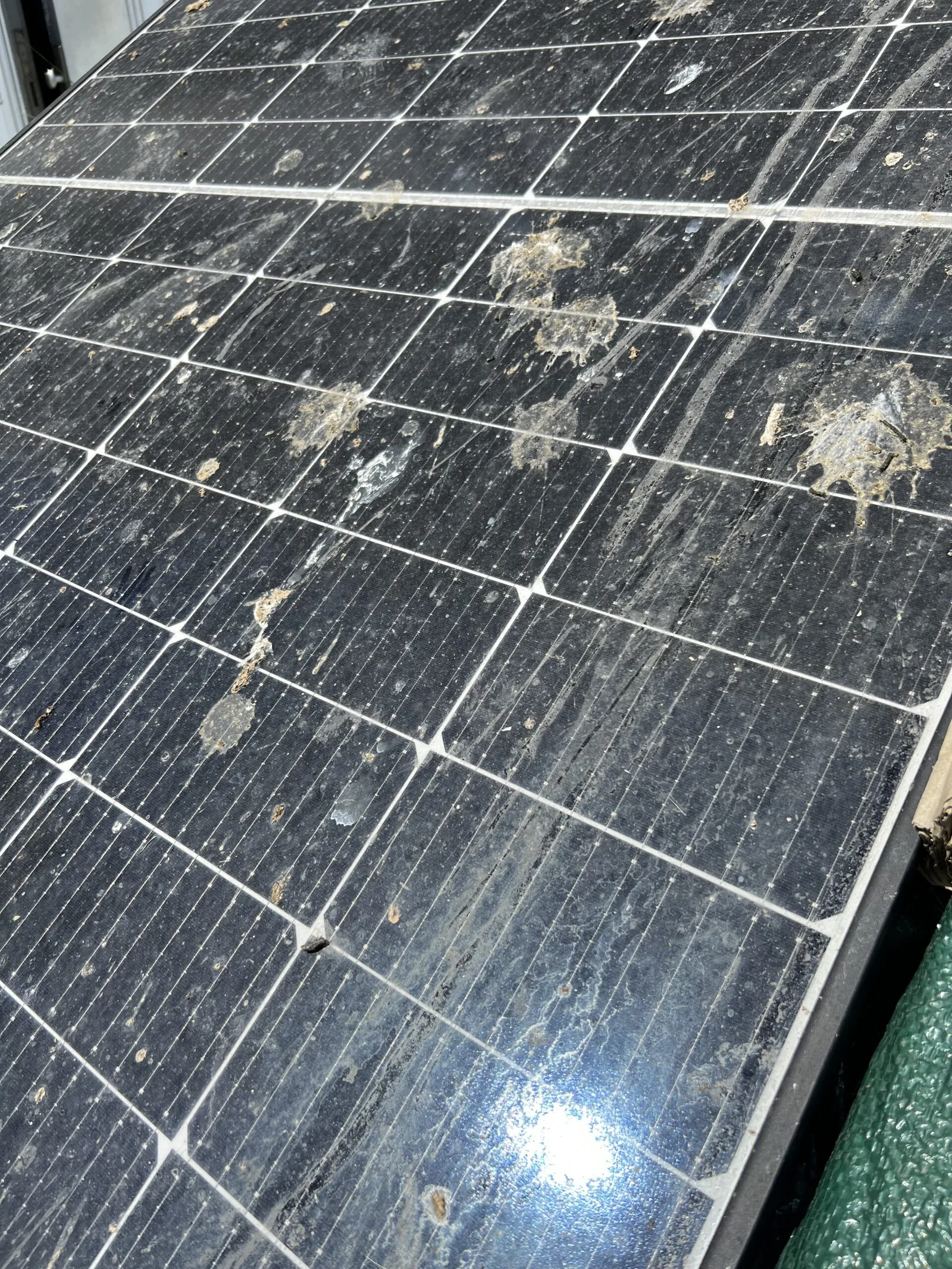
An international research team has conducted a year-long experimental study to assess the impact of bird droppings on PV system performance and has found that soiling losses stabilized after a prolonged accumulation period, remaining at consistent levels despite repeated rainfall events.
“Our paper highlights this limitation, but we cannot yet provide a solution,” corresponding author Leonardo Micheli told pv magazine. “Factors such as bird activity and proximity to nesting areas are likely to influence soiling accumulation under these conditions, but further research is needed to identify the quantitative variables that could be used to reliably model this type of soiling.”
“Our study demonstrates that a monitoring approach based on clean irradiance measurements can successfully estimate soiling losses caused by bird droppings, without the need to maintain a clean reference module,” Micheli added. “However, we also show that its accuracy depends on calibration. Furthermore, accuracy could also be influenced by operating conditions, and further validation across different sites is needed to confirm its general applicability.”
“We show that rainfall does not necessarily restore modules to clean conditions: significant soiling losses can persist even after repeated natural cleaning events,” he said. “The existence of this phenomenon has already been discussed in the literature, and our study confirms its relevance in environments affected by bird droppings, as this can be particularly difficult to remove. This challenges the common modelling assumption that rainfall effectively removes accumulated soiling and should be considered when optimizing cleaning schedules and costs. A rainy period should not be taken as evidence that PV modules are free from soiling.”
The experimental setup consisted of two monocrystalline JA Solar JAM54S30-410/MR silicon modules installed at ground level at the University of Split, Croatia. One module served as a clean reference, while the other was left to accumulate natural soiling. Both were mounted on an open rack with identical tilt, azimuth, and height to ensure comparable environmental and irradiance conditions.
The researchers conducted weekly measurements from July 2024 to July 2025. During each session, they recorded four current-voltage (I-V) curves per module using an EKO Instruments MP-11 tracer, while also measuring irradiance and module temperature. Measurements were taken near solar noon under clear skies and stable irradiance conditions, in accordance with IEC 61724-1.
The researchers calculated the soiling ratio by comparing the short-circuit currents of the soiled and clean modules. They also tested an alternative approach that estimates clean-module output using irradiance and temperature data. In addition, they evaluated three established soiling models based on particulate matter concentrations and rainfall. Two models assumed complete cleaning when daily rainfall exceeded 1 mm, while the third accounted for partial cleaning.
The researchers recorded an average soiling ratio of 0.941 over the monitoring period, corresponding to performance losses of approximately 6%, or an estimated 72.1 kWh/kWp annually. The ratio fell below 0.90 in November 2024 following a prolonged dry period, with bird droppings identified as the main source of contamination. Subsequent rainfall events only partially restored module performance, with the soiling ratio stabilizing at around 0.94 to 0.96.
A second accumulation period in April and May 2025 reduced the ratio to approximately 0.90, resulting in estimated daily energy losses of 0.41 kWh/kW and 0.47 kWh/kW, respectively.
The researchers found that only manual cleaning fully restored module performance. Their analysis also showed that the three conventional soiling models systematically underestimated losses because they relied primarily on particulate matter concentrations and assumptions about rainfall-induced cleaning.
They concluded that existing models cannot adequately capture the accumulation and removal of bird droppings, particularly in urban environments. They also recommended incorporating additional soiling measurements, more detailed rainfall characteristics, and saturation effects into future models.
“Overall, the results highlight that the applicability of current soiling modelling approaches is strongly dependent on the deposition mechanisms. Clearly, in environments where soiling is not dominated by gradual particulate accumulation, estimates based on current models may be unreliable,” the researchers stated.
Their findings are presented in “Mind the birds: Assessing the uncertainty in modelling of urban photovoltaic soiling,” published in Solar Energy. The research team included scientists from the University of Split in Croatia and Sapienza University of Rome in Italy.
The post Rainfall alone cannot eliminate bird-dropping soiling on solar panels, study finds appeared first on pv magazine Global.