The Soil Carbon Sponge Opens a New Path to Cooling the Planet
Happy Eco News The Soil Carbon Sponge Opens a New Path to Cooling the Planet
Reading Time: 3 minutesA new report argues that restoring the soil carbon sponge could help cool the planet by rebuilding a hydrological system that has regulated heat for billions of years.
The soil carbon sponge, Earth’s living water-management layer, may be one of the most overlooked tools in the fight against climate change. A new report argues that restoring healthy soil could help cool the planet directly. The idea centers on how living soil manages water, not just carbon.
Researchers behind the report work with the Conscious Planet Save Soil initiative. Their analysis builds on decades of earlier work by Australian soil scientist Walter Jehne. The report frames water, not carbon alone, as the planet’s primary heat regulator.
Water has shaped Earth’s temperature for roughly four billion years. Evaporation and condensation move enormous amounts of heat through the atmosphere. Healthy soil acts like a sponge that keeps this cooling cycle running.
Underground fungal networks help build this sponge-like structure over time. Fungi bind soil particles together, creating tiny air pockets that trap water. That structure lets soil absorb heavy rainfall instead of letting it run off the surface.
Right now, that sponge is badly damaged across much of the world. About 52 percent of global agricultural land is now considered degraded in some way. In parts of the United States, soil erosion runs up to ten times faster than natural formation.
In Europe, an estimated 60-70% of soils are now considered unhealthy. Degraded soil holds less water and supports less plant growth. That shift pushes more solar energy into heating the air instead of evaporating water.
Scientists describe this shift using two related terms: latent heat and sensible heat. Latent heat describes energy used to evaporate water, which cools the surrounding air. Sensible heat instead raises air temperature directly, as happens over dry, degraded land.
Rebuilding soil organic matter could reverse much of this damage over time. The report estimates that each 1% increase lets a hectare hold 250,000 more liters of water. That stored water supports the plant growth needed for continued evapotranspiration.
The report’s authors calculate that healthy evapotranspiration moves about 80 watts of energy per square meter. They compare this to the roughly 0.9 watts per square meter driving current global warming. Restoring the soil carbon sponge, they argue, could offset that imbalance several times over.
This calculation reflects a newer and less mainstream approach within climate science. Most researchers still treat cutting greenhouse gas emissions as the primary lever for limiting warming. Even so, many scientists agree that healthy soil provides real, measurable local cooling benefits.
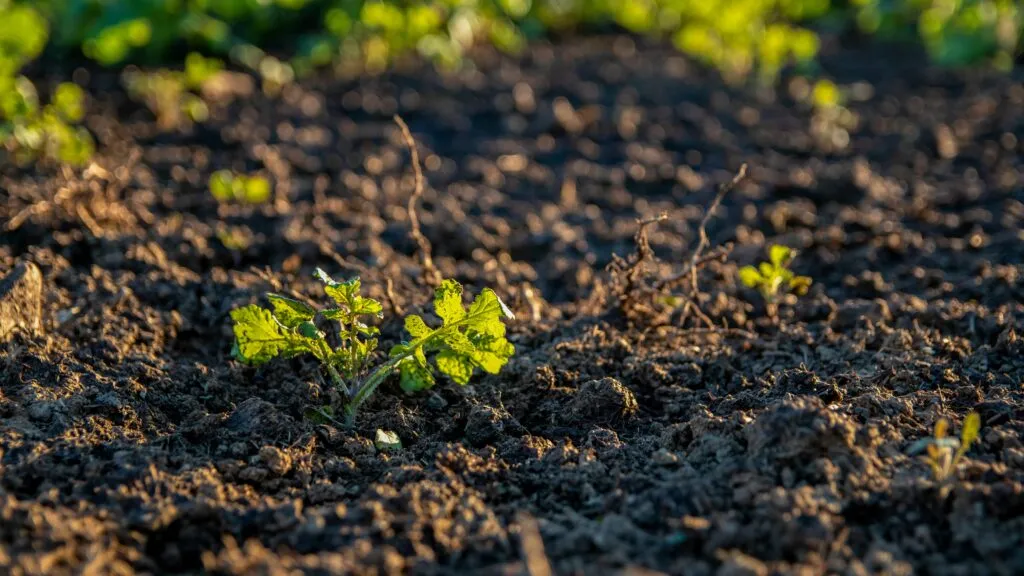
Restoring the soil carbon sponge and cutting emissions are not competing strategies but complementary ones, with the report’s authors arguing that land regeneration and decarbonization pursued together can reinforce each other’s benefits across the same climate system. Photo by Sven Hornburg on Unsplash.
The report’s authors frame soil restoration as a complement to emissions cuts, not a replacement. Both strategies address different parts of the same climate system. Pursued together, they argue, land regeneration and decarbonization could reinforce each other’s benefits.
The report recommends several practical steps for restoring the soil carbon sponge. Cover cropping and mulching can keep bare soil from radiating heat back into the sky. Protecting forests also helps sustain the smaller, regional water cycles that keep landscapes moist.
Researchers call these regional patterns small water cycles, distinct from the planet’s larger water cycle. Forests recycle much of their own rainfall internally, moistening the air around them. Losing forest cover can dry out a whole region even without any change in total rainfall.
Some cities are already testing these ideas at a smaller scale. A trial in Canberra, Australia, is rewetting soil beneath open grassland to cool nearby streets. Early results suggest that even modest soil restoration can measurably lower local air temperatures.
These recommendations echo growing interest in regenerative farming worldwide. Similar cover-cropping and mulching methods are already common practice for many small-scale farmers. Wider adoption could extend these local benefits across much larger areas.
None of these steps require waiting on new technology to scale up. Farmers, land managers, and city planners around the world already have the tools to start today. Restoring the soil carbon sponge, one field at a time, could offer valuable climate protection.