Behind-the-meter generation could deliver five times more grid relief than data center load shifting
The rapid deployment of data centers is placing substantial new loads on electricity systems that, in many cases, are not expanding at the same pace. An analysis published by Ember in October 2026 examines the extent to which data centers can provide grid flexibility through two mechanisms: shifting computing workloads and using behind-the-meter generation or storage. The study covers nine markets across the United States, Europe, and Southeast Asia, with particular relevance to Ireland, the United Kingdom, and Germany.
Ireland faces one of the largest impacts on electricity demand
Data centers could account for a significant share of peak electricity demand as their capacity expands. In Ireland, one of Europe’s leading data center hubs, they already account for approximately 19% of peak demand. In January 2025, when system demand peaked at 6 GW, data centers accounted for an estimated 1.1 GW. Ember projects that this share could rise to 24% by 2030, with data center demand reaching 1.6 GW against a system peak of 6.5 GW.
The challenge is particularly acute because of the mismatch between data center construction timelines and electricity infrastructure development. A large data center can require between 200 MW and 500 MW of power capacity and be built within 18 to 24 months, while conventional grid expansions can take four to 10 years.
Load shifting offers limited flexibility potential
Load shifting involves moving certain computing workloads to different times or locations to reduce demand during periods of grid stress. However, the composition of data center workloads significantly limits this option.
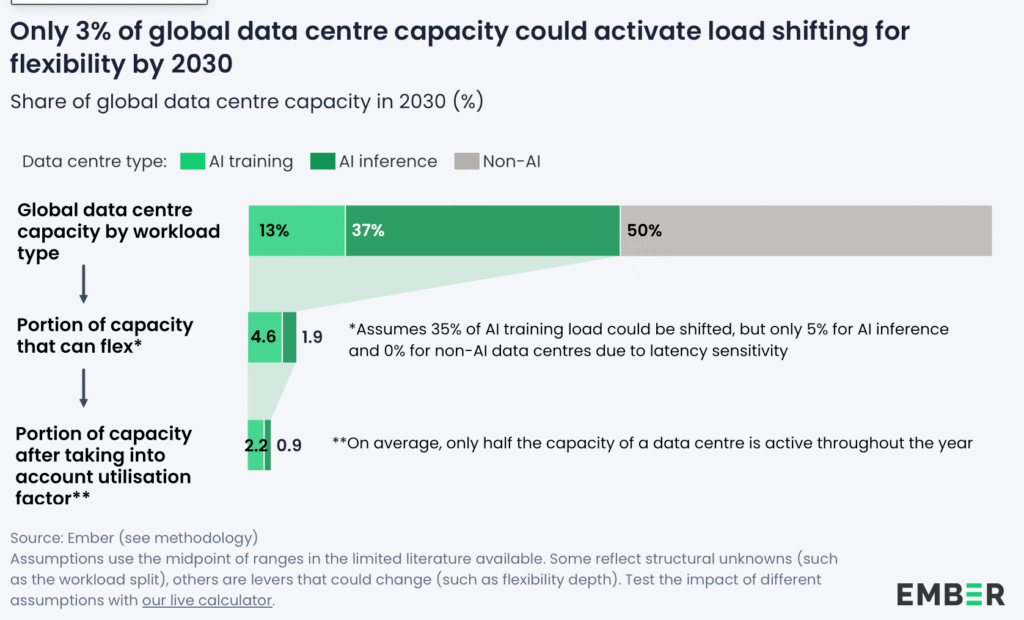
Cloud services, enterprise workloads, and artificial intelligence (AI) inference require low latency and currently account for most data center capacity. Ember estimates that these workloads will represent approximately 87% of global data center capacity by 2030. By contrast, AI model training offers greater flexibility, as workloads can be interrupted or relocated with fewer operational consequences.
Under Ember’s assumptions – 35% flexibility for AI training workloads, 5% for inference, and none for traditional data centers – approximately 6.5% of global data center capacity could theoretically be shifted. Factoring in an average utilization rate of approximately 48%, the capacity effectively available to respond to periods of grid stress falls to around 3%.
The impact on peak demand would therefore be limited. In Ireland, load shifting could reduce peak demand by approximately 100 MW by 2030, equivalent to 1.5% of the projected peak. Across the other markets analyzed, estimated reductions range from 0.1% to 0.6%.
Behind-the-meter generation and storage
An alternative offering greater flexibility involves maintaining computing workloads while temporarily replacing grid electricity with on-site generation or storage. This approach, known as bring-your-own-capacity (BYOC), can combine renewable generation, batteries, and other backup technologies.
The study finds that this approach could provide nearly five times as much grid relief as load shifting. For two large data centers analyzed in Texas, with a combined projected load of 5.6 GW, load shifting could reduce grid demand by approximately 0.55 GW during periods of stress, while on-site generation could reduce it by up to 2.7 GW.
Although the Texas example is outside Europe, it is relevant to the European regulatory debate because it illustrates the scale of flexibility that behind-the-meter resources could provide when grid connections become a bottleneck.
Ireland offers a European regulatory precedent. Initial proposals by the country’s energy regulator to impose flexibility requirements on data centers were replaced, following public consultation, with requirements for facilities of 10 MW or more to provide generation or storage capacity.
Energy sources determine system benefits
On-site generation does not automatically deliver decarbonization benefits. If it relies on fossil fuel-based technologies, it could lock in infrastructure and emissions for decades. There is also a risk of duplicating investments: a data center could install its own firm capacity while the system operator procures additional capacity to meet the same potential demand.
The report recommends integrating behind-the-meter resources into grid planning and connection requirements. Renewable generation and storage could enable data centers to reduce grid demand during critical hours without passing the costs of additional infrastructure on to other electricity consumers.
Storage is particularly relevant to this approach, as it can partially decouple data center electricity consumption from real-time grid availability and supply power during periods of congestion or peak demand.
Ember’s analysis indicates that no single flexibility solution is suitable for all data centers. Traditional computing and AI inference workloads, which could account for 87% of global data center capacity by 2030, offer limited scope for load shifting. For these facilities, renewable generation and behind-the-meter storage could be the primary means of reducing grid dependence during peak periods. Data centers dedicated to AI training, by contrast, offer greater potential to shift workloads across time or locations.
The post Behind-the-meter generation could deliver five times more grid relief than data center load shifting appeared first on pv magazine Global.