Key takeaways from RE-Source 2026 in Amsterdam
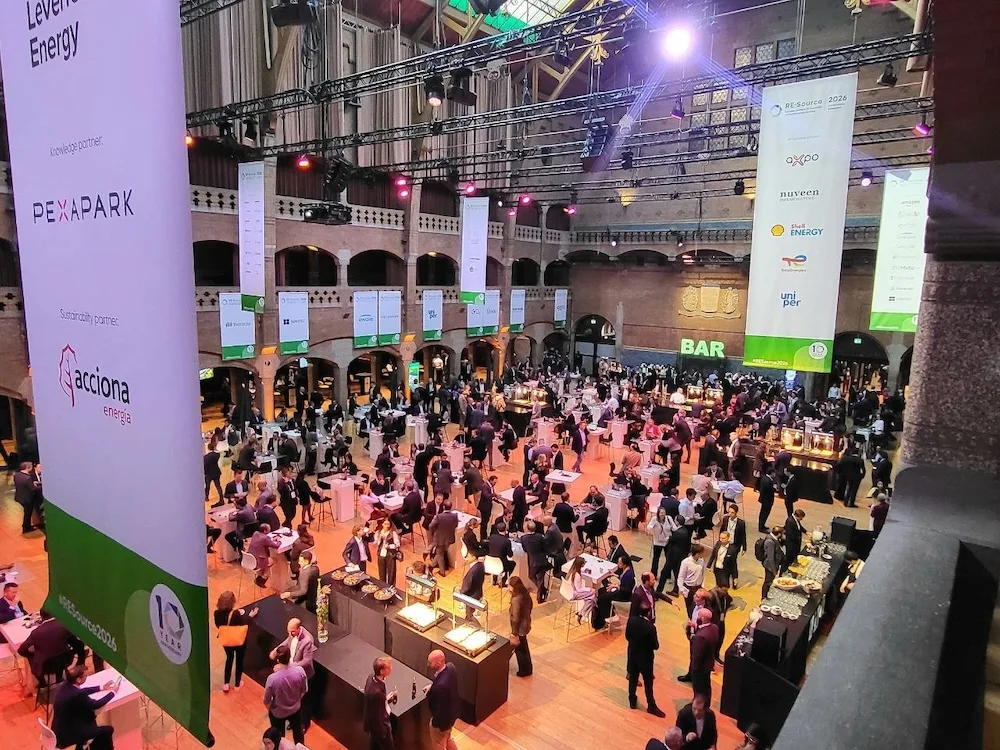
The Beurs van Berlage, a former commodities exchange on the avenue between Amsterdam’s central train station and main square, was built more than a century ago so the city’s merchants had somewhere to agree on prices. But the 1,400 or so people who filled the cavernous red-brick hall on Nov. 4 and 5 came to negotiate deals for renewable electricity, a commodity whose price falls below zero for a growing number of hours each year.
The 10th edition of RE-Source, organized by SolarPower Europe and WindEurope through their joint RE-Source Platform, brought more than 350 corporate energy buyers to some 400 prescheduled meetings with suppliers. But the deal flow they were chasing is thinning: the RE-Source Platform said corporate power purchase agreements (PPAs) have secured 5.9 GW of renewable capacity in Europe so far in 2026, down 9.7% on the same period last year.
Francesco Rossetto, a policy officer at the EU Agency for the Cooperation of Energy Regulators (ACER), presented the agency’s annual PPA assessment and described “a market that is cooling down a little bit.” He said activity peaked in 2024 and has held near 2025 levels since. Meanwhile, the share of hours with very low power prices has climbed from 1% to 2% in 2021 to about 10%.
Solar is taking the brunt. Max Plumptre, director of European transactions at Seattle-based PPA marketplace LevelTen Energy, said capture rates – the share of the average market price a solar plant actually earns – have roughly halved in Spain and Germany since 2022.
Swiss market intelligence firm Pexapark said standalone solar PPA volumes have fallen 43% this year, and that Italy has overtaken Spain as their largest market, largely because Spanish activity has collapsed. Almost one-quarter of Spanish solar output has been generated during negative-price hours, according to the research firm.
Itamar Orlandi, director of commercial strategy at Pexapark, said solar prices “started to go into free fall about three years ago and that free fall still hasn’t stopped.”
Buyers are responding by asking for more than one technology. Plumptre said nearly every request for proposals on LevelTen’s platform this year has included a hybrid product “in some sort of fashion,” and about 25% of offers in its latest quarterly report were hybrid.
Pexapark said PPAs combining several technologies have almost doubled, while Rossetto said capture rates for solar paired with storage are diverging from those for solar alone.
Hybrid hedging
For insulation maker Rockwool, the shift is practical. Kenneth Dupont, energy category director for the Danish company, said it moved away from single-technology PPAs because they do not fit factories that run around the clock. He advised buyers to contract about half of their demand through PPAs and cover the rest with renewable energy certificates.
Spain shows why storage is now central. Silvia Escudero, head of upstream and downstream origination Iberia at Statkraft, noted that the country has logged about 920 hours of zero or negative prices so far this year. With grid connections scarce, she said, putting batteries behind existing solar connections is by far the fastest route to market. However, she warned buyers that a battery’s flexibility carries an opportunity cost, because grid services can be worth more than delivering power to a customer. “A hybrid PPA is not a solar PPA with a battery, it’s much more complex than that,” said Escudero.
That complexity is where traders see their opening. Kristina Herold Høgh, director of RETO origination and contract management at Centrica Energy, said new contract structures for batteries are emerging. Profile swaps, which convert a renewable plant’s variable output into a delivery shape that suits the buyer, are becoming more standard.
Herold Høgh cast traders as “problem solvers” that bring the risk capital and credit these deals require. One gap remains in recognizing stored power: one panelist said only one or two European countries issue guarantees of origin, the certificates that prove renewable sourcing, for stored electricity.
Domenico Franceschino, head of origination for West and East Europe at Axpo Solutions, explained how a battery’s location shapes its value, using indicative figures for tolling agreements in France, under which an offtaker pays a fixed fee for control of the battery. For seven- to 10-year contracts starting in 2029, he put annual fees at about €80,000 ($89,500)/MW for a standalone battery, €65,000/MW for a co-located unit that can also charge from the grid and €45,000/MW for one that charges only from on-site solar.
The standalone premium comes at a price: cabling and grid fees of about €50,000/MW per year, against about €35,000/MW per year for the battery itself. It “costs more to pay the grid fees than to actually buy the batteries,” said Franceschino.
Pexapark’s Orlandi said “the most valuable asset has now become the grid connection point.” Utilities and traders still take almost all battery offtake, he said, although a handful of sophisticated German corporates have recently signed hybrid contracts.
The obstacle lies in where the money is. Half to two-thirds of a battery’s value comes from ancillary services, the balancing products that grid operators buy, Orlandi said, and most corporates have neither the interest nor the capability to trade them.
Risk allocation
Mathieu Ville, chief revenue officer at battery investor Tavion, questioned why sellers should accept zero-price floors. “Why would you floor me at zero? And if you do, why wouldn’t I cap you at 80?” he said. He was equally skeptical of state-backed PPA guarantee schemes. He said they look great “on paper” but have produced only three or four deals in five or six years, which he put down to their pricing and complexity.
Italy is about to test the model again. Francesca Morra, a partner at Herbert Smith Freehills Kramer in Milan, said the country’s energy regulator gave a positive opinion in October on rules for a new organized PPA market. The rules include a guarantee of last resort from GSE, the state-owned energy services company, which she said will be limited and fee-based to comply with EU state aid rules. Her advice was to settle key terms at the term-sheet stage. “The PPA is not an easy animal,” Morra said. “We need lawyers.”
But Ricardo Estévez Solís, senior originator at Centrica Energy, dismissed the idea that the market has stalled. He said that Spanish buyers facing forward prices above €100/MWh for next year are active alongside sellers, and that contracting is shifting from single assets to portfolios.
For large buyers, the question is now certainty. Cédric Saussez, head of green power structuring and origination for Northwestern Europe at Engie, said customers who once asked how green and how cheap a project was now ask how certain it is.
Rønnaug Sægrov Mysterud, head of energy sourcing at Norsk Hydro, said electricity makes up 30% to 40% of the cost of primary aluminum, leaving the company “extremely price sensitive.” Hydro needs sufficient power at competitive prices and certainty on indirect carbon cost compensation before it signs more PPAs, she said, adding that “the grid cost should not kill the rest.”
Carbon accounting
Carbon accounting rules are adding to the uncertainty. Daniela Fitzpatrick, senior manager energy procurement for Amazon Web Services, said up to 35% of renewable energy contracts globally could be stranded unless revisions to the GHG Protocol, the most widely used corporate carbon accounting standard, protect existing deals. “There’s a real concern that the draft GHG Protocol revisions are cooling down the PPA market,” said Fitzpatrick.
The rules may tighten further. Merve Güngör, policy and network manager for the RECS Energy Certificate Association, said the protocol’s standards board is weighing an age limit on eligible assets. “It’s not decided yet. I think 10 or 15 years are on the table,” said Güngör. A final standard is due at the end of 2028.
Javier de la Fuente Iglesias, head of flexibility and physical services at Statkraft, told pv magazine that industrial buyers see the value of battery arbitrage but do not yet know how to bring it into their procurement processes.
The premium buyers pay for firmer supply is already visible in pricing. LevelTen data for the second quarter put hybrid solar-plus-storage PPAs at a 24% premium to solar-only contracts.