I’m Offended By It

There is, so far as we humans are aware, nothing richer in the universe than personality. There is nothing so endlessly fascinating. It’s not just that “The brain is the last and grandest biological frontier, the most complex thing we have yet discovered in our universe. It contains hundreds of billions of cells interlinked through trillions of connections. The brain boggles the mind.” (See here.) It’s not merely that the human brain is far more complicated and difficult to understand than a rock floating in space or a gaseous and luminous spheroid of plasma held together by its own gravity that we term a “star” — or far more complex and difficult to grasp than even a galactic assemblage of such objects.
No, I’m not talking here about neuroscience or cranial anatomy. I’m talking, very specifically, about personality. There is nothing more inexhaustibly interesting, complex, and rich. Nothing.
So the loss of any person is, to me, incalculable. Every person is unique, irreplaceable. Like a snowflake, but infinitely more important and infinitely deeper.
Thus, the famous lines from Meditation XVII of John Donne’s 1623 Devotions upon Emergent Occasions have always resonated with me:
No man is an island, entire of itself; every man is a piece of the continent, a part of the main. If a clod be washed away by the sea, Europe is the less, as well as if a promontory were, as well as if a manor of thy friend’s or of thine own were: any man’s death diminishes me, because I am involved in mankind, and therefore never send to know for whom the bell tolls; it tolls for thee.
I’ve always been inclined to read obituaries. I know, I know. Weird. But each obituary that I read, whether for a friend or a person unknown to me, whether for a celebrity or a “private person,” leaves me with the acute sense that experiences and perspectives that are utterly unrepeatable, unparalleled, and beyond price have been lost.

A Wikimedia Commons public domain photo of Peleș Castle, in Romania
It’s a peculiarity of mine, I’m sure, and it might surprise some who have detected no prior traces in me of the macabre or the morbid or the funereal or the gloomy — and they’re absolutely not misreading me in that regard — that, for as long as I can remember, I’ve been acutely aware of the transience of human creations and even of natural phenomena. When I see beautiful flowers, I can’t help but think of the fact that they’ll soon fade. When I see geological formations, I know not only that they were created over time but that they are still being created — which means, inevitably, that they’re being destroyed. Tectonically speaking, the Pacific Plate upon which I was born has moved somewhere between seventeen and twenty-three feet to the northwest since I drew my first breath. Even the most beautiful architecture reminds me of foredoomed sand castles. When I’ve visited castles, palaces, and historical mansions — most recently, Peleș Castle, here in Romania — my thoughts have almost invariably turned to the brief time that their builders occupied them and to how long those builders have now been gone. (Perhaps I’ve spent overmuch of my life studying and, in a sense, living in ancient and medieval times; I can’t avoid thinking of the fact that those who ruled over Old Kingdom Egypt and who have been gone for nearly five millennia were once every bit as vivid and alive as the youngest and healthiest of us today. Yet most of them — to say nothing of their courtiers and of the peasants below them — are not only gone but completely forgotten.) As I planned for my current retirement, I knew that it will last only a short while, and that, even then, I had, at the most optimistic, far fewer years ahead of me than I had already lived. As the old rock song goes:
We are but a moment’s sunlight
Fading in the grass.
The “Great Pyramid” (of Khufu or Cheops) is actually the one on the right in the distant background of this photograph. (Wikimedia Commons public domain image)
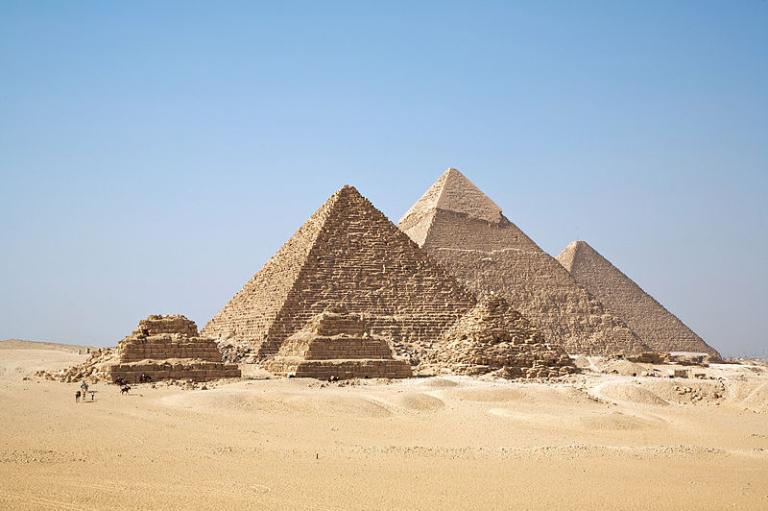
I’m fairly gregarious and not notably lonesome, and I’m not especially well known for my grim solemnity, but another passage that has echoed in my mind for decades can be found in Jacob 7:26, where an aged prophet reflects on his life and comments that
“the time passed away with us, and also our lives passed away like as it were unto us a dream, we being a lonesome and a solemn people.”
(By the way, this doesn’t strike me as the kind of thing that a healthy, seemingly indestructible and immortal young person — say, Joseph Smith in his vigorous early twenties — would be likely to write. But it makes enormous sense to me now that I’m stumbling inescapably into advanced decrepitude, continuously astounded to be as old as I am, much older than my father was when I began to worry about his age. Where did the time go? Have I been sleepwalking? When older people commented to me about how short life is, I would smile and nod my assent without real comprehension. But no longer.)
Surprisingly, I don’t think that I feel any particular or unusual fear of my own personal death, or that I ever have felt such a fear. But I’m offended by death. I’m offended by the fact that it’s taken many of my loved ones, many of my friends, many people that I’ve admired, and many that I dearly wish were here to help us out today.
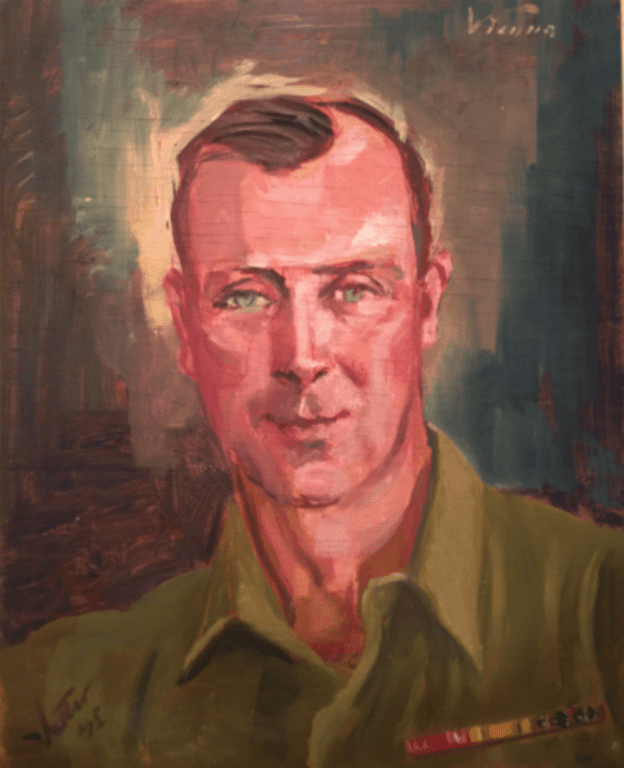
Staff Sergeant Carl Peterson at Gmunden, Austria, ca. April 1945, by Theodor Detter. Why “Vienna” is written in the upper righthand corner, I cannot say.
I recall when we were driving, years ago, toward the cemetery in the small funeral procession for my father’s burial. Suddenly, and quite unexpectedly, it struck me as almost incredible that, as we passed, I saw people shopping and filling their cars up with gas and laughing and listening to music and enjoying the sunny southern California weather as if nothing had happened. But something monumental had happened. Were they really unaware of the cosmic obscenity that had just occurred? My father — the North Dakota farm boy, son of immigrant Scandinavian parents, veteran of the Great Depression and President Roosevelt’s Civilian Conservation Corps and General Patton’s Third Army and the liberation of the Nazi extermination camp at Mauthausen, builder of a successful business and of a not insignificant number of construction projects across booming post-war greater Los Angeles and beyond, a gentle and good-humored man who was held in affection by many, a father and grandfather and brother, late in life turned a Latter-day Saint, a hunter and angler and golfer and prankster and joker and genealogist and Scouter, and so many other wonderful things — was suddenly, unreachably, gone. Just gone.
Yet the lives of others went on uninterrupted, despite the enormity of what had just happened.
I thought of videos that I’ve seen of deer grazing in a meadow. A shot rings out, and one of them falls to the ground, dead. Startled, the others look up and about. And then they go back to grazing, thoughtless and unconcerned.
We have no alternative, of course. In the words of the old Joni Mitchell song, “we’re captives on a carousel of time.” We can’t just say “Stop!” and expect it to stop.
I realize perfectly well, of course, that my indignation at death doesn’t make it unreal. Nor does it confirm as true my belief in a life beyond life, and even (as N. T. Wright would say) in a resurrected life beyond life beyond life. But I confess that it does make the indifference and apathy and thoughtless inattention of many toward the matter utterly incomprehensible to me.

The Panama City Panama Temple (LDS.org).
As illustrated in this trio of accounts, all three of which I’ve recently retrieved from the Christopher Hitchens Memorial “How Religion Poisons Everything” File, fanatical religious zealots will pass up no opportunity to meddle in the lives of their innocent neighbors:
- “Latter-day Saint Volunteers Assist in Hurricane Cleanup in Florida”“Church Sends Emergency Aid to Panama After
- Earthquake: Members of the Church in Panama City helped assemble and prepare emergency kits for families in need”
- In praise of Notre Dame: What a football coach’s kindness to a BYU player teaches about faith: After fourth quarter interception, Notre Dame coach showed BYU what sportsmanship means, writes BYU President Shane Reese”