To Protect Little Tokyo’s Legacy Businesses, Residents Are Buying Its Buildings
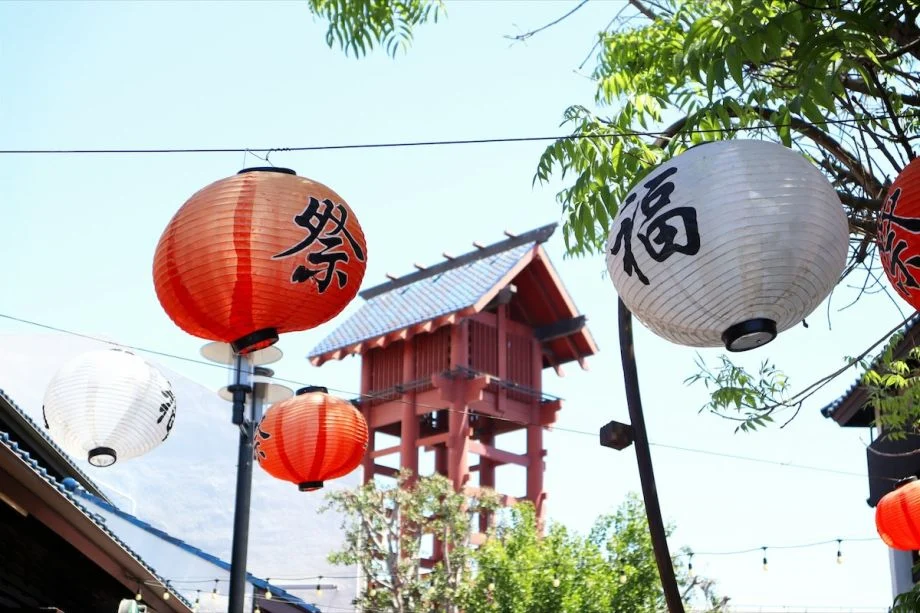
The Little Tokyo neighborhood in Los Angeles. (Photo by Looka Chow / Unsplash)
There are so many reasons for people to love LA’s Little Tokyo.
There’s the Japanese American Cultural and Community Center, with its famous Japanese garden, and Nisei Week, the annual cultural festival that’s drawn visitors to the neighborhood since 1934.
There’s Little Tokyo’s small businesses, like Fugetsu-Do, a confectionery and bakery famous for its mochi, owned and operated by the same family since 1903. There are the seniors who sit at the same coffee shop together every morning at 7 o’clock.
For about a hundred investors scattered across the Los Angeles area, these are just some of the reasons they decided to pool their savings and form the Little Tokyo Community Impact Fund. Their goal: to begin acquiring commercial real estate to protect their beloved long-time local businesses and third places from the market forces threatening them.
“It’s an ongoing struggle with affordability,” says Midori Mizuhara, an LA-based planner and urban designer who had supported Little Tokyo businesses in her previous work and now sits on the fund’s board. “Developers or outside owners are buying buildings, jacking up the rent, and legacy businesses really are under attack.”
After raising nearly a million dollars through community investments of as little as $1,000, the fund acquired its first building last year — a two-story commercial building on East 1st Street, in the heart of historic Little Tokyo, just a few doors down from Fugetsu-Do.
“If we don’t own our own land, if we don’t own our space, we don’t really have as much say in the future of the community as we would like,” says Kristin Fukushima, executive director at Little Tokyo Community Council.
“Our community just historically has not owned a lot of the neighborhood. And that goes back to everything from the Alien Land Law Act to World War II incarceration, to just all these other things.”
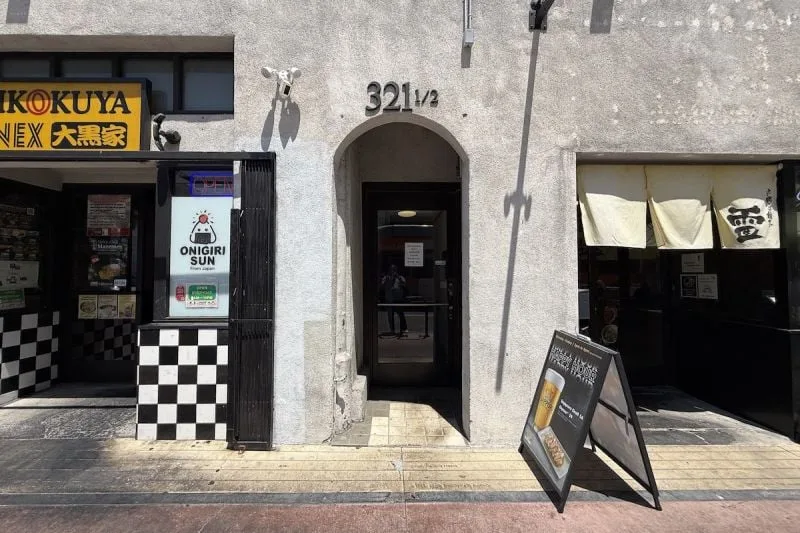
The two-story commercial building on East 1st Street purchased by the Little Tokyo Community Impact Fund. (Photo by Oscar Perry Abello)
History repeating
It’s not the first time longtime Little Tokyo community organizer Bill Watanabe has led a band of local activists to protect Little Tokyo from outside forces — including the city itself.
In 1980, he worked with Yasuko Sakamoto and Evelyn Yoshimura to found the Little Tokyo Service Center with the aim of providing “linguistically and culturally sensitive social services to the Little Tokyo community and the broader Japanese American community in Southern California.” Watanabe was selected as executive director.
As the decade went by, the trio saw many affordable housing units lost in Little Tokyo, some to clear the way for mere parking lots.
Just north of East 1st Street in Little Tokyo, the three-story San Pedro Firm Building has a celebrated history as a home built by and for Japanese immigrants in the early 20th century. The city ended up acquiring the building in 1974 and, in 1986, the Los Angeles Community Redevelopment Agency announced plans to demolish it as part of a $200 million expansion of the LA Civic Center. But many low-income Japanese American seniors were still living there. Led by the Little Tokyo Service Center, the community fought back, getting a city council resolution passed to preserve the building as low-income housing.
By 1989, Little Tokyo Service Center acquired the San Pedro Firm Building, marking the nonprofit’s first venture into real estate. Since then, the center has amassed a portfolio of more than 1,400 affordable housing units and 130,000 square-feet of commercial or community space across the LA region.
Watanabe retired from the nonprofit back in 2012. But he just can’t stop thinking and talking about how to protect Little Tokyo from forces that would displace so much of what makes it so special in his eyes.
Back in 2018, he recalls to Next City, “There was a small group of us, about seven or eight people, just folks who were active in the community and concerned about gentrification impacting our community and what it looks like. We got together at a condo in Little Tokyo and just started chatting.”
The big ticket item on everyone’s minds at the time was a major new transit station, part of the Regional Connector, that had been in the works for several years. The project was connecting and reconfiguring three major light rail lines into two, while allowing for faster and more frequent service to and through downtown LA and out as far as Pomona, East LA, Santa Monica or Long Beach.
The new station in Little Tokyo was already projected to be the second-busiest transit hub in all of LA County. And it was going to be right on East 1st Street, directly across from the Japanese American National Museum.
“Our concern was once the Regional Connector, Little Tokyo Station opens up, it’s going to raise rents, raise property values, more speculation and all of that,” Watanabe says.
Speculation around the Regional Connector had already started ramping up around when the project broke ground in 2014. It added to existing real estate pressures on the neighborhood, given Little Tokyo’s proximity to the LA Arts District and the rest of Downtown LA.
Cosmos, a beloved local dive bar and karaoke lounge, closed in May 2014 after a battle with its landlord, who wanted to clear it out and renovate the space for another business. Aoi, a popular lunch spot that had been operating at the same location since two sisters from Japan established it in 1976, closed just one month later after its landlord also ordered it to vacate for renovations.
In August 2014, Brunswig Square, a prominent eight-story, 140,000 square-foot office and retail building in Little Tokyo was sold for $33 million. A little over a year later, it sold again for $60 million. In the turmoil around the ownership changes, Yakitori joint Kokekokko lost its lease in Brunswig Square, closing for good in January 2016.
Watanabe and his partners considered whether Little Tokyo Service Center could work toward acquiring more of the smaller historic commercial properties in Little Tokyo, especially along East 1st and East 2nd Streets. It had already acquired several historic properties in the area for use as affordable housing with ground-floor storefronts.
“But their mission was not small business,” Watanabe says. “Their mission was affordable housing and community economic development. So they felt another organization focused on helping the small businesses would be an ally, but not necessarily something Little Tokyo Service Center would want to expand its mission to do.”
Watanabe’s crew could work with Little Tokyo Service Center as their property manager, but the group would have to come up with their own way to raise money and acquire properties.
“We kicked around different ideas,” Watanabe says. “Maybe a land trust or a co-op. Then we came up with this idea of an investment fund, kind of like a REIT.”
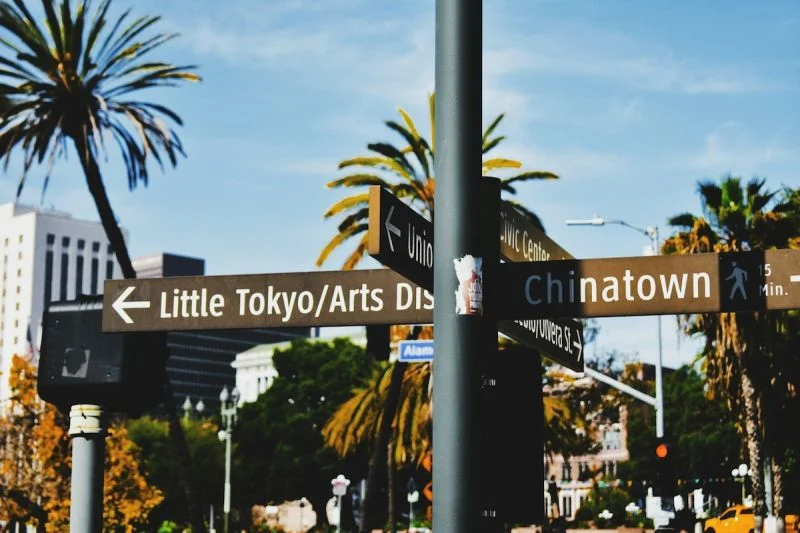
Union Station in Los Angeles, near Little Tokyo. (Photo by Mandy Bourke / Unsplash)
Found a lawyer in a hopeful place
Created by federal legislation in 1960, REITs — real estate investment trusts — are tax-advantaged investment vehicles that allow groups of investors to own property together, primarily for the purpose of making a profit. According to the National Association of Real Estate Investment Trusts, REITs currently own more than 570,000 properties in the U.S.
Some REITs are traded publicly on stock markets, while others are private investment vehicles only open to institutions or individuals with enough personal wealth. Many of these trusts specialize in specific kinds of real estate, like housing, hotels, healthcare, shopping malls, or data centers.
But since the primary purpose of a REIT is to generate profits for investors, they often end up doing things like evicting tenants at higher rates than small landlords, or raising rents at higher rates in certain markets compared to others.
A REIT wasn’t going to be quite the right fit for what Watanabe and his longtime community activist friends were looking to do.
“We would provide a modest return for the investor, but keep some of the money to help the small businesses,” Watanabe says. “We thought there might be enough people who don’t need to get top dollar on their investment, but would feel good about helping the community. So we took that idea to the community.”
They organized three workshops — two in Little Tokyo, one in the nearby city of Gardena, where a significant portion of the population is of Japanese descent. At each workshop, they talked about the gentrification taking hold of Little Tokyo, made their pitch, and collected pledges for investments.
“We pitched a very rough model that we could form the fund, the fund could purchase a building, that building could then be refinanced to purchase a second building and eventually have enough commercial real estate that we could have an impact on gentrification,” Watanabe says. “The response was pretty favorable. Now these are not millionaires, these are not deep-pocketed people. These are normal folks. But I think the key ingredient was that they have a concern and a heart feeling for Little Tokyo. They want to see Little Tokyo survive.”
Fukushima, from Little Tokyo Community Council, invited attorney Brett Heeger to attend one of the workshops in Little Tokyo. At the time Heeger was working at a boutique securities law firm — the kind whose clients include tech startups, TV and film production houses, and real estate syndicates who want to raise capital from family, friends and other private investors. There’s a whole menu of legal mechanisms available to do so.
But Heeger had seen how emerging groups like the East Bay Permanent Real Estate Cooperative, Oakland Community Land Trust, and E.G. Woode in Chicago were starting to use some of these mechanisms to raise capital from their networks of followers who shared their values and vision for an economy that looked very different from the current mainstream economy.
After hearing the pitch from Watanabe and the crew, Heeger stepped in to offer his expertise.
“I was so naive,” Watanabe says. “I figured, how hard can this be? We’ll just ask people to put in money and buy a property. And so Brett [Heeger] had to tell us the investment field is very highly regulated. It makes sense, I had just never thought of it at the time.”
Protecting purpose
From a legal perspective, one of the big questions was choosing the right legal entity to incorporate.
Conventional REITs or other trusts are typically set up to prioritize profits above all else. REIT board members or managers can be held liable for making decisions that lead to lower returns. A building could be owned by a family for one or more generations, and the family could place it into a trust for tax purposes, but eventually that trust may be forced to sell that property because it’s a conventional trust required to perform its fiduciary duty to maximize profit for the family.
“We considered all the different entity types,” says Heeger, now a partner at Impact Matters Law LLP. “Should this be a nonprofit? Because nonprofits certainly can hold real estate and you can bring in [community] investors through debt.”
In 2010, Maryland became the first state to pass legislation creating a “benefit corporation,” a kind of hybrid legal entity that blends aspects of both for-profit businesses and nonprofits. Over 40 states have since passed legislation creating some kind of hybrid legal entity along these lines. Chicago’s E.G. Woode and all its member businesses are incorporated in the state of Illinois as “low-profit, limited-liability corporations,” or L3Cs. California has the similar “social purpose corporation,” or SPC.
These hybrid entities are different from “Certified B Corporations,” which are for-profit businesses that meet certain “high, verified standards of social and environmental performance” as determined by the nonprofit B Lab. Incorporating or reincorporating as one of these hybrid legal entities is one way companies can satisfy the legal accountability requirement to become a certified B-corp.
Little Tokyo Community Impact Fund eventually incorporated as a social purpose corporation in the state of California. As a social purpose corporation, the fund’s board of directors must consider the fund’s social purpose in addition to shareholder profits when making business decisions.
The primary social purpose of the fund, as stated in its articles of incorporation, is to “contribute to community revitalization and cultural preservation in the Little Tokyo neighborhood of Los Angeles, California, and among the broader Japanese community in southern California.”
“It gives the board the authority to make broader decisions that are not solely profit maximizing and instead take into account this special social purpose feature,” Heeger says.
Being a social purpose corporation means, for example, if presented with an opportunity to sell a building, the board of Little Tokyo Community Impact Fund may decline to do so if it believes selling the property doesn’t support the fund’s social purpose, even if the property could be sold at a profit. If the board does decide to sell a property, it’s under no obligation to distribute the proceeds to investors — it could instead use those proceeds to subsidize rents or to make another acquisition.
And unlike nonprofits, Heeger says, SPCs can issue ownership shares to raise funds from investors. Also known as equity, it’s a more flexible investment offering that comes with the benefit of being perceived more favorably later by a potential bank or other lender.
“The ability to offer people equity compared to only debt is really meaningful,” Heeger says. “It’s patient in a way that debt is not. Especially when you’re in the real estate world, being able to not have debt on your books can give you a pathway to other resources.”
The perfect buy
To help ensure it would be a multi-generational effort, Little Tokyo Community Impact Fund opened up its offering in 2019 to two classes of investors: Class B shareholders, targeting older generations with years of retirement savings already piled up, and Class A shareholders, targeting younger professionals and activists who are still saving up for retirement. The minimum investment for Class B was $10,000, while Class A had a minimum investment of just $1,000. Only California residents were eligible to invest.
And then the COVID-19 pandemic hit.
“It put the kibosh on all of our outreach, our gatherings,” Watanabe says. “You can do a Zoom meeting with potential investors, but it’s really hard to get them to cut a check after the Zoom meeting ends.”
Little Tokyo Community Impact Fund started actively selling shares again in 2022, eventually raising almost a million dollars from nearly 100 investors.
That doesn’t sound like much, but it was enough for Watanabe to start telling brokers and contacts around the neighborhood that Little Tokyo Community Impact Fund was officially in the market for its first acquisition. The first offer they made on a building, they were outbid at the last minute. Other potential opportunities came up, but upon looking into the buildings, there was just too much deferred maintenance for a small, scrappy, all-volunteer group to take on.
In the spring of 2025, a friend of Watanabe’s was offered a building to purchase. She wasn’t interested, but she directed the broker to the impact fund.
The building was one of eleven parcels on the north side of the 300-block of East 1st Street. Nearly all the buildings on that side of the historic street were built between 1896 and 1934. The five western-most buildings — including the one presented for sale to the fund — back up into the San Pedro Firm Building, just around the corner.
If you needed to point to a block that defined Little Tokyo’s most lively era — when Japanese Americans moved south after the 1906 San Francisco Earthquake and the neighborhood’s population boomed — this is that block. The National Park Service designated this block as part of the Little Tokyo Historic District National Historic Landmark. Over the years, Little Tokyo Service Center had already acquired two of the larger historic buildings along the block, preserving them as affordable housing and storefronts.
It’s the block where the iconic lunch spot Aoi used to be. It’s the block where Fugetsu-Do remains.
The building needed some work, but not a lot. Anxious not to be outbid this time, the board of Little Tokyo Community Impact Fund quickly agreed to make an offer of $3.8 million. That was far more than they had pooled together. To find the rest, Watanabe appealed to a local community foundation, which has chosen to remain anonymous.
“All they can say is no,” Watanabe says. “The community foundation board members are all people who are very familiar with Little Tokyo. And so I pitched the building. … The history and just the idea of not letting an outside buyer come in and snatch it was a strong enough motivation for them to say, ‘we want to help you.’”
The fund closed escrow on the building in August 2025. The foundation put in more than $3 million in the form of a very flexible, very-low interest, very patient loan, also known as a program-related investment. Little Tokyo Community Impact Fund only needed to put in about half the funds it had raised from investors, leaving the rest available for a future acquisition.
What’s next
Little Tokyo Community Impact Fund discloses its structure and purpose to every prospective investor. In addition to being a legal requirement of raising capital in this way, disclosure also helps weed out anyone who might instead be looking for an investment as a way to get rich. The fund’s board members are all elected from and by its investors; per its bylaws, at least a third of the board must be elected from the fund’s Class A shareholders.
Chaired by Watanabe, the board of Little Tokyo Community Impact Fund meets monthly, usually at the offices of Little Tokyo Service Center, on East 3rd Street in Casa Heiwa, one of the nonprofit’s many buildings across the region.
Still, the founders of Little Tokyo Community Impact Fund saw it fit to add an additional layer to help protect its mission. Its board includes a non-voting seat allocated to a nonprofit observer who can attend, observe, and engage in board meetings. Right now, that’s Fukushima from Little Tokyo Community Council.
“It’s to make sure they don’t go off the rails, don’t do things they shouldn’t be doing and then also just make sure there’s like a really clear connection back to Little Tokyo,” Fukushima says. “They really wanted to think about the long term future of the organization, and while everyone involved at the founding were community-based people, they could imagine there could be a time where maybe the folks on the board were less connected to the neighborhood and the community and the history and the mission of why [Little Tokyo Community Impact Fund] exists.”
Mizuhara, the planner and a Class A board member, chairs the fund’s marketing committee. She’s been thinking about how to bring on more investors during the next capital raise. She suspects it will be a little easier than before, since there are now more groups using some kind of community investor model — like LA Más, just a few miles away in Northeast LA.
At the University of Miami, the new Community Ownership Learning & Action Lab has mapped more than 300 examples of community ownership vehicles across the country, holding around $10 billion in real estate.
“When I first invested, I didn’t know as much about land trusts or the impact fund model, and since I joined it’s just proliferated nationally,” Mizuhara says. “I’ve just heard so many more impact funds starting and people pooling their money and land trusts. Even just in LA, there’s so many more groups that are doing this.”
Meanwhile, the board is keeping its ear to the ground for the fund’s next potential acquisition.
“If you think about 1st Street as an example or 2nd street, every single one of those buildings, almost every single one, is owned by a different person,” Fukushima says. “So it’s a different person or a different family or sometimes a company, and they have their own timeline and considerations for when they might decide to put it up on the market, which means it’s pretty hard to predict.”
Oscar Perry Abello is Next City's senior economic justice correspondent and author of The Banks We Deserve: Reclaiming Community Banking for a Just Economy (Island Press). He also writes Next City's free economic justice newsletter, The Bottom Line.
Since 2011, Oscar has covered community development finance, impact investing, economic development, housing and more for media outlets such as Shelterforce, Impact Alpha, Yes! Magazine, City & State New York, The Philadelphia Inquirer, B Magazine and Fast Company. Oscar is a child of immigrants descended from the former colonial subjects of the Spanish and U.S. imperial regimes in the Philippines. He was born in New York City and raised in the inner-ring suburbs of Philadelphia. Reach Oscar anytime at oscar@nextcity.org or follow him on your favorite social media platform at @oscarthinks.