Life with ALS: Why Here?
The Procession
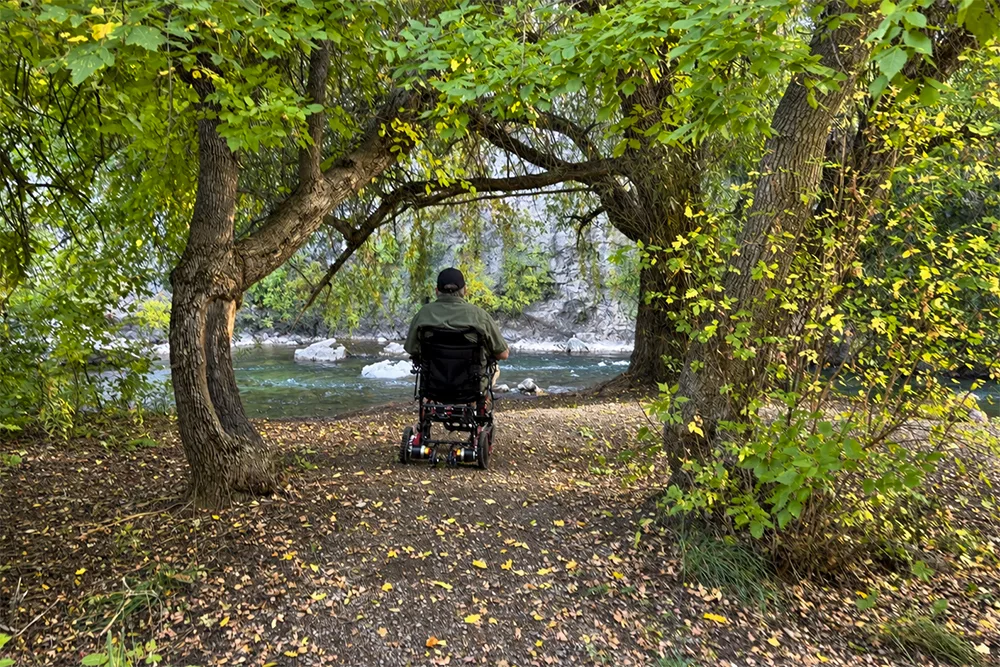
My wife always goes first. Before anything comes out of the van, she walks the path ahead at Card, the picnic site in Logan Canyon that I would name, if pressed, as my favorite place on the planet. She is looking for ruts and roots and anything a wheel could catch on. When she is satisfied, she comes back and opens the van. Lilith, my wheelchair, rides behind a small crowd of necessary things, and the crowd has to come out before the chair can. Once Lilith is on the ground, everything else goes back in. Then I come out, the most necessary thing in the van and the slowest to unload.
What follows is a procession, though nobody at the next table would call it that. A woman clears the way, and a man rolls behind her at about the speed of a hymn, down a path to the water. We are going to the river. We are going to my trees.
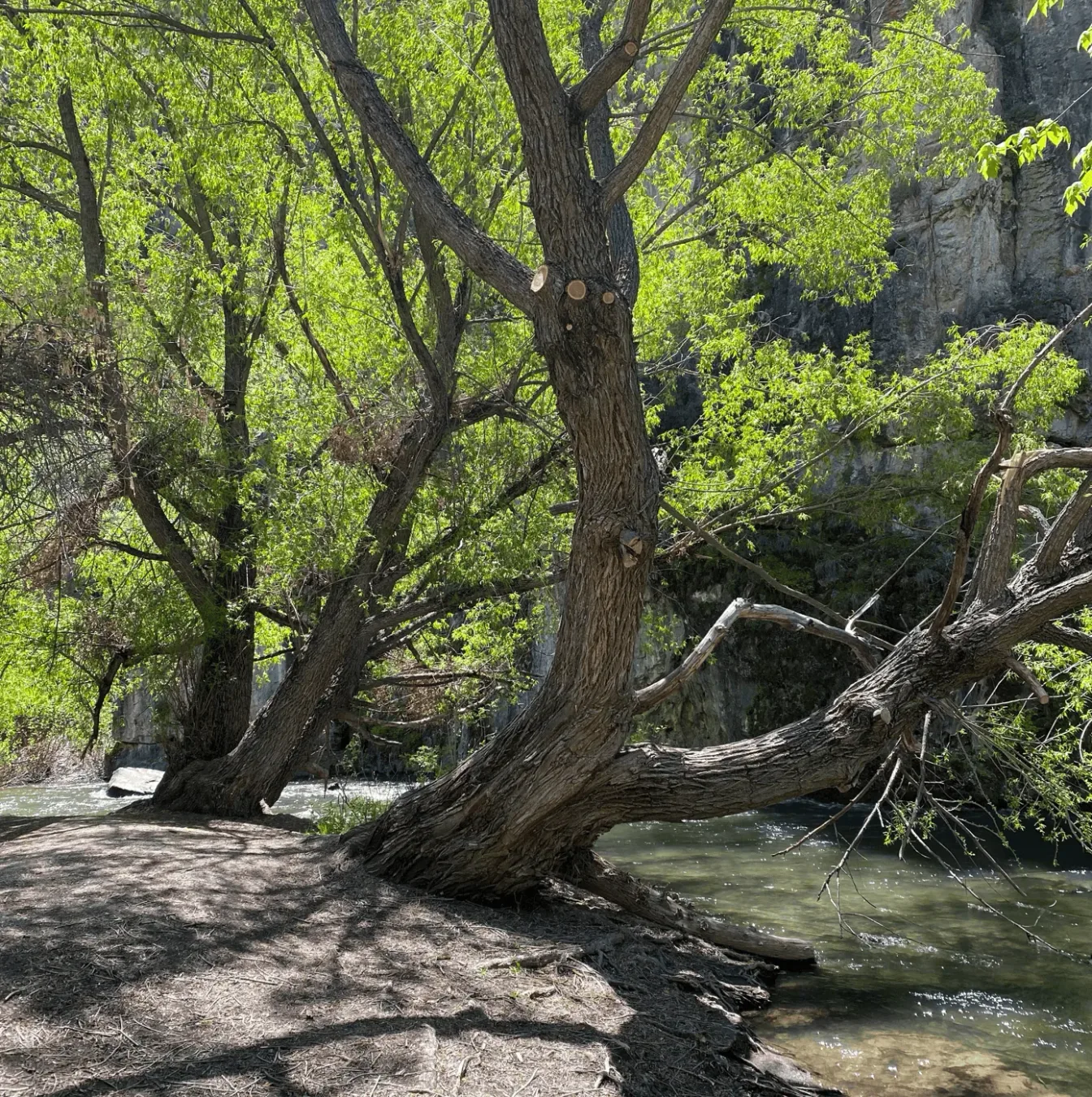
There are two of them, old ones, standing on the bank where the river bends around them as though it had been asked to. One of them reaches a mighty limb out over the water. In June 1981 my parents brought our little family up the canyon, and I sat out on that limb while the river went by beneath me. Card has been a sanctuary to me ever since. I carry it around the way other men carry a photograph of home. Thomas Traherne, remembering his own boyhood, wrote that “the corn was orient and immortal wheat, which never should be reaped, nor was ever sown.”¹ That is how the canyon looked from the limb. On a good afternoon it still does.

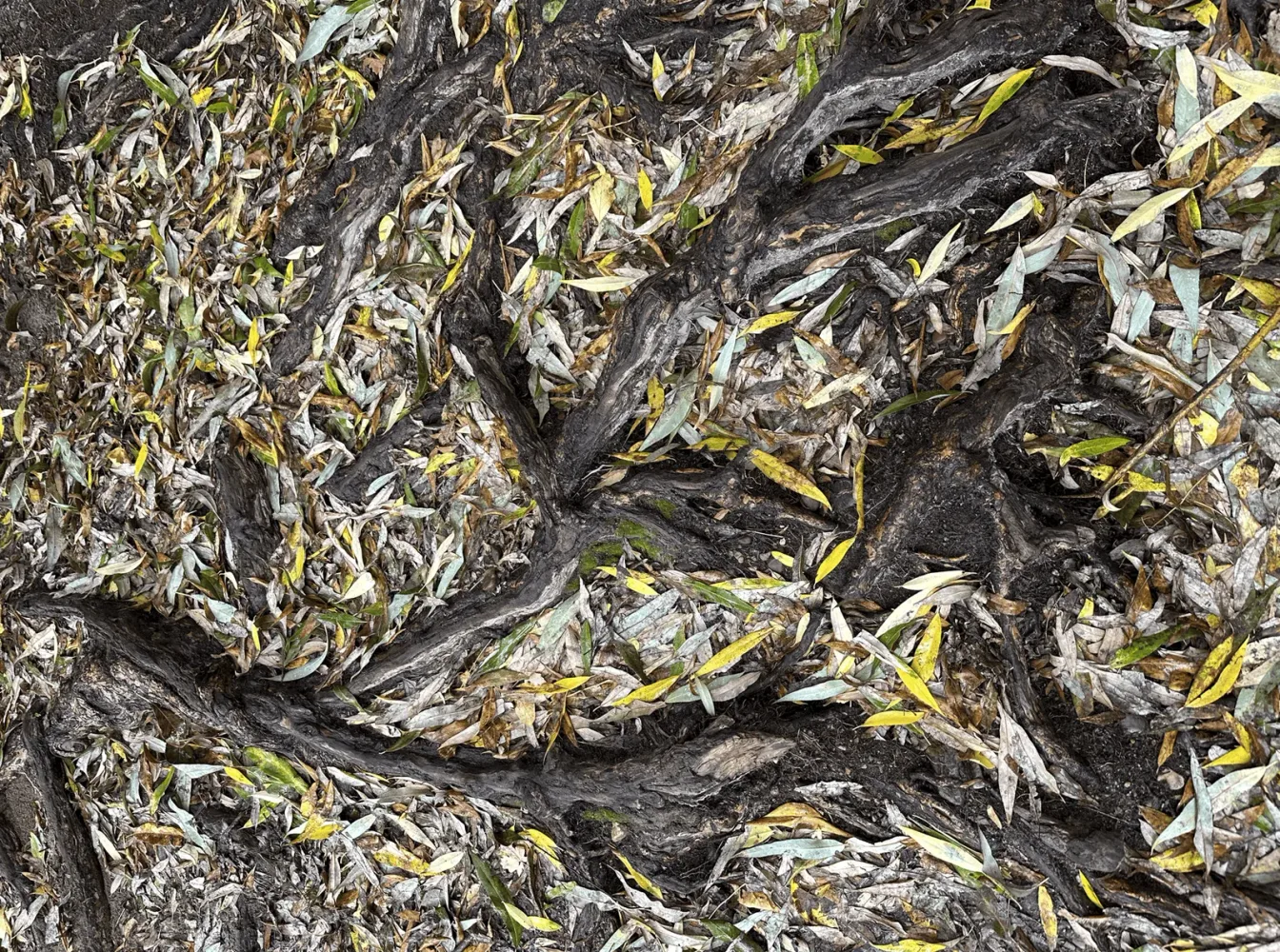
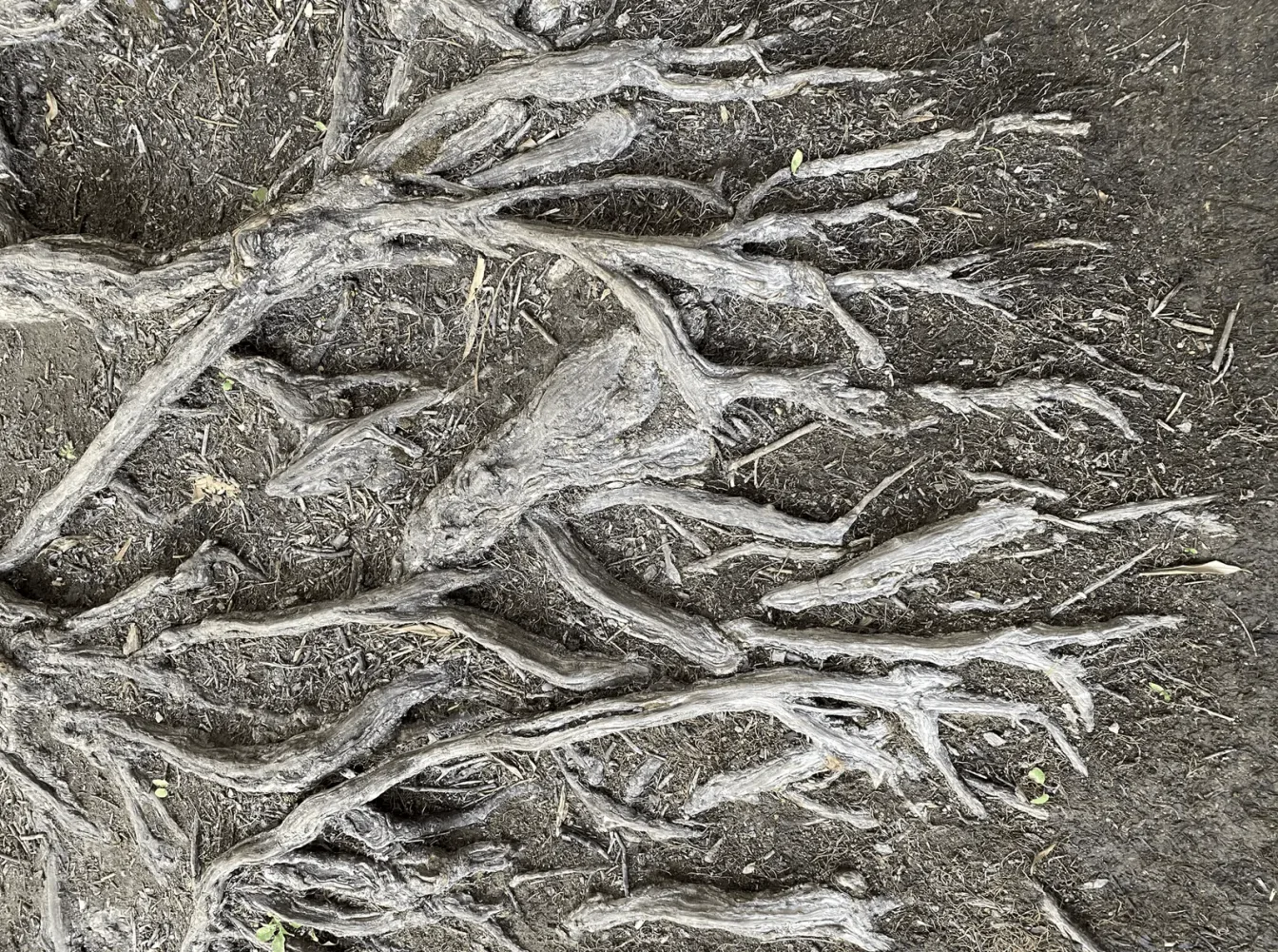
For years I kept a small tradition with those trees. I would get down close and photograph their roots where they spread from the base of the trunk, bare to the air, the great knuckled grip of them still holding the ground, like a hand that has held on for a century and sees no reason to let go. I can’t do that now. I can’t get out of the chair, and I can’t put a hand in the river to feel the cold of it. So I sit. The river goes by. A breeze comes through the canyon and finds me, and I let it.
After a while the whole business runs in reverse. Things come out of the van again so that Lilith can go in, and then they go back to where they ride. Gerard Manley Hopkins once watched a plow at work and saw what the dragging does to the blade: “shéer plód makes plough down sillion / Shine.”² Steel gets its polish from the dirt. I have watched my wife at her plodding long enough to know where the shine comes from.
The Efficient Question
It was there, with the breeze on my face, that the question arrived. Couldn’t I do this anywhere? There are breezes all up and down the canyon. There are breezes outside the canyon, in the parking lot of the grocery store and on my own driveway at home. Why put a woman through all that lifting so that I can sit in a chair here instead of a chair there? The driveway offers the same sitting with considerably less lifting. What has the canyon got that the driveway hasn’t?
Behind that question stood a darker one. It isn’t as though I can take it with me. If death is the end of a man, then Card goes dark with me, and the river and the trees and the breeze go dark along with it. And if the whole affair is really for the people who come with me, the question only changes its address.
The question has a respectable pedigree. It belongs to every careful man who has ever stood at the edge of something lavish, done the arithmetic, and got the sum right and the answer wrong.
A House in Bethany
It was asked once in a house in Bethany. A woman broke an alabaster box of ointment and poured it on the head of Jesus, and the disciples were indignant. “To what purpose is this waste?” (Matthew 26:8). By their lights they had a point. Mark tells us the ointment could have fetched more than three hundred pence for the poor (Mark 14:5). Any sensible man could see that a little oil from the kitchen would have done, provided the object was merely to get oil onto a head.
The Lord’s defense of her sounds like no accounting at all. “She hath done what she could: she is come aforehand to anoint my body to the burying” (Mark 14:8). What they called waste was how her love became visible. A body bound for the tomb was being treated as precious when the accountants could see little future in it. Then He added a promise that ought to stop every one of us who wonders whether anything done for a dying man will be remembered. Wherever the gospel is preached, He said, what she had done would be told as a memorial of her (Mark 14:9). John remembers that “the house was filled with the odour of the ointment” (John 12:3). The scent would have lingered a few days and then faded. The deed has outlasted the empire that crucified Him.
Extravagance did not start in Bethany. A ditch would have carried the snowmelt out of those mountains well enough. God cut a canyon instead and lined it with trees and bent a river around two of them, and He has told us why. The things of the earth are made “both to please the eye and to gladden the heart … for taste and for smell” (Doctrine and Covenants 59:18-19). For smell. The Maker of worlds keeps a line in His ledger for perfume, and nobody who has stood on that bank has ever accused Him of thrift.
I think my wife is the woman at Bethany. I don’t mean it as flattery, and she would wave it off anyway and go back to the van. The likeness holds at the one point where it matters. She spends her strength on a body that will not keep, getting me to a river when a driveway would satisfy every requirement except the reason for going. And the efficient voice in me asks what was asked at that table. John is blunt about whose voice it was. It belonged to the disciple who “had the bag” (John 12:6), and I have no wish to keep his books.
Heaven is a place, and the revelations give it an address. But it is more truly a state, and I mean the word the way a neurologist means it when he asks after mine. A state of being. The chalkboard diagrams of a thousand Sunday School lessons, all circles and arrows, have taught a good many of us to picture heaven as geography. Read section 76 again and you find a gallery of portraits where you expected a map. “They are they who received the testimony of Jesus” (Doctrine and Covenants 76:51), and on it goes, one description after another of the kind of people they are. Kingdoms are made of people. “Where” is the smaller question.
Amulek put it about as plainly as it can be put: “that same spirit which doth possess your bodies at the time that ye go out of this life, that same spirit will have power to possess your body in that eternal world” (Alma 34:34). So I had it backwards on the bank. What I am when I leave is what I take with me, and Card has had forty-five years to work its way into what I am.
At first that seems to cut against me. If heaven is chiefly a state, why should Card, which is only an address, matter so much?
Julian of Norwich gives the gentlest answer I know. She was shown “a little thing, the quantity of an hazel-nut,” lying in the palm of her hand, and was told that it was all that is made. She marveled that anything so small could keep from falling into nothing, and the answer came: “It lasteth, and ever shall [last] for that God loveth it.”³ Card lasts for the same reason. So does the river, and so do the trees, and so, I am told, do I. On Julian’s showing, every place is held up by love before anybody ever spreads a picnic in it.
Places matter the way an old armchair matters, for the shape a life has worn into them. Card was already a sanctuary when I could climb out on the limb. Now a woman walks the path ahead of me, clears it for a wheelchair, and sits beside me at that water. Love has worn the place deeper. God’s love keeps the canyon in being, and hers has made it ours. That is why here and not the driveway.
And the address the revelations give for heaven is this earth. “The earth abideth the law of a celestial kingdom,” the Lord told Joseph Smith, and then He gave the earth a prognosis I know rather well: “notwithstanding it shall die, it shall be quickened again” (Doctrine and Covenants 88:25-26). The earth and I share a diagnosis. We also share a promise. The tenth article of faith says this world “will be renewed and receive its paradisiacal glory” (Articles of Faith 1:10). The canyon is a piece of that renewed world with the scaffolding still up, and when I sit at Card I am sitting on part of the inheritance.
Whether Heaven Remembers a Canyon
That leaves the rest of the darker question. Will I remember any of it?
Joseph Smith gave an unusually homely answer. “That same sociality which exists among us here will exist among us there,” he taught, “only it will be coupled with eternal glory” (Doctrine and Covenants 130:2). Heaven, on that telling, is the afternoon at Card with the glory switched on. The sociality is the same sociality. The woman is the same woman. Nobody is going to introduce us.
C.S. Lewis went further, and I think he went in the right direction. In The Great Divorce, George MacDonald, appearing as the narrator’s guide, tells him that mortals misunderstand eternity because they suppose some earthly suffering can never be made up for, “not knowing that Heaven, once attained, will work backwards and turn even that agony into a glory.”⁴ The saved, he says, will look back and find they have never lived anywhere but in heaven. I don’t press a novelist’s dream into doctrine. I only notice that the key fits a lock the Restoration had already shown us. If heaven works backwards, then Card is one of the places it will reach back and claim.
And the people who come with me are laying up treasure on the same bank, the one where moth and rust do not corrupt. Whatever we keep of that river, we keep together.
The Breeze
The breeze could have found me anywhere. That is the nature of wind, as the Lord told Nicodemus. It “bloweth where it listeth” and nobody can say where it comes from or where it goes (John 3:8). I have noticed, all the same, that it keeps coming to Card.
Dante closed the whole of his Comedy on one line about what moves the world, l’amor che move il sole e l’altre stelle, “the Love that moves the sun and the other stars.”⁵ Modern revelation says much the same thing in plainer English. “The earth rolls upon her wings,” the Lord told Joseph Smith, and the stars roll upon theirs, and “any man who hath seen any or the least of these hath seen God moving in his majesty and power” (Doctrine and Covenants 88:45, 47). Any or the least. A Love that moves the sun can spare a little of itself for the air in a canyon.
Elder Patrick Kearon learned to fly gliders as a teenager in Oxfordshire, which means he learned to feel for rising air and turn into it. “Your Saviour is your lift,” he told the Church at general conference in October 2026. “He is your ever-rising air.”⁶ When the breeze finds me by the river now, I have quit wondering where it came from. I have a fair idea who sent it.
I used to photograph the roots, the part of a tree that does all the holding and gets none of the admiration. The admiration comes up in October, when the slopes go red and gold and every tree looks like Traherne’s cross, “a tree set on fire with invisible flame.” He knew the name of that fire. He called it Love. So did Nephi, who was asked what his father’s tree meant and already knew: “it is the love of God, which sheddeth itself abroad in the hearts of the children of men” (1 Nephi 11:22). Traherne also called that cross “the root of happiness,”⁷ and I think he had hold of the right end of the tree. The roots stay down in the bank through all of it, bare to the weather, and keep the whole tree from going down the river.
Some afternoon I expect to walk that path on my own legs, ahead of her for once. She will have nothing to carry. I will get down on the bank with a camera and take my pictures, and I already know that the first roots I photograph will not belong to a tree.
Notes
- Thomas Traherne, Centuries of Meditations, Third Century, sec. 3, Christian Classics Ethereal Library, accessed October 12, 2026, online text.
- Gerard Manley Hopkins, “The Windhover,” lines 12–13, Poetry Foundation, accessed October 12, 2026, https://www.poetryfoundation.org/poems/44402/the-windhover.
- Julian of Norwich, Revelations of Divine Love, ed. Grace Warrack (London: Methuen, 1901), chap. 5, Project Gutenberg, accessed October 12, 2026, https://www.gutenberg.org/files/52958/52958-h/52958-h.htm.
- C. S. Lewis, The Great Divorce (New York: HarperOne, 2015), 69.
- Dante Alighieri, Paradise, trans. Anthony Esolen (New York: Modern Library, 2007), canto 33, line 145.
- Patrick Kearon, “Jesus Lives to Lift,” general conference, October 3, 2026, https://www.churchofjesuschrist.org/study/general-conference/2026/10/27kearon.
- Traherne, Centuries of Meditations, First Century, secs. 60, 58.