The Revenge Cycle: Are You Getting Even Without Knowing It?

 When we hear the word revenge, we tend to picture something dramatic. Someone has been terribly wronged and sets out to destroy the person who hurt them. Literature and movies are filled with such stories.
But most revenge doesn’t look like The Count of Monte Cristo. It happens in marriages, families, friendships, wards, and workplaces. We gossip about someone who embarrassed us. We withdraw affection from a spouse who disappointed us. We give someone the silent treatment. We make a sarcastic comment designed to sting. We withhold help. We secretly enjoy watching someone who hurt us fail.
We may never call any of this revenge. But perhaps we should.
In Healing the Wounded Heart, I define revenge as the self-appointed pursuit of justice through retaliation. Revenge occurs whenever we intentionally attempt to make someone else experience some measure of the hurt we believe they caused us. In that sense, revenge is the opposite of forgiveness. It is a form of unforgiveness—and we may be practicing it without realizing it.
The Revenge Cycle
Revenge often develops through a three-stage cycle: resentment, resistance, and retaliation.
It begins with resentment. Someone hurts or offends us, legitimately or perhaps only in our perception. We replay what happened. We rehearse imaginary conversations. We think about what they should have done and what we wish we had said. Unlike explosive anger, resentment often burns slowly. It feeds on rumination and our desire for justice.
Then comes resistance. We begin putting up walls. We avoid the person, stop communicating, withhold warmth, or emotionally withdraw. Resistance can feel entirely justified: After what they did to me, why should I be nice to them?
Finally comes retaliation. We want them to feel something of what we felt. Retaliation can be obvious, but more often it is subtle. The telltale thought is: Now they’ll know how it feels. Or perhaps: Serves them right.
Unfortunately, retaliation usually gives the other person a new grievance against us. They become resentful. They resist. Eventually, they retaliate. And the revenge cycle begins again.
President Gordon B. Hinckley warned about precisely this tendency: “Let us bind up the wounds—oh, the many wounds that have been caused by cutting words, by stubbornly cultivated grievances, by scheming plans to ‘get even’ with those who may have wronged us.” He then acknowledged something important: “We all have a little of this spirit of revenge in us.”
That is worth pondering. Revenge is not merely something violent or vindictive people do. There may be a little of it in all of us.
“Vengeance Is Mine”
The Lord could hardly be clearer about who is responsible for ultimately settling the score. Paul taught, “Dearly beloved, avenge not yourselves, but rather give place unto wrath: for it is written, Vengeance is mine; I will repay, saith the Lord” (Romans 12:19).
Notice that the Lord does not say there will be no justice. He says that justice belongs to Him.
There is an enormous difference between human revenge and God’s vengeance. Human revenge is a counterfeit of divine justice. When we take revenge, we appoint ourselves judge, jury, and sometimes executioner, despite possessing only a fraction of the information God possesses.
The difference becomes clearer when we place the two side by side:
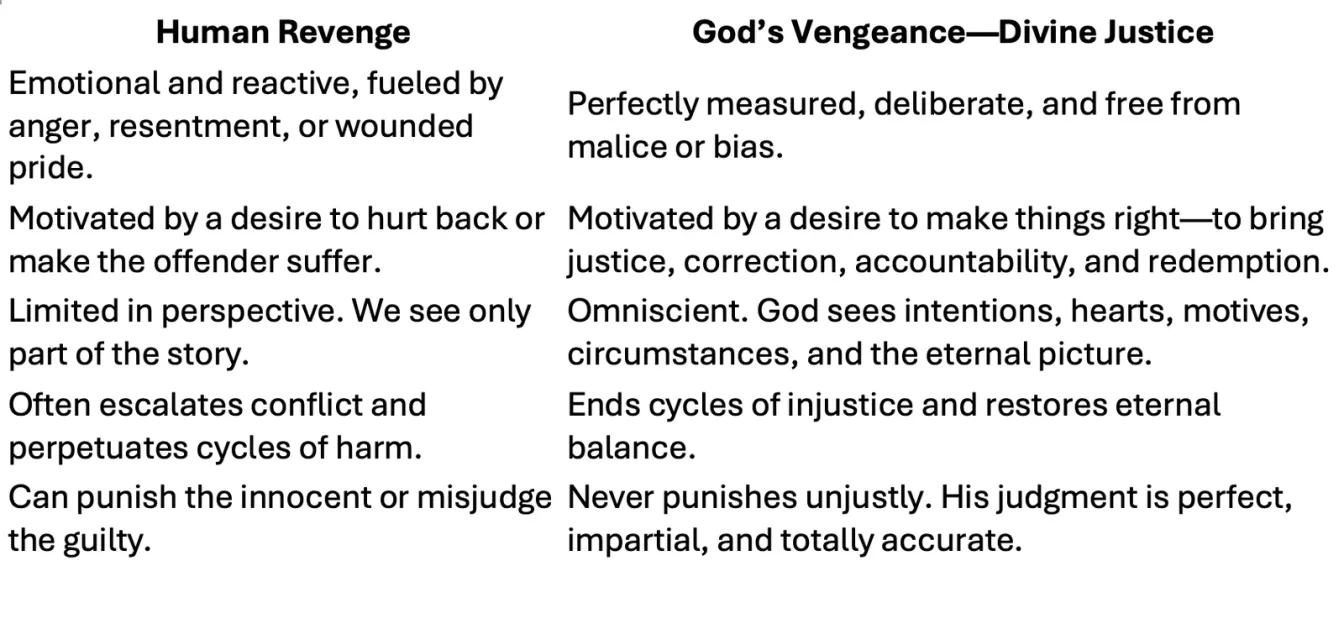 This helps explain why the Lord reserves vengeance to Himself. The issue is not that wrongdoing should go unanswered. It is that we are simply not qualified to administer perfect justice.
When we take revenge, we assume a role that belongs to God. In effect, we say, I do not trust that You will make this right—or at least not in the way or on the timetable I think you should.
Forgiveness requires something very different. It requires enough faith in Jesus Christ to surrender our claim to personal vengeance and trust that no wrong escapes His notice. Our responsibility is to forgive. His responsibility is to judge.
Seven Ways We Get Revenge Without Calling It Revenge
The problem is that most of us aren’t plotting some elaborate scheme of vengeance. Revenge usually shows up in much smaller ways.
One is sabotage. We intentionally create obstacles, withhold help, or undermine someone’s work because we want to make things a little more difficult for them.
Another is gossiping or backbiting. Someone has hurt us, so we tell others about their faults, spread damaging information, or subtly injure their reputation. We may tell ourselves we are simply explaining what happened, when part of us actually wants other people to think less of them.
A third is relational withdrawal. This is particularly common in close relationships. We withhold affection, slow down on things we normally do, or conveniently “forget” an important commitment as a way of expressing displeasure or punishing the other person.
A fourth is the silent treatment. We stop communicating or deliberately become distant so the other person will feel our hurt—and perhaps regret what they did.
A fifth is passive-aggressive behavior. A sarcastic jab, a backhanded compliment, an intentionally unenthusiastic response—small actions that allow us to punish someone while maintaining plausible deniability.
A sixth is passive resistance. We withdraw effort and do only the bare minimum. At work, this can look like deliberately disengaging or withholding the cooperation someone needs because we resent how we have been treated.
And the seventh may be the most surprising: delaying forgiveness. Sometimes we withhold forgiveness specifically to punish someone. We use time as leverage because we want them to feel guilty, suffer a little longer, or prove how sorry they really are.
The Revenge Paradox
All seven have something in common: we want the other person to pay.
The paradox of revenge is that we think making someone else pay will somehow reduce our pain. But adding another injury to the first one cannot heal either person.
Forgiveness does not mean that what happened was acceptable. It does not eliminate appropriate boundaries, accountability, restitution, or consequences. It simply means that I relinquish my self-appointed role as the one responsible for making you pay.
I turn that responsibility over to the only Being capable of administering perfect justice.
And when I do, the revenge cycle stops with me. Resentment no longer has to become resistance. Resistance no longer has to become retaliation. Retaliation no longer creates another wound that someone else feels compelled to avenge.
Getting even never really makes us even. Forgiveness does something far better than settling the score—it puts us ahead, freeing us to move forward while revenge keeps us tied to the past.