Trust and Climate-Smart Agriculture Scaling Depend More on Neighbors Than Institutions, Study Finds
Happy Eco News Trust and Climate-Smart Agriculture Scaling Depend More on Neighbors Than Institutions, Study Finds
Reading Time: 3 minutesA study of 514 Central American farmers found that trust and climate-smart agriculture scaling are closely linked, with relationships with neighbors mattering more than trust in outside organizations.
Trust and climate-smart agriculture scaling have long been treated as separate concerns, one social, one technical. New research published in Agricultural Systems directly challenges that separation, showing that farmer-to-farmer relationships shape whether climate innovations spread at all, regardless of how well-designed they are on paper.
Researchers from the Alliance of Bioversity International and CIAT, the University of Copenhagen, and the Gates Foundation analyzed data from 514 smallholder farmers participating in Climate-Smart Villages, known locally as Territorios Sostenibles Adaptados al Clima, across Guatemala and Honduras. The study examined how different dimensions of social capital influence knowledge sharing about climate-smart practices, and what that process reveals about the earliest stages of responsible scaling.
The findings reframe how funders and policymakers should evaluate trust and the scaling of climate-smart agriculture. Success is traditionally measured only after an innovation has already reached large numbers of adopters. This study instead focuses on an earlier moment: when farmers first share experiences, discuss new practices, raise questions, and learn from one another, long before adoption becomes visible at any meaningful scale.
Trust among farmers emerged as the single most consistent factor enabling knowledge sharing. When farmers trust one another, they are much more likely to share experiences, discuss new practices, and learn from each other’s successes and failures. Close relationships among farmers further strengthen these learning networks, making it easier for knowledge and hands-on experience to circulate freely within a community rather than remaining isolated within individual households.
Perhaps the study’s most striking finding for trust and scaling climate-smart agriculture is the role of mutual support. Researchers found that support between farmers becomes especially critical in communities where trust remains low. In these lower-trust environments, guidance, collaboration, and the exchange of practical experience help sustain knowledge flows that trust alone would otherwise fail to carry. Mutual support effectively functions as a backup mechanism, compensating for weaker social bonds that might otherwise block information sharing entirely.
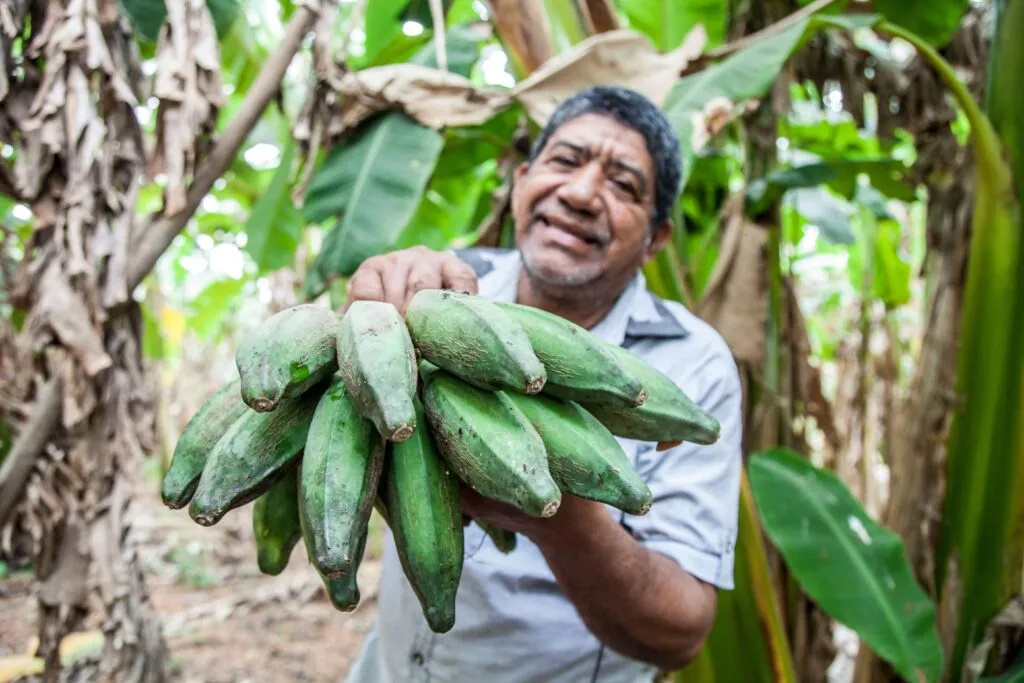
Trust and climate-smart agriculture scaling depend heavily on mutual support in low-trust communities, where researchers found that guidance and collaboration between farmers help sustain the flow of knowledge that institutional trust alone fails to provide. Photo by Frank Meriño on Pexels.
By contrast, the research found that trust in formal organizations, whether government agencies, NGOs, or research institutions, carried notably less influence than trust built directly among farmers themselves. This distinction matters enormously for how development programs are typically designed, since many climate-smart agriculture initiatives invest heavily in institutional credibility and extension services while underinvesting in the peer networks that this study identifies as more decisive.
Researchers also found a positive association between adopting climate-smart practices and knowledge sharing, reinforcing that these two processes reinforce each other rather than operating independently. A farmer observing a neighbor successfully implementing a drought-coping technique, discussing the results, adapting that practice to their own land’s specific conditions, and later sharing their experience with others exemplifies the kind of organic circulation of trust and climate-smart agriculture scaling research seeks to capture and understand.
These findings carry direct implications for how governments, development organizations, and innovation programs design their interventions. The evidence suggests development organizations need to place social dynamics at the center of scaling strategies rather than treating community relationships as secondary to technical training and resource distribution. Programs that invest in building trust and facilitating informal peer networks, rather than relying solely on top-down institutional messaging, appear better positioned to achieve the kind of local ownership that sustains results over time.
Trust and climate-smart agriculture scaling research also supports what the study authors describe as a responsible scaling approach, one that anticipates and manages unintended consequences before they emerge rather than addressing problems only after widespread adoption has already occurred. Understanding how knowledge circulates among farmers before adoption becomes visible allows program designers to build strategies that are more inclusive, more context-sensitive, and more attuned to the specific social fabric of the communities they aim to serve.
As agrifood systems worldwide face mounting pressure to accelerate climate adaptation, this research corrects purely technical approaches to scaling innovation. The impact of any climate-smart agricultural practice depends not only on its scientific merit, but equally on farmers’ capacity to share knowledge, learn collaboratively, and build the relationships of trust that let that knowledge travel organically through a community, often well before any formal program measures success.