Shared grid connections could improve bankability of residential solar-plus-storage systems
A research team in the Netherlands has developed an optimization model for sizing and operating battery storage systems in solar-powered apartment buildings, finding that shared grid connections could significantly improve the economics of energy storage.
“Our study uses real operational data from a 58-apartment building in Utrecht to investigate how battery storage can improve solar self-consumption and reduce grid peaks,” corresponding author Simone Coccato told pv magazine. “A key contribution is showing how grid connection configurations and network tariffs can significantly influence the economic value of batteries.”
Coccato said the team is now extending its research to clusters of residential buildings operating as virtual power plants (VPPs). “We are investigating how coordinated batteries can reduce grid congestion, improve renewable energy integration, and provide flexibility to electricity markets,” he said.
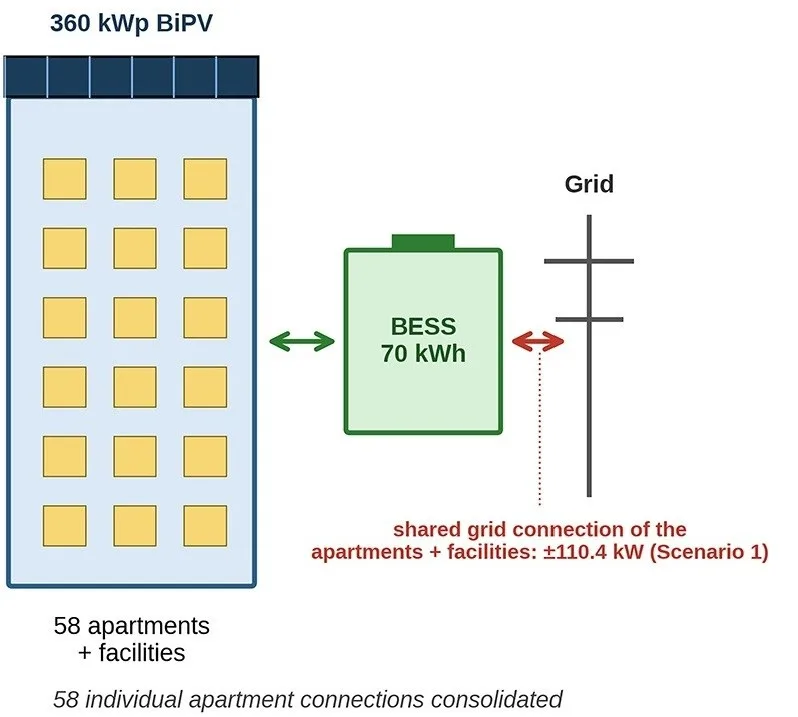
The researchers tested the model on an apartment building equipped with 356.6 kW of rooftop and building-integrated facade PV capacity and 70 kWh of battery storage.
The case study focused on a 10-story, 58-apartment building constructed in Utrecht in the 1970s and renovated to a positive-energy standard between 2019 and 2020. In 2022, the building consumed 200 MWh of electricity and generated 255 MWh from its PV systems. Its two 35 kWh batteries currently serve shared facilities, including heat pumps, elevators and common utilities, while each apartment retains an individual grid connection.
The researchers examined two scenarios: a hypothetical configuration in which the apartments and shared facilities operate under a single grid connection with import and export limits of 110.4 kW, allowing the batteries to serve the entire building; and the existing configuration, in which storage serves only shared facilities.
Using a full year of measured data, the team developed a linear programming optimization model to evaluate battery capacities of up to 500 kWh under three operating strategies: minimizing peak grid imports, maximizing PV self-consumption and combining both objectives.
“We found that a relatively small 70 kWh battery could eliminate 122 hours of grid export-limit violations under a hypothetical shared-connection scenario, enabling potential savings of over €20,000 ($22,154) annually in grid connection costs,” Coccato said. “Interestingly, optimizing the existing battery operation could also increase solar self-consumption by more than 15 percentage points compared with its default control strategy.”
The results showed that, under the hypothetical shared-connection scenario, the economically optimal battery capacity was approximately 280 kWh, delivering a net annual benefit of €32,829 (36.318,89) and a payback period of 1.7 years. The existing 70 kWh system achieved a modeled net annual benefit of €25,297 and a payback period of approximately 0.55 years.
The researchers presented their findings in “Unlocking flexibility in buildings through batteries: a case study of the Netherlands,” published in Applied Energy. The research team included scientists from the Netherlands’ Utrecht University and building energy systems developer Inside Out Technologies.
The post Shared grid connections could improve bankability of residential solar-plus-storage systems appeared first on pv magazine Global.