Life with ALS: Envy Is a Verb
The Birthday
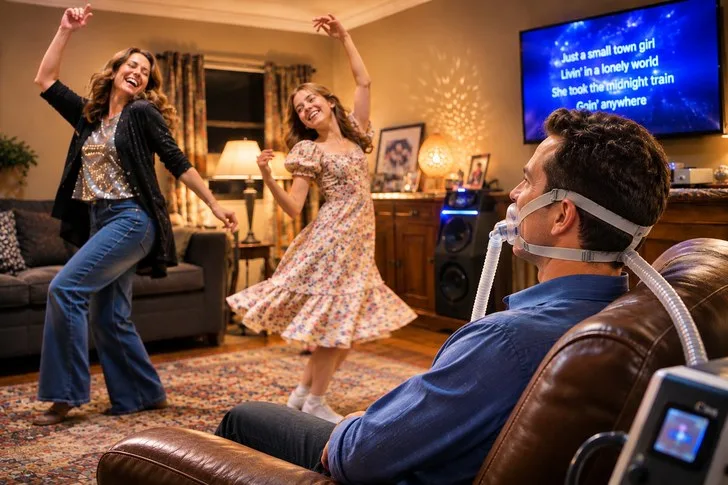
My daughter’s birthday ran long. Somewhere after the cake, and well past any reasonable hour, my wife and daughter found the karaoke and decided the night was young. It was not young. They refused to be told. They sang song after song, and they danced across the living room carpet while they sang, and they laughed whenever a high note got away from them. I have rarely seen two people more adorable or harder to wear out. The house was full of noise and lamplight and the sort of silliness that waits until everyone is too tired to be dignified.
ALS has been taking me apart for some time now, a little at a time.
ALS has been taking me apart for some time now, a little at a time, so I was in the recliner, where I generally am, with Luisa, my ventilator, strapped to my face. Anything that spends that much time on my face has earned a name. Leonardo, my walker, waited in his corner. I held my phone up and filmed the whole thing, and I took pictures between the songs. Somebody has to keep the record, and the record keeper is the one job at a party that requires no legs.
It was a happy night. I want that on the record too. But under the happiness ran a longing I couldn’t talk myself out of. I wanted to put the phone down and be in the dance. I wanted to get up out of that chair and take my wife by the hand and murder a song in front of my daughter. I wanted to sing badly at the top of my lungs, and my lungs have other plans.
Useless Things
Consider what they were doing, because it is the most gloriously useless thing a human body can do. Dancing gets nobody anywhere. A dancer crosses the room only to cross it back. Singing moves no furniture and fills no pantry. And karaoke raises uselessness to a fine art: two amateurs imitating professionals who already recorded the song properly, with the words supplied on a screen in case anyone forgets them. Nothing was produced in my living room that night. Nobody was fed or paid or improved. If you had asked my wife and daughter what it was for, they would have looked at you as though you had asked what a birthday is for.
A dancing body is a body with nothing to earn, and Joseph Smith made such a body a condition of happiness itself.
Useful things are servants. They get us to the meal, the paycheck, the roof over our heads. But some things are too important to be useful. They are what all the useful things were for. A dancing body is a body with nothing to earn, and Joseph Smith made such a body a condition of happiness itself. “The great principle of happiness,” he taught, “consists in having a body.” Then he explained, in a single sentence, why the devil is such poor company: “The devil has no body, and herein is his punishment.”1 The devil, who can never dance, was by long tradition the first to envy (Wisdom of Solomon 2:24). My daughter dancing on her birthday may look like a girl playing hooky from heaven. To my eye she is rehearsing the resurrection.
The Lord seems to count a merry body as one of the ways we pray.
The Lord has said as much in a revelation. In January of 1847, with the Saints wintering at Winter Quarters on the Missouri River and the trail west still ahead of them, the word of the Lord came through Brigham Young: “If thou art merry, praise the Lord with singing, with music, with dancing, and with a prayer of praise and thanksgiving” (Doctrine and Covenants 136:28). Those were refugees in the cold, and the Lord told them to dance. David had known it long before, when he “danced before the Lord with all his might” (2 Samuel 6:14) in a linen ephod and did not care who saw. The Lord seems to count a merry body as one of the ways we pray.
The Evil Eye
Two different things can go on in a man in that chair, and from across the room they look exactly alike.
The first was an ache. A man who once crossed rooms without a thought watches two women he loves dance across his carpet, and something in him longs for his legs and his breath. That longing was honest. It came the way a bruise comes, without asking permission. The ache told me what I had lost. Envy would tell me what their joy meant, and that required a second act of seeing.
Envy only poses as a noun. It is a verb, a thing a man does with his eyes.
The second thing was envy, and envy was no bruise. I had met it not long before, in front of the television. Professional dancers were spinning under the lights. The judges were leaping out of their chairs, and I caught myself keeping score. The dancers stopped being people I was enjoying and became people who had something I lacked. Their joy turned into a kind of theft, as though every spin had been taken out of my account. And the strange part was what it did to the evening. It left my legs exactly as they were and made the show worse. It drained the pleasure out of the one thing I could still do, which was to watch and laugh along. Envy only poses as a noun. It is a verb, a thing a man does with his eyes, and I was doing it from my own recliner. When the judges held up their paddles, I found I had been holding up paddles of my own.
The old word knew this. Our English “envy” comes from the Latin invidia, from a verb that meant to look upon someone with malice, to cast an evil eye.2 Envy began as a way of looking. When the laborers who had sweated all day grumbled that the latecomers got the same wage, the householder answered one of them, “Is thine eye evil, because I am good?” (Matthew 20:15). Their wages were untouched. Only their eyes had gone bad. Age will dim any eye in time. These men had dimmed their own. Envy is a chosen blindness, which makes it the one kind of blindness a man can repent of.
C. Terry Warner, who spent a career studying the ways we fool ourselves, would say the blindness comes dressed as sight. In self-deception, he wrote, a person lives a lie: “It is not a lie told with the tongue. It is a lie that is lived with one’s feelings.”3 Envy is that kind of lie. It tells me joy is being rationed and somebody else has been handed my portion. The dancers become thieves simply by dancing. None of it is true, and all of it feels true the moment I start to do it.
Envy tells me joy is being rationed and somebody else has been handed my portion.
On my daughter’s birthday, with the phone up and the music going, I could feel the evening in front of the television trying to happen again. A camera is a machine for looking, but it cannot envy for you. It records the room. The eye behind it decides whether the room is a feast or an indictment. I had the rest of the set list to choose.
Music and Dancing
There is a man in the Gospels who stood exactly where I was sitting. He is the elder brother in the parable of the prodigal son. He had been out in the field, working, and as he “drew nigh to the house, he heard musick and dancing” (Luke 15:25). His wastrel brother had come home, the fatted calf was on the fire and the house was full of noise. Luke gives his response in a single line, “And he was angry, and would not go in” (Luke 15:28), and then leaves him standing in the yard.
Notice what the elder brother kept. He kept his inheritance. The father says so plainly: “all that I have is thine” (Luke 15:31). He kept his record too. “Lo, these many years do I serve thee,” he says, “neither transgressed I at any time thy commandment” (Luke 15:29), and nobody in the story contradicts him. He had every fact right. What he got wrong was his brother. He could count calves and years and commandments. He could not count a brother. He calls him “this thy son” (Luke 15:30), as though the boy belonged to somebody else, and the father hands the word back to him: “this thy brother” (Luke 15:32). The father corrects no arithmetic. He corrects the man doing it.
For as long as Luke tells the story, the party went on without him. The music was playing for him too, and he stood outside in the dark with his arms folded, keeping his ledger, while his own father came out and pleaded with him to come in. His brother had been lost in a far country. He managed it within earshot of the music.
“Who is it that whispers so subtly in our ear that a gift given to another somehow diminishes the blessings we have received?”
President Jeffrey R. Holland once gave a whole conference address to this older son, and he put the question I ought to keep by the recliner. “Who is it that whispers so subtly in our ear that a gift given to another somehow diminishes the blessings we have received?”4 It is the one who has no body to dance with. Hell, on this reading, begins by keeping score at somebody else’s party. Lucifer’s earliest recorded words are a bid for an honor that belonged to another: “wherefore give me thine honor” (Moses 4:1). He wanted what was another’s before there was a world to want it in.
In the same discourse in which Joseph Smith said the devil has no body, he turned to the herd of swine in the Gospels (Mark 5:12–13). When the Savior cast the devils out of a man, they begged to be sent into the pigs, and Joseph read the request plainly: the devil “would prefer a swine’s body to having none.”5 Envy that began by demanding God’s honor ends by begging for a pig. As I see it, a man with a failing body who resents the healthy ones dancing in front of him is being offered a small share in the devil’s own sin. The danger in that chair lay in turning their legs into evidence against them. My wife and daughter had not taken a single step away from me. The only thing between me and that music was a door, and it was locked from my side.
The Second Terrace
Dante put the envious on the second terrace of his Mount Purgatory, and their penance fits the sin with terrible exactness. Because they used their eyes to look at others with malice, their eyelids are stitched shut with iron wire, the way a falconer once seeled the eyes of a wild hawk to tame it. They sit in coarse cloaks against the rock, blind, and each one leans on the shoulder of the next, like beggars at a church door. The men and women who once could not bear another’s good now cannot sit up without another’s help. Dante does not exempt himself. He tells one of the penitents that his own eyes will be sewn shut on this terrace after he dies, though only briefly, since he has envied little. The terrace below, where the proud bend under their stones, is the one he dreads.6
In the needing they are healed of the eye that resented every gift that went to somebody else.
I read that canto differently now. I spend my days leaning on other people’s shoulders, and by now I am something of a connoisseur. But Dante’s picture tells me what the leaning is for. The envious had spent their lives measuring themselves against their neighbors. Dante makes them lean on those neighbors instead. In the needing they are healed of the eye that resented every gift that went to somebody else. The wire only makes visible what they had already done to themselves. Every excuse they made for resenting another’s good was a stitch. Their blindness is a school for the eyes.
And the first thing Dante hears on that terrace is a voice passing overhead with three Latin words, Vinum non habent. They have no wine.7 It is the mother of Jesus at Cana. She noticed that someone else’s wedding feast was about to run dry, and she cared enough to say so (John 2:3). The envious could never bear to see another’s cup run over. Their first lesson is a woman who could not bear to see another’s cup run dry.
That is the opposite of envy, and it too is a way of looking. Mary looked at the bride and groom as people whose joy mattered, and the wine came along behind.
Going In
The elder brother had two good legs and would not go in. I have no legs worth mentioning, and I can. Going in was always a matter of where a man sets his eyes, and the eyes are about the last thing this disease will take from me.
Somewhere in the middle of the set list I felt the old arithmetic start up, the quiet tally of everything they could do and I could not. Then I remembered “Careless Whisper.”
It has been a running joke in our family for years that I cannot sing George Michael’s “Careless Whisper” with even a shred of dignity. My wife and daughters have heard me try, more than once and against their will. I sound less like George Michael than like a smoke alarm going through a breakup, and the saxophone part is a crime I decline to describe. Nobody in my house has ever needed me to hit that note. They loved the attempt. Half the joy of a family karaoke night is somebody failing magnificently, and for years that somebody was me. Their laughter at my wrecked high notes was a shoulder of the kind Dante’s penitents lend one another, and I had leaned on it longer than I knew. My wife and daughter were not taking my place at that party. They were keeping it warm.
“Rejoice with them that do rejoice.”
So the ledger closed. I kept filming, but what I was filming had changed. Two women who had something I lacked became two guests at a feast I was invited to. Paul’s counsel turned out to be plain enough to follow from a recliner, late at night, with a phone in my hand: “Rejoice with them that do rejoice” (Romans 12:15). I laughed at the high notes they missed and cheered the ones they landed. Years from now they can watch themselves on that carpet and remember how young the night was.
I don’t pretend the ache is gone. I still miss crossing a room, and I miss singing, badly and at full volume. But the ache is a feeling, and I can carry a feeling. Envy came dressed as one and made it heavy. Envy was my doing.
Mourning into Dancing
The Psalmist sang of a God who turns mourning into dancing (Psalm 30:11), and I believe Him on that point more than I did when my legs still worked. The resurrection will hand me back my legs and my lungs. Joseph’s “great principle of happiness” will then be more than a principle to me. It will have feet. That is the one gift the devil can never get, not even by way of a pig.
The Psalmist sang of a God who turns mourning into dancing, and I believe Him.
The Lord once told Emma Smith, “My soul delighteth in the song of the heart; yea, the song of the righteous is a prayer unto me” (Doctrine and Covenants 25:12). He said nothing about pitch. I expect there will be music. I expect my wife will be there, and my sons, and both my daughters, in one room with no miles between us. I expect every aunt and cousin and in-law, all of them raised incorruptible and not one of them raised on key. No one will keep a ledger or hold up a paddle. Somebody will find the karaoke. And this time the man behind the camera will set it down, take a full breath of his own and murder “Careless Whisper” in front of everyone he loves.
Notes
1. Joseph Smith, discourse, Nauvoo, Illinois, January 5, 1841, reported by William Clayton, in Andrew F. Ehat and Lyndon W. Cook, eds., The Words of Joseph Smith: The Contemporary Accounts of the Nauvoo Discourses of the Prophet Joseph (Provo, UT: Religious Studies Center, Brigham Young University, 1980), 60; see also Teachings of Presidents of the Church: Joseph Smith (Salt Lake City: The Church of Jesus Christ of Latter-day Saints, 2007), 211, https://www.churchofjesuschrist.org/study/manual/teachings-joseph-smith/chapter-17?lang=eng.2. Douglas Harper, “envy,” Online Etymology Dictionary, accessed October 4, 2026, https://www.etymonline.com/word/envy.3. C. Terry Warner, “Feelings, Self-Deception, and Change,” Issues in Religion and Psychotherapy 8, no. 2 (1982): 22, https://scholarsarchive.byu.edu/irp/vol8/iss2/6/.4. Jeffrey R. Holland, “The Other Prodigal,” Ensign, May 2002, 63, https://www.churchofjesuschrist.org/study/ensign/2002/05/the-other-prodigal?lang=eng.5. Smith, discourse, January 5, 1841, in Ehat and Cook, Words of Joseph Smith, 60.6. Dante Alighieri, Purgatory, trans. Anthony Esolen (New York: Modern Library, 2004), canto 13, lines 58–72 and 133–138.7. Dante, Purgatory 13.29.