A Year In, Networks for Nature is Reconnecting Cheshire’s Wild Spaces
Happy Eco News A Year In, Networks for Nature is Reconnecting Cheshire’s Wild Spaces
Reading Time: 3 minutesChester Zoo’s Networks for Nature community project planted 14,000 trees and restored and created 13 ponds in its first year, putting it well on its way to its five-year goals.
Networks for Nature started with a simple idea. Wildlife does better when habitats connect, and so do communities. One year in, about 8,700 people across northwest Cheshire, England, have put that idea to work.
Chester Zoo launched the project with a £4.4 million grant from The National Lottery Heritage Fund. It covers about 60 square miles, from Ellesmere Port to Chester, and runs through 2028. The Westminster Foundation and individual supporters also help fund it.
The project builds on the zoo’s earlier Nature Recovery Corridor. That effort improved more than 62 hectares for wildlife and engaged over 12,000 people.
Connection is the core of the approach. Small, isolated habitat patches leave plants and animals stranded. Hedgerows, ponds, and green corridors help them move, feed, and breed across a wider area.
Hannah Brooks leads the project as Chester Zoo’s Senior Community Participation and Engagement Manager. She says connectivity is how species grow and thrive. In her view, the project works the same way, relying on landowners, community groups, and individuals working together.
Networks for Nature’s first-year numbers show that cooperation in action. Volunteers and partners planted 14,000 trees and created or restored 13 ponds. They also established or restored 1.6 kilometers of hedgerow.
Those figures put the project well on track. Over the full five years, it aims for 20 ponds and nearly 3,000 meters of hedgerow. In year one, it reached about two-thirds of the pond target and more than half of the hedgerow goal.
Woodland work added nearly 7 hectares of new or improved habitat, roughly the size of 10 soccer fields. Teams also removed 269 tonnes of invasive plants and animals from the water. These species crowd out native wildlife and can choke waterways.
One cleanup stands out. The project cleared 500 cubic meters of illegally dumped rubbish from a single community green space. That is enough to fill about seven large shipping containers.
Each site has its own focus. At Gowy Meadows Nature Reserve near Ellesmere Port, work has improved public access. In Lache, a neglected space called The Backies has reopened as an enhanced community green space.
Along the Shropshire Union Canal, teams have cleared invasive species. The Canal and River Trust is also monitoring water quality there. Meanwhile, The Land Trust is creating a wetland at Countess of Chester Country Park.
Getting people to nature matters as much as restoring it. The project built 1,090 meters of new pathways so residents can reach green spaces more easily. Cheshire West and Chester Council is also planting wildflower meadows and improving five public parks for wildlife.
Local participants did much of the hands-on work, from planting and clearing to laying footpaths. Others joined bug hunts, bird box building, and garden makeovers that brought wildlife closer to home.
Some participants have gone further and trained as Wildlife Champions. They learn practical skills to keep improving outdoor spaces in their own neighborhoods. Brooks sees this long-term local leadership as central to the project’s value.
Young people have played a central role. In year one, 83 young people joined hedgehog awareness campaigns, built bird and bat boxes, and improved allotments. They also completed leadership skills courses, nearly reaching the project’s five-year goal of 90.
Schools are the next big focus for Networks for Nature. The project aims to reach 4,500 students through a year-long program to improve school grounds for wildlife. Local pupils have already joined in through wildlife clubs.
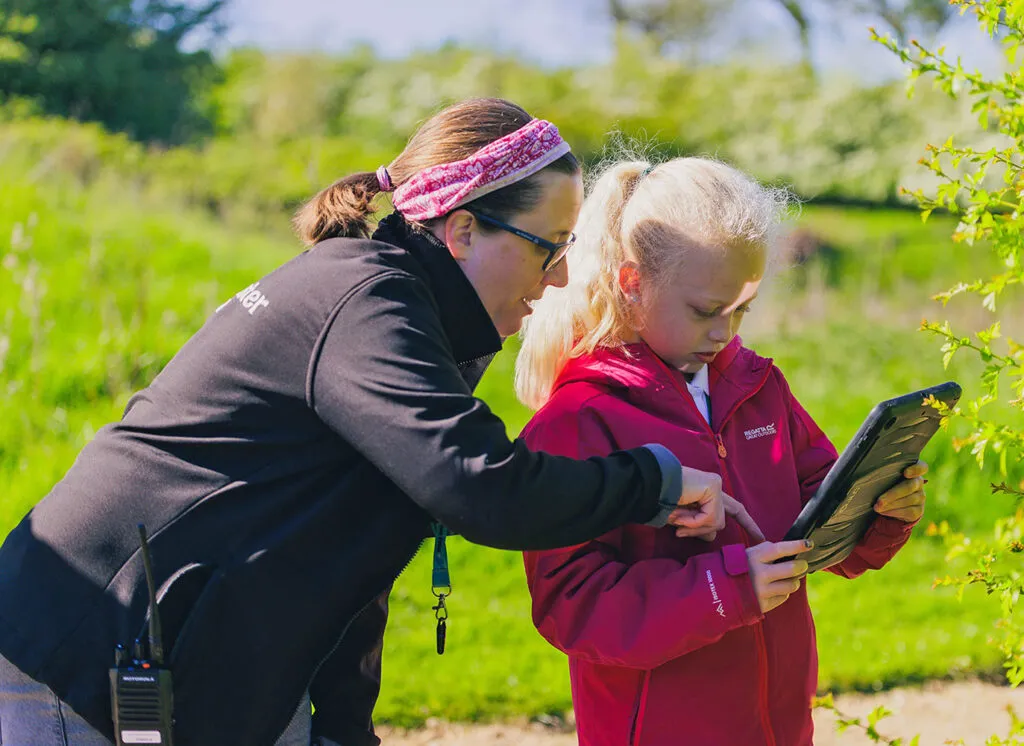
Through Networks for Nature, Sutton Green Primary pupils joined the City Nature Challenge, using tablets to log the plants and animals they found outdoors. Photo courtesy of Chester Zoo.
The project also links nature with health. Through green social prescribing, doctors can refer patients to outdoor, nature-based activities instead of, or alongside, medicine. Western Avenue Medical Centre in Blacon and Great Sutton Medical Centre in Ellesmere Port take part.
Research suggests that time in green spaces can boost mental and physical wellbeing. Restoring parks and ponds close to home makes that benefit easier for residents to reach.
Helen Featherstone, Director, England, North at The National Lottery Heritage Fund, praised the project’s community-led approach. She says it shows how communities and conservation groups can protect natural heritage together for the long term.
Year one has focused on completed work, such as planting trees and restoring ponds. The bigger test will be whether wildlife responds. Ongoing monitoring, including water quality checks on the canal, will help show those results over time.
The first year shows what community involvement adds. Thousands of residents turned a funded plan into trees in the ground, cleaner green spaces, and new local leaders. With four years still to go, Networks for Nature is only beginning to grow.
Schools, community groups, landowners, and volunteers can learn more on Chester Zoo’s Networks for Nature page. Opportunities to train and take part continue to expand.