Sungrow launches C&I storage solution with modular scenario dock and full SiC PCS
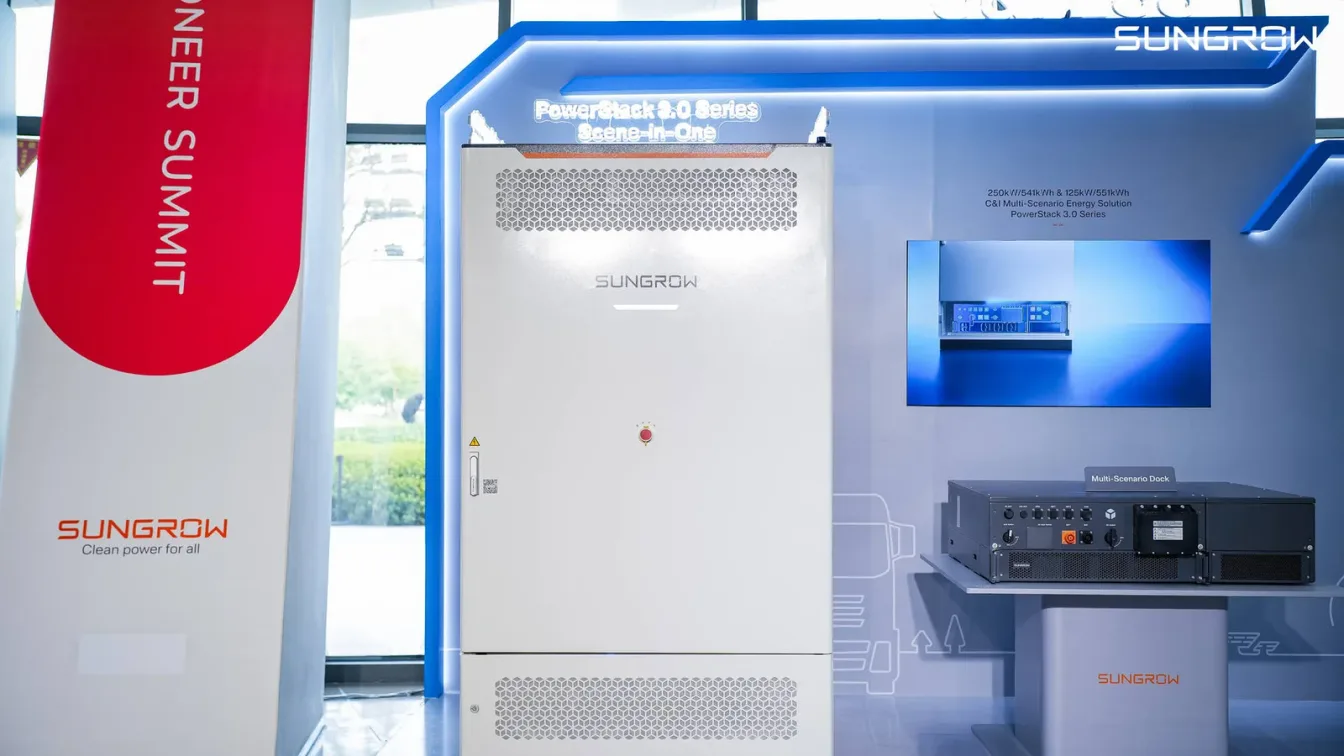
Sungrow launched the PowerStack 3.0 series, its latest commercial and industrial energy storage platform, positioning the product as a shift from standardized physical integration toward what the company calls “scene-in-one” architecture designed to serve pure storage, solar-plus-storage, solar-storage-charging, and microgrid applications from a single hardware base.
The core of the launch is a “1+N=S” design — a standardized main cabinet paired with interchangeable expansion docks — which Sungrow describes as an industry-first approach to C&I storage. In the solar-plus-storage configuration, the company says a single power conversion system can absorb PV power conversion, eliminating the need for a separate PV inverter and supporting twice the rated PV capacity on the DC side. For the microgrid dock, Sungrow claims seamless grid-to-island transition without an external static transfer switch. These specific performance claims come from the manufacturer and have not been independently verified.
On the hardware side, PowerStack 3.0 uses 684 Ah laminated LFP cells, a full silicon carbide power conversion system rated at up to 99.2% peak efficiency, and a stated system round-trip efficiency of at least 92%. Energy density is listed at 256 kWh per square meter, which Sungrow says reduces footprint by 43% compared with conventional solutions. The system carries IP55 enclosure protection and C5 corrosion resistance, operates from −30 C to 50 C, and tolerates up to 30% grid harmonic content — specifications aimed at harsh industrial environments and weak-grid sites. Liquid cooling with AI-driven thermal management is said to cut auxiliary power consumption by 33% versus the previous generation.
The control architecture consolidates what Sungrow previously handled across four layers — energy management, cluster management, and local control — into a two-layer fusion controller. Each cabinet retains independent dispatch capability, with automatic host failover designed to keep the station running if a single unit drops offline. Units can be paralleled from one to 20 to scale from small commercial sites to campus-level installations.
Sungrow has also embedded an AI assistant, branded Bubbly, across the product lifecycle. The company claims the system can generate a site-specific design and revenue forecast in 30 seconds, complete complex scenario commissioning in three minutes, and lift operating revenue by 12% versus a self-consumption baseline through forecast-driven dispatch optimization. These figures are manufacturer projections based on internal modeling rather than field-validated results.
PowerStack 3.0 succeeds the company’s 255CS and 510CS C&I lines, and Sungrow says it is targeting Europe, Asia-Pacific, and the Middle East — regions where C&I storage demand is growing as electricity price volatility, demand-charge management, and behind-the-meter renewable integration drive more complex use cases. The underlying technology — large-format laminated cells, SiC conversion, and liquid cooling — has migrated from Sungrow’s utility-scale PowerTitan platform, reflecting a broader industry pattern of utility-grade hardware moving downstream into distributed applications.
From ESS News
The post Sungrow launches C&I storage solution with modular scenario dock and full SiC PCS appeared first on pv magazine Global.