Why Melissa Dalton-Bradford thinks you should be more political
Melissa Dalton-Bradford traces her civic awakening to walking the streets of Salzburg, Austria, as a teenager in the 1970s. She remembers seeing old women in dark green army coats wearing black bands around their arms. “It was everywhere I went,” she recalled on a September morning over avocado toast at a restaurant in Lehi, Utah.
She later learned that the bands commemorated loved ones who had died in World War II, a visible reminder of the difficult history carried by a generation that had lived through the Nazi era and devastation of war.
I first met Dalton-Bradford and her family on a beach during my honeymoon more than a decade ago. I’d followed her work from afar ever since, but this was the first time we’d sat down together for a conversation.
For much of Dalton-Bradford’s life, her sense of civic responsibility to her home country had unfolded away from it. After studying abroad and serving as a missionary in Austria, she met her husband while teaching German to missionaries in Utah. His work took the family, and eventually their four children, to eight countries, including Austria, Hong Kong, Norway and France. Dalton-Bradford’s longest stay is her latest — it’s the 16th year she’s lived in Frankfurt, Germany.
From there, Dalton-Bradford co-founded two nonprofits, including Mormon Women for Ethical Government, and taught German to Middle Eastern and Ukrainian refugees. But in recent years, with her Instagram account with over 500K followers and her latest book, Dalton-Bradford has reinvented herself as a fierce political voice, speaking out candidly about what she believes are threats to democracy in the current political landscape and inviting people to do something about it.
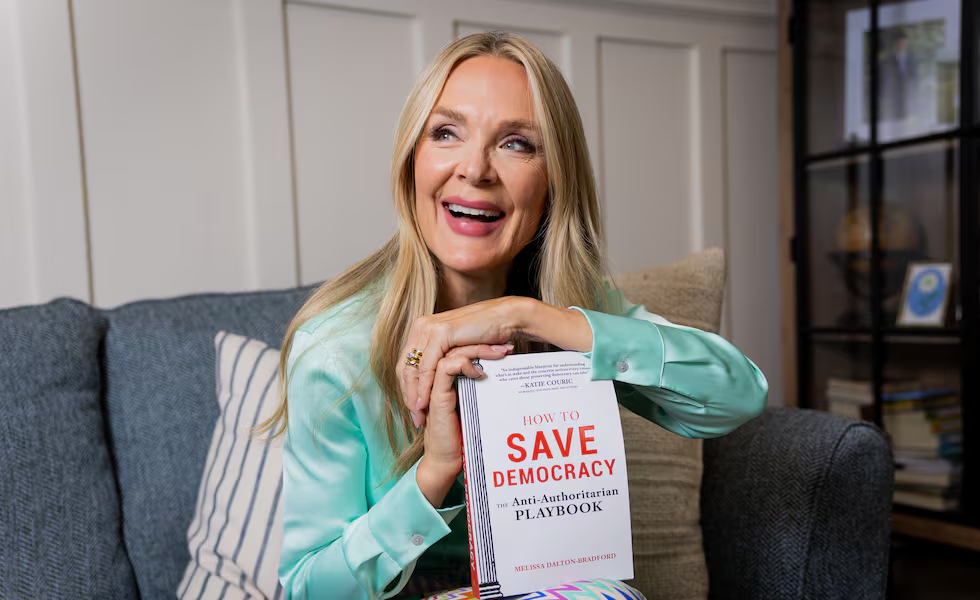
In “How to Save Democracy: The Anti-Authoritarian Playbook,” Dalton-Bradford traces the stories of fallen democracies from Germany and Russia to Venezuela and Chile, and points to what she sees as warning signs at home, like the attacks on the free press, the treatment of migrants, the use of faith for political power, and the politicization of government institutions.
She’s taken on a delicate and bold role: speaking out against what she sees as threats to democratic norms under the current administration, while also rallying Americans to bridge divides in the name of the Constitution, as her faith has taught her.
As a Latter-day Saint who has voted for both Republican and Democratic candidates, Dalton-Bradford’s message reaches with some concern a faith community where nearly 73% of Latter-day Saints identify as Republican. But she’s also giving voice to the shifting politics within the faith. Although predominantly Republican, the Latter-day Saints have moved toward the Democratic Party over the past two decades. During this year’s midterm elections, Democrats flipped 16 Republican-held seats in the Utah House, while the Republican margin in the state’s U.S. House races declined by 30 percentage points between 2022 and 2026.
To members of any party weighed down by the polarization of the moment, Dalton-Bradford’s plea is not to disengage. She offers concrete ideas: form a “democracy defense pod,” audit your news diet, subscribe to a local newspaper, rehearse your public meeting comment.
“Today, no one, especially my fellow Americans, can afford the luxury of being neutral, of hiding behind ‘apolitical,’” she writes. “Because apolitical is not a position. It is an absence.”
What is home?
Dalton-Bradford learned early on that her sense of home wasn’t confined to Provo, Utah, where she was growing up. Her father, who was a violinist and a longtime music professor at Brigham Young University, directed study-abroad programs, and the family began spending extended periods outside the United States.
At 19, while attending lectures at the University of Vienna, Dalton-Bradford began seeing her home country through the eyes of people from other places. Another awakening came when she served as a missionary for The Church of Jesus Christ of Latter-day Saints in Austria. “It was being American and bringing this message from what still was understood to be an American church to these beautiful Austrian people, people of my heart, and understanding better my country’s role on the global stage from their point of view,” she told me.
These experiences ignited an enduring attachment to German-speaking Europe and eventually led to a career that allowed the family to live abroad. Dalton-Bradford’s husband, Randall, became an international human-resources executive, first with Merck and later with Medtronic. His work took the family through eight countries and 16 addresses — among them Hong Kong, Norway, France, Singapore, Geneva and, eventually, Frankfurt.
Wherever they moved, the family brought their 10-foot Norwegian dining table, an object that embodied the family’s openness to newcomers and adventure. In each country, they tried to put down roots, to become as local as they could be. The family learned the languages — Dalton-Bradford reads and writes fluently in German, French and Norwegian, and has studied Mandarin. They sent their kids to local schools and took on callings in the church.
After an eight-year stint in France, Dalton-Bradford arrived in Munich carrying flowers from the funeral of their eldest son, Parker. Parker, who was then 18, jumped into a hidden whirlpool near Rexburg, Idaho, to save a college classmate from drowning. The classmate survived, but Parker was pulled underwater. Dalton-Bradford has written about grief in her memoir “Global Mom: A Memoir” and her book “On Loss and Living Onward.”
https://www.deseret.com/2013/8/28/20524737/worlds-apart-the-challenges-of-global-parenting/
Parker died trying to save someone in trouble, Dalton-Bradford said, and her work now echoes that legacy.
Through the years of moving from one country to the next, home has become a malleable concept, a liminal space that always demanded change and adaptation. Now, visiting Utah on her book tour after 35 years of living away, Dalton-Bradford is aware of her internal duality — both a foreigner in her home country and a loyal citizen deeply invested in healing the country’s wounds. She’s quick to note that she’s continued to pay American taxes while living abroad.
Another constant has been the service in the congregations wherever she went. “My home has become my faith,” she said. “We speak a common language, we share common values, we speak shorthand to each other. These are my people.”
But this sense of home has also felt fragile as political rifts and vitriol grew sharper stateside. Dalton-Bradford described their effects as “existentially painful.” “I feel sometimes like I have to tread on eggshells, and it’s a really fresh pain that I’ve never felt before, and I know a lot of people feel that.”
Refugees and MWEG
While living in Frankfurt, Dalton-Bradford began planning a historical novel about the rise of authoritarianism and a globally mobile family much like her own. The subject was a natural fit: She had earned a graduate degree in German studies, focusing on interwar literature, and had spent years studying the political and cultural history of the period. She began setting aside days to read and research, thinking of herself as a kind of “civic researcher.”
Then the war in Syria sent hundreds of thousands of refugees toward Europe, many of them arriving in Germany. “I saw it instantly as divine choreography,” she told me. “This is why I’m here.” So she got a security clearance and began teaching German to Afghan, Syrian, Iranian, Iraqi and later Ukrainian refugees. In 2016, along with a friend, she founded a nonprofit, Their Story Is Our Story, to share stories of refugees and show them as people with individual stories and journeys.
At the same time, she was increasingly troubled by the rhetoric about immigrants coming from the new President Donald Trump in the United States. Along with her close friend Sharlee Mullins Glenn, they created a Facebook group that eventually grew into Mormon Women for Ethical Government. “The urgency, intensity, and velocity with which we work feels like racing at breakneck speed down the autobahn, building the car as we go,” she wrote about that time.
MWEG was initially conceived in 2017 as a humanitarian and nonpartisan organization, and its work eventually expanded into political advocacy rooted in the same nonpartisan approach. Its members have pushed for what they argued are more compassionate immigration policies, due process and border security. They visited the southern border to meet with asylum seekers and challenged Utah’s congressional maps in court.
Eventually, leading two nonprofits became unsustainable for Dalton-Bradford. “I had to choose between the two,” she said.
She stepped away from MWEG and immersed herself in the refugee work, teaching classes several times a week, with some sessions that lasted five hours. To bridge the language gap, she’s employed tricks from her past training as an aerobic instructor and off-Broadway actress. “I just sang and danced and brought visual aids,” she told me. “We learned together.”
How these Mormon artists discovered that refugees are 'just like you'
From humanitarian work to politics
The turning point for Dalton-Bradford came in February 2025, when Ukrainian President Volodymyr Zelenskyy’s visit to the Oval Office devolved into a heated exchange with President Donald Trump, and when Vice President JD Vance criticized Zelenskyy for not being grateful enough. After she watched it, she decided to turn her Instagram account into a platform for civic engagement.
“I thought, this is what I need to do,” she said.
She propped up her phone on a windowsill and began recording. One of her most widely viewed posts — it has 7 million views — details 10 lies circulated in Germany during the rise of the Nazi regime and draws on some claims being made in American politics. Her following grew from a few thousand to nearly half a million within a year. Scholars and democracy advocates began reaching out. Later, Katie Couric tracked her down and hosted her on her podcast.
When her publisher broached the prospect of a book, Dalton-Bradford knew she wanted to write a political book and have it in people’s hands by the midterm elections. For months, she worked close to 13 hours a day. “That’s all I did,” she said. “My husband brought me all of my food.”
The book is brimming with hands-on advice: the Rev. Martin Luther King’s six principles of peacemaking, action plan items, lists of books. Each chapter includes several action plans, although she says even committing to one small action, ideally a communal one, is sufficient. “One of the tactics that authoritarians exploit is isolation — you’re much more easily driven to despair and depression,” she told me. There are 30 pages of bibliography, with each reference reviewed by an editorial team, according to Dalton-Bradford.
The approach has led some to compare her with Sharon McMahon, the popular political educator known for explaining civic institutions and government in accessible terms, who has also drawn criticism after Charlie Kirk’s assassination. Dalton-Bradford says her approach is different, mainly because she brings distinctly religious and international perspective.
For all her politics, Dalton-Bradford wants to be clear that her primary and foundational identity is being a follower of Jesus Christ. “Secondary to that, I’m a mother, I’m a wife, I’m a daughter, I’m an American, I’m a global citizen,” she said.
She believes that Christ is a defender of free agency embodied in the democratic systems and sees it as her responsibility to fight for everyone’s ability to exercise it. “So what I’m doing is not from a partisan standpoint at all,” she said, noting her scholarship of German history and politics and years of living abroad.
Some conservatives, however, see her message as a hostile view of the Republican Party. After Dalton-Bradford’s recent talk at Southern Utah University two weeks ago, The Cougar Chronicle, an independent student publication unaffiliated with BYU, wrote that Bradford “built a personal brand, comparing pre-WWII Nazi Germany to modern Republican policies.”
Dalton-Bradford told me she thought the article misrepresented her words and that she is careful not to draw equivalencies between authoritarian regimes of the past and the current U.S. administration. Instead, she sees those histories as a guide to the warning signs Americans should be watching out for.
Carolyn Phippen, who leads the Women’s Republican Club of Salt Lake City, believes the Democrats are motivated by opposition to specifically Republican leaders and, in her view, are overlooking threats to civil liberties and other problems that have been coming from the left for a long time.
“I don’t care about finger-pointing,” Phippen told me in a phone interview. “I care about all of us coming together and saying, ‘OK, how about we stop these practices that are antithetical to the founding of this nation?’ I would be all over that if (the Democrats) actually cared about it.”
Carolyn Phippen announces candidacy for Romney’s Senate seat
Both parties should reject practices she believes depart from the Constitution, particularly the expansion of presidential and executive power. Rather than focusing on partisan blame or comparisons to historical atrocities, Phippen said, Americans should acknowledge the problems on both sides and work together to restore constitutional principles and institutions. “The left is really great at pointing fingers and then saying we need to unite,” she said. “That doesn’t work.”
Dalton-Bradford admits that Trump has tapped into legitimate concerns people have, like rising costs and border security, but her concern is about the approach to the solutions. “My main issue is, is it going to be done constitutionally? Can we address these problems without dismantling democracy?” she told me.
The same principles and standards, both women seem to agree, should apply regardless of which president is in office. “When the norms are changed … you’re setting a precedent for what happens in the next administration. It’s not always going to be your guy,” Dalton-Bradford said. “So it must be principles that we’re based on and not any party or any single figure.”
The stone of hope
Now that Dalton-Bradford’s husband is retired and their children are scattered between Boston and Utah, the couple has newfound flexibility. Why not move back to the U.S. to continue her fight from the inside? I asked.
It’s a possibility, she said, but not yet. For now, they feel they are needed in Germany, where they hold responsibilities in their local congregation. “We feel deeply, and we keep on getting the spiritual affirmation that we’re needed where we are,” she said.
From Germany, she’s been watching the unexpected rise of the far-right Alternative for Deutschland (AfD), which is now the most popular party in the nation, with 1 in 4 German voters backing it. “Maybe I am where I am to help with that battle as well,” she told me. She sees the experience as another reminder that the struggle over democracy is not confined to the United States.
Among her half-million Instagram followers are Europeans, she said, and her own life has given her a perspective that crosses national boundaries. History and living alongside victims of authoritarian regimes left her with an obligation to pay attention and resist fear.
That sense of obligation is what ultimately keeps her from despair. “There’s something deeper than our grief, than the here and now,” she said.
She thinks of the people who came before her — those who fought for the country, for religious liberty, for the right to vote and for civil rights. “I owe them something, you know?” she said. “And that’s my stone of hope.”