How Algae Could Be Nature’s Secret to Energy Efficient Solar Panels
Happy Eco News How Algae Could Be Nature’s Secret to Energy Efficient Solar Panels
Reading Time: 4 minutesHow Algae Could Be Nature’s Secret to Energy Efficient Solar Panels
With global temperatures hitting record highs, and energy demand continuing to increase, the need for cleaner, more renewable power generation has never been more urgent. Investment in solar was greater than all other power generation technologies combined. But despite this high level of investment, solar power still faces challenges in real world applications.
The most notable are efficiency and stability issues, especially in low light conditions. While commercial silicon solar panels convert roughly 15-20% of the sunlight they are exposed to, and recent record-breaking perovskite research having led to energy efficiencies surpassing the 30%-mark, nature has spent billions of years perfecting a far superior alternative.
Algae, Natures 95% Efficiency Secret
When we think of solar power, we usually think of traditional silicon-based panels baking upon suburban rooftops, yet some of the most groundbreaking advancements are happening at an intersection between materials science and biology. Researchers are looking towards nature, specifically algae, to unlock the future of clean energy.
Microalgae and cyanobacteria have evolved over billions of years to become the planet’s most efficient solar harvesters, these photosynthetic organisms can process 95% of the sunlight they absorb even in low-light, underwater, or filtered light environments. Researchers are now looking toward these organisms and asking, “Could they hold answers to how solar panels can be more efficient?”
Photosynthesis is an important chemical reaction in which plants, algae, and certain bacteria convert solar energy into chemical energy, that is then used by the living cells. Researchers are using this framework to study bio-photovoltaics (BPVs), devices that harvest electrical currents directly from the photosynthetic activity of living microorganisms.
Microalgae, namely cyanobacteria and red algae, use a unique geometric protein arrangement, their surface is made from a mass of light harvesting antenna called phycobilisomes in a way that mimics a funnel. This outward-facing geometry vastly increases the cell’s surface area for light absorption. A major cause of energy loss in standard solar photovoltaics is photon scattering, in algae’s case the geometric rods catch photons from multiple angles and funnel them inward toward a single, central reaction center.
It is important to note that compared to the land environment, which typical solar panels would be located, light intensity decreases underwater and becomes unstable as it is refracted or absorbed by the water. Yet cyanobacteria and red algae can live in water as deep as 100m because they have evolved sophisticated light harvesting antennae allowing them to harvest a much more diverse range of wavelengths, most notably short-wave light (blue-green light). Additionally, some freshwater alga can absorb far-red light, typically out of the optimal range for chlorophyll to absorb, by rearranging chlorophyll molecules into larger clusters within its photosynthetic antenna.
Decoding Nature with Spectroscopy
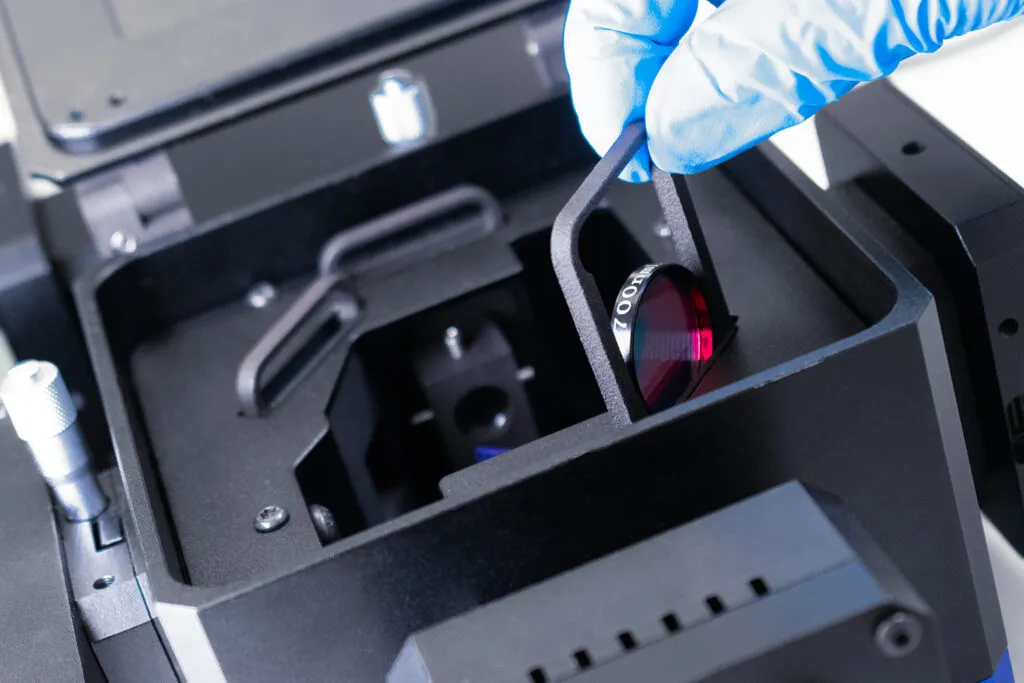
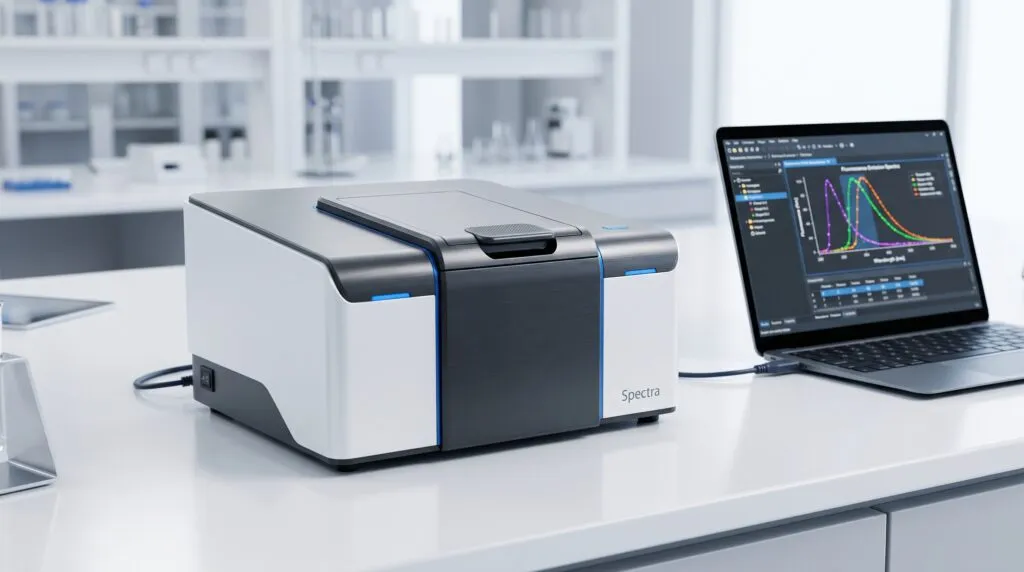
Researchers use benchtop spectrofluorometers to run highly sensitive fluorescence extraction and emission measurements. Image credit Ossila
Spectroscopy is an invaluable technique used to study the interaction between radiative energy and matter, or in this case how light of varying wavelengths interacts with algae. To translate the characteristics of algae into scalable technology, researchers must first precisely map how these organisms handle photons. This requires analyzing the organisms’ internal pigment-protein complexes for a range of metrics:
- Light Absorption – The process in which light is absorbed by matter and converted into energy.
- Energy Transfer – The process by which energy is passed between one ion to another ion, vital to the development of efficient luminescent materials.
- Fluorescence Emissions – The process where a substance absorbs light or other electromagnetic radiation and immediately re-emits it as light of a longer wavelength.
To achieve this level of precision, modern research laboratories rely on advanced spectroscopic equipment. Researchers use benchtop spectrofluorometers to run highly sensitive fluorescence extraction and emission measurements.
- Fluorescence Emission Spectra: Researchers shine a fixed wavelength of light into the algal culture to capture the exact fingerprint of the re-emitted light. This reveals how energy is distributed across different pigment groups (i.e. Chlorophylls and Phycobiliproteins).
- Fluorescence Extraction Spectra: Researchers can pinpoint exactly which specific colors of light are most effective at driving energy transfer within the organism. This is achieved by sweeping across a broad spectrum of light wavelengths and measuring resulting emission at a target wavelength.
How Can Algae Impact the Future of Solar?
The long-term vision of this research stretches far beyond boosting power metrics. Algae are part of a paradigm shift in renewable energy by serving as the blueprint and living engines for next-generation “Bio-Solar Cells,” also known as biophotovoltaics (BPVs). Bio-solar cells leverage living, self-repairing photosynthetic microorganisms like microalgae and cyanobacteria to convert sunlight, water, and carbon dioxide directly into electrical current.
Traditional silicon-based photovoltaic panels require resource-intensive, toxic manufacturing which relies heavily on rare earth metals, and when they reach the end of their lifespans, recycling them creates a large electronic waste challenge. In comparison, BPV solar units offer a circular alternative with potential future iterations that could function as disposable, compostable solar elements. BPV power output is currently low (around 0.345 mW/m², which is much lower than standard silicon panels), making them unviable for whole-home power, though suitable for low-voltage sensors or trickling light.
Another avenue sees specialized algae being integrated into traditional solar panels, not as a living organism but by using diatom shells. Diatoms are a unicellular phytoplankton that naturally build porous, glass-like silica shells to aid in the capturing of light during photosynthesis, even in murky water. Researchers have found that when these shells are applied as an antireflective coating or integrated into the panel’s encapsulant layer, their nano structures trap and scatter visible light effectively, which has been found to boost silicon solar panel efficiency by at least 4%.
The use of diatom shells has also led to reduced panel degradation and extended panel lifespans as the material naturally blocks UV light. UV exposure degrades materials and reduces performance over time, which is unfortunate for devices that, by design, are exposed to it consistently.
While scalability and long-term performance remain as the biggest challenges for energy efficient solar panels. By using precision spectroscopic research to take a closer look at our natural world and using spectroscopy tools to uncover its “secrets”, researchers are proving that the greenest future for solar energy might come from the very planet we are trying to protect, in one of nature oldest organisms.