How this single word can shape a life, according to Christian editor Anne Snyder
It’s one of the first words to become a part of a child’s vocabulary. It’s uttered so often that we rarely think of its substance and what it commits us to do.
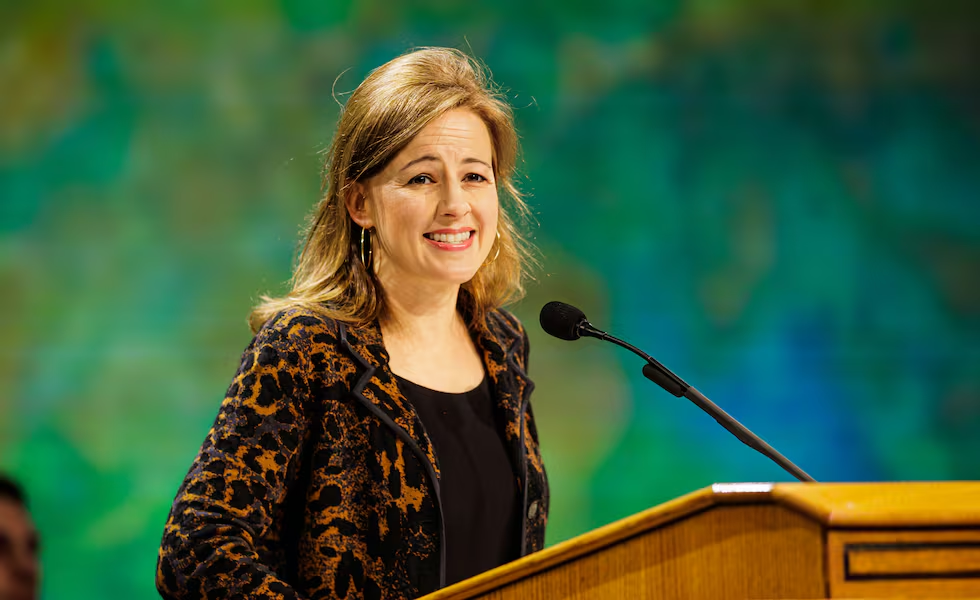
“The word which we learn so early in all of our lives as human beings, yet probably spend a lifetime coming to understand is ‘yes,’” said Anne Snyder, a Christian public thinker and editor-in-chief of Comment magazine, during her speech at a forum at Brigham Young University on Tuesday.
What does it mean to say a “yes” to a particular way of living, a passion, a person or a community? And how do the myriad things that we say “yes” to, Snyder asked, shape who we become?
Comment magazine, which describes itself as a magazine of “public theology for the common good,” frames this essential question this way in its own manifesto: “We want to begin with the Yes in Christ, not our own noes.”
The publication publishes writing from across faith traditions, but its approach is rooted in “2,000 years of a Christian humanist tradition.” The term “Christian humanism” became more widely used in the 20th century. It encompasses Christian teachings and humanist values like education, dignity, individual freedom and compassion. Snyder’s magazine is trying to give this tradition a “fresh voice” and “flesh” amid the various “antihuman currents” of our time, she said in her speech.
Snyder, a graduate of Wheaton College, wrote a 2019 book called “The Fabric of Character: A Wise Giver’s Guide to Renewing Our Social and Moral Landscape,” a guidebook for donors and organizations interested in moral formation. She often writes and speaks on moral imagination and Christian renewal, including joint lectures with her husband David Brooks.
Through collaborative publishing projects and events, such as The Breaking Ground publishing project and the Understory Festival, she has become an influential voice advocating for renewal of Christian humanist thought and its application to public life.
Snyder’s BYU address was this year’s Truman G. Madsen lecture, which honors the late BYU philosopher and his wife, Ann, a poet who taught religious education at the university.
Discerning what deserves a ‘yes’ in her life can be a challenging task, Snyder said. She often wrestles with the choice between what’s “new and intriguing” and what is “really mine” to pursue.
The hedgehog or the fox?
She drew on a 1953 essay by Isaiah Berlin, “The Hedgehog and the Fox,” to distinguish between foxes, who pursue many interests, and hedgehogs, who organize their lives around one central purpose.
In Berlin’s analogy, Snyder herself identified more with a fox, drawn to a range of projects and interests ignited by the journalistic curiosity that she thinks partly formed during her childhood in Hong Kong and Australia, where she lived until the age of 10.
She confessed her admiration for people who give “one full-throated yes” to a place, a community, a cause or a craft, and build their lives around something larger than themselves.
She called it “one great penultimate yes by which to order all the other yeses.”
In living a “wholehearted life,” Snyder admired a fellow Christian writer, Elizabeth Oldfield, who lives in a commune with her family in London, sharing meals, a garden and services in a chapel in their backyard.
There are also Amber and David Lapp, who left New York City with their six children to live in a working-class town in Ohio, where they embarked on a study of love and marriage.
In Salt Lake City, she touted the work of The Other Side Academy’s Joseph Grenny and executive director Dave Durocher, who help people recover from addiction and learn accountability, she said.
Throughout history, Dorothy Day and Dr. Martin Luther King Jr. pursued a similar commitment to their particular “yes.”
The life of a commitment to one thing — similarly to the hedgehog — and a more “receptive” life of a fox, while in tension, can exist alongside each other.
“How does one yes become substantial enough to shape a life, but also remain alive enough to hear what a living God is asking of us, of me, of you right now?” Snyder asked.
The painter and the Pietà
For an answer, Snyder turned to Manuel Dürr, a Swiss painter who was chosen through an anonymous international competition to paint 14 new Stations of the Cross for St. Peter’s Basilica in Rome.
He belongs to a small Reformed Protestant congregation in the foothills of the Swiss Jura, where shared meals and common prayer give shape to daily life. Snyder visited his studio in November 2025.
When Snyder asked him how he balanced the spiritual listening and his creative process, he said: “Creative agency is not about conjuring up a specific thing spontaneously; it’s about becoming the kind of person who can respond spontaneously and well, even becoming the medium through which certain things can manifest themselves.”
In his view, creativity grows out of responding to the world and to other people, and it requires sacrifice. “I think perception is wider when the ego dies,” Dürr told Snyder.
While painting Pietà in the series, Dürr realized that he had unconsciously painted his own mother’s face and how it absorbed suffering without turning away from it.
He realized that her example of love had shaped him more deeply than he understood and taught him a capacity for compassion he had previously tried to evade.
“The love that had formed him was still capable of surprising him,” Snyder said.
‘We are only fragments’
As he was trying to complete the paintings, Dürr struggled to surrender control and worried about how his work would be received. It was not the “ambition to make it excellent,” but the ambition to “make it mean something for me,” he distinguished.
With his wife’s help, he realized that the meaning and legacy of his paintings were not his to determine. As he reflected on the artwork in Venice, much of which had been taken from Constantinople centuries earlier, he realized that artists can’t know where their work will end up or what it will mean.
“We are only fragments, and God will take care of the rest,” the artist told Snyder.
Dürr’s life, Snyder said, showed how the prayers and the closeness to the spiritual and creative practices made him receptive to the inspired and less predictable influences.
“So maybe the question for foxes and hedgehog types alike is whether our many yeses are answering to the very first one,” she said.
In an apparent nod to missionary service, Snyder noted that some students had already given “18 months to 2 years” of their lives to a yes whose results they may never fully see. The language of covenant, which she said “our theological traditions share,” holds together “a commitment substantial enough to make claims upon a life with much of what it will mean still awaiting discovery.”
“And that is what I find myself hoping for, for you and for myself,” Snyder said. “That there is a yes substantial enough to shape a life but alive enough to keep listening.”