But If Not
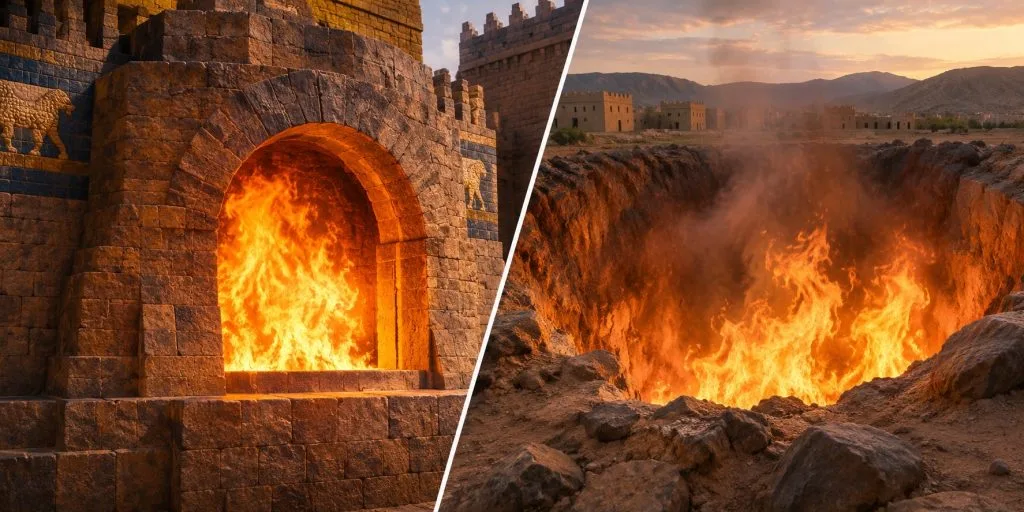
Three words in the third chapter of Daniel carry more weight than whole sermons—But if not…
The setting is familiar. Nebuchadnezzar has raised a golden image on the plain of Dura and commanded every knee to bend when the music plays. Three young Hebrew men—Shadrach, Meshach, and Abed-nego—remain standing. The king, furious, gives them one more chance and points to the furnace awaiting anyone who refuses. Then he asks the question that makes the whole chapter turn, And who is that God that shall deliver you out of my hands? (Daniel 3:15).
Their answer comes in two halves, and most of us remember only the first. Our God whom we serve is able to deliver us from the burning fiery furnace, and he will deliver us out of thine hand, O king. That is the half we would pray. It is confident and sound and exactly what we hope to say when our own furnace is lit. Then comes the hinge. But if not, be it known unto thee, O king, that we will not serve thy gods (Daniel 3:17–18).
It would be easy to hear those three words as a hedge, a way of lowering expectations so disappointment would not sting. But a hedge is spoken quietly to oneself. This was announced to a king with the furnace awaiting them. Nothing about their declaration was soft. They were telling Nebuchadnezzar where their faith stood, and they were telling him before they knew how the day would end.
Notice what they did not say. They did not suggest God would fail them, nor did they make their obedience conditional upon His intervention. They declared His power to deliver them while acknowledging the possibility of a different outcome. Notice also how they identified their relationship with God before speaking of the furnace. Our God whom we serve. Their faith was never independent of God. It was independent of the outcome.
We know how the chapter ends. Nebuchadnezzar orders the furnace heated seven times hotter than usual. The three young men are bound and thrown into the flames, but the king sees something he did not expect. Lo, I see four men loose, walking in the midst of the fire, and they have no hurt; and the form of the fourth is like the Son of God (Daniel 3:25). Shadrach, Meshach, and Abed-nego emerge unharmed, without even the smell of fire upon their clothing. They had settled the matter before the miracle arrived, and the miracle did not change what they had settled.
Daniel 3 is the chapter we frame and hang on the wall. It has a tidy ending. Alma 14 is harder to hang anywhere. There is fire there too. In the city of Ammonihah, believing women and children are cast into the flames, their scriptures burning with them, while Alma and Amulek are made to watch. Amulek says what any of us would say. How can we witness this awful scene? Therefore let us stretch forth our hands, and exercise the power of God which is in us, and save them from the flames (Alma 14:10). Alma refuses him. The Spirit constraineth me that I must not stretch forth mine hand; for behold the Lord receiveth them up unto himself, in glory (Alma 14:11).
The passage is difficult, and I do not think it was written to be otherwise. Alma goes on to speak of the judgment awaiting the persecutors, but his explanation does not make the suffering any less terrible. Women and children have been murdered, and the power to intervene was available. Yet Alma tells Amulek the Lord has received those who perished into His glory.
The deliverance of Daniel 3 stopped the flames. The deliverance described in Alma 14 carried the believers beyond them. One was visible to everyone watching. The other required faith in a promise extending beyond mortality. Neither account tells us why God intervened to save the three young men but did not intervene to save the believers in Ammonihah, and I will not pretend to explain it for them.
Alma and Amulek are not spared what follows. They are struck and spit upon and kept for days without food. At last Alma prays. O Lord, how long shall we suffer these great afflictions? O Lord, give us strength according to our faith which is in Christ, even unto deliverance (Alma 14:26). Alma acknowledges the suffering and asks God for the strength to overcome it. The cords break, the prison walls fall, and the two men walk free.
Hold the two chapters side by side. In Daniel, the fourth figure appears and the three young men walk out of the furnace. In Alma, the believers perish while the two men who wanted to save them eventually walk out of their prison. The same God possesses the power to intervene in both accounts, yet deliverance comes in different forms.
We naturally pray for the kind of deliverance experienced by Shadrach, Meshach, and Abed-nego. We ask for healing when someone we love is ill and for relief when circumstances threaten to overwhelm us. We believe in a God of miracles, and we have every reason to seek His help. But when the miracle we plead for does not come, we are left with the same uncertainty the three young men faced before the furnace.
God’s understanding reaches beyond our own. We see the immediate danger, the suffering before us, and the outcome we desperately want. God sees what we cannot. This does not mean every tragedy is something He desired or every unanswered prayer conceals an explanation we are meant to discover. Some things remain painfully beyond our understanding, and faith does not require us to explain them.
The three young men did not stand before Nebuchadnezzar because they knew how the day would end. They stood because they knew whom they served. Their declaration was not resignation in the face of an unavoidable consequence. It was a commitment made without conditions, leaving the outcome in God’s hands.
I have always admired the courage of Shadrach, Meshach, and Abed-nego. But there are times I wonder whether I could have stood beside them. They faced a terrible choice without knowing whether God would spare their lives. Their answer was already settled—I hope I can do the same.