When Heaven Rejoiced at the Dedication of the Salt Lake Temple
As we approach the long-awaited rededication of the Salt Lake Temple, I’m making an effort to get myself into a proper frame of mind for that historic event. One important element of my preparation involves reading Mark Henshaw, Forty Years: The Saga of Building the Salt Lake Temple (Salt Lake City: Deseret Book, 2020). Drawing on Brother Henshaw’s work, I want to share a brief glimpse of the very beginning of that sacred structure, and a brief glimpse at its completion.
On 25 July 1847, the first Sunday after the first Latter-day Saints had entered the Valley of the Great Salt Lake, Elder George A. Smith was the first speaker in the morning Sabbath service. Reportedly, he took Isaiah 2:2 as his text:
“And it shall come to pass in the last days, that the mountain of the Lord‘s house shall be established in the top of the mountains, and shall be exalted above the hills; and all nations shall flow unto it.”
Elder Smith explained that, by “the mountain of the Lord’s house,” Isaiah was referring to a temple. And, he explained, they would build a temple there, high in the Rocky Mountains, in a new settlement that would become one of the most elevated cities on the continent.
The next day, on Monday, 26 July, Brigham Young took several of the Twelve with him to explore the area, including Wilford Woodruff, who had driven him in the back of a carriage—a light horse-drawn wagon—when he was feverishly ill with “mountain fever.” They climbed what is now known as Ensign Peak, a dome-shaped eminence to the north that Brigham had reportedly seen in vision while still in Nauvoo. Praying for guidance about where to lead the Saints, he had seen the martyred Prophet Joseph Smith gesturing toward a “conical hill” and indicating that the exiled Saints would find prosperity and peace if they settled beneath it.
He recognized the hill immediately. It was, the group decided, “a proper place to raise an ensign to the nations, so they tied a yellow bandana to a walking stick and planted it as a makeshift flag.” Here, they foresaw, would be the new focal point for the gathering of Israel in the latter days:
“And he will lift up an ensign to the nations from far, and will hiss unto them from the end of the earth: and, behold, they shall come with speed swiftly.” (Isaiah 5:26)
“And he shall set up an ensign for the nations, and shall assemble the outcasts of Israel, and gather together the dispersed of Judah from the four corners of the earth.” (Isaiah 11:12)
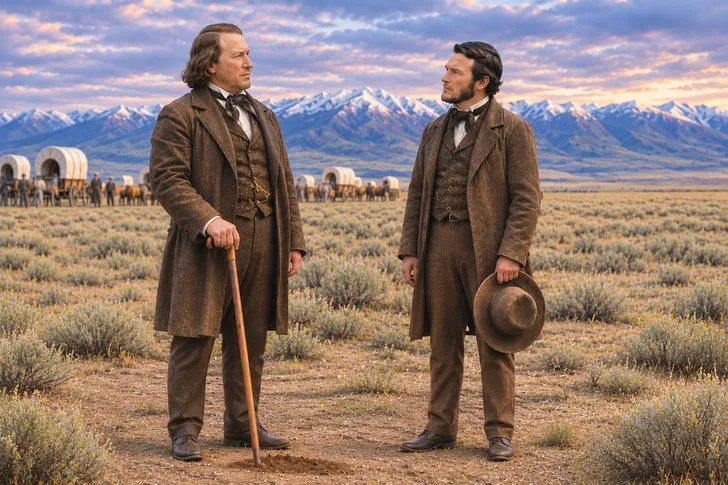
Later that day, in the early evening, Brigham Young and Wilford Woodruff walked again near the camp. Suddenly, Brigham stopped. He thrust his cane into the valley’s hard, dry dirt and declared, “Here will be the temple of our God.”
Wilford later recalled that this statement “went through [him] like lightning.” Worried, though, lest they not be able to identify that precise spot again, he found a stick nearby and, using a rock, pounded it into the soil where Brigham had made the mark with his cane. Two days later, again early in the evening, the other apostles joined with Brigham and Wilford and agreed together that this would be the location of a new temple, significantly larger than the temple they had been forced to abandon back in Illinois. They had scarcely planted their first crops, and already they were planning a city that would be centered on the House of the Lord.
However, urgently pressing needs intervened, such as developing dependable supplies of food and water and building shelters, not only for themselves but for the large waves of immigrants who continued to arrive in “Great Salt Lake City.” Settlements were already beginning to expand into Utah Valley (by 1847) and Sanpete Valley (by 1849).
But construction on the temple finally began in earnest in 1853. At the groundbreaking ceremony, Brigham Young recalled that he had seen a vision when he first set foot upon the ground as they surveyed the valley floor. “I knew [then],” he testified, “just as well as I now know, that this was the ground on which to erect a temple—it was before me.”
“I want to see the temple built in a manner that it will endure through the Millennium,” Brigham told the Saints at October conference in 1863. “This is not the only temple we shall build; there will be hundreds of them built and dedicated to the Lord. This temple will be known as the first temple built in the mountains by the Latter-day Saints. And when the Millennium is over, and all the sons and daughters of Adam and Eve, down to the last of their posterity, who come within the reach of the clemency of the Gospel, have been redeemed in hundreds of Temples through the administration of their children as proxies for them, I want that Temple still to stand as a proud monument of the faith, perseverance and industry of the Saints of God in the mountains, in the nineteenth century.”
For forty years the Saints and their leaders labored against enormous challenges and opposition on the great Salt Lake Temple. In the meanwhile, ordinances for the living were performed, sometimes even on Ensign Peak itself, but eventually in the temporary Endowment House and then, for both the living and the dead, in three other and somewhat smaller temples that were commenced later, in St. George (1877), Logan (1884), and Manti (1888), but finished and dedicated before the Salt Lake Temple.
Finally, though, the House of the Lord in Salt Lake City was completed. Its dedicatory services began on 6 April 1893.
By this time, Wilford Woodruff—who had been present when Brigham Young designated the site for the Salt Lake Temple—had succeeded Brigham (and John Taylor) as the fourth president of the Church. Thus, it fell to him to consecrate the massive new sanctuary to the Lord.
A more appropriate person could scarcely have been found. Wilford Woodruff was one of the greatest missionaries of the nineteenth-century Restoration. However, under the direction of President Young and President Taylor and the direct inspiration of the Lord, he had also dedicated a substantial portion of his remarkable life to genealogical and temple work. In other words, to use a favorite phrase from President Russell M. Nelson, he had been devoted to “gathering Israel on both sides of the veil.” He had, for instance, presided over the newly dedicated St. George Temple as its first president—and, indeed, as the first designated temple president in the history of this dispensation. Later, in 1894, he would receive a landmark revelation instructing Church members to trace their own lineages and to have themselves sealed to their own direct biological parents and ancestors rather than, as many had been doing, to prominent Church leaders. With this was born the work of family history and temple sealings essentially as modern Latter-day Saints know it.
During one of the dedicatory services on 7 April 1893, President Woodruff informed the congregation in the temple’s Assembly Room that he had received a heavenly revelation:
“[H]e arose and said the Lord had made it manifest to him that there was gladness among the sanctified in heaven and that all the prophets of this dispensation, Joseph, Brigham, and John Taylor, and the prophets of ancient days among the Nephites and Israelites led by the Son of God all rejoiced exceedingly at the dedication of this Temple, and it was accepted of God.”
In fact, he told the Saints, while they were celebrating the temple’s completion on earth, a parallel celebration was taking place on the other side of the veil.
Henshaw writes that President Woodruff had known for most of his long life that the dedication of this temple was to be a major element of his earthly mission. He had been aware of it even before Brigham Young had marked the spot on which it would stand with his cane. He had foreseen it even before the Saints had left Nauvoo for their epic migration across the Great Plains, over the Rocky Mountains, and into the Great Basin West:
“Near[ly] fifty years ago while in the city of Boston I had a vision of going with the Saints to the Rocky Mountains, building a temple and I dedicated it. Two nights in succession before John Taylor’s death, President Brigham Young gave me the keys of the temple and told me to go and dedicate it.”
At which point, Henshaw concludes his book: “And then this humble phrase, a fitting close to that mortal duty: ‘. . . which I did.’”
John Taylor died in 1887. Brigham Young had died in 1877, a decade earlier. So when, on “two nights in succession,” had Brigham given Wilford the charge to dedicate the temple? It may help to remember a remark of the late Truman Madsen about Wilford Woodruff, that he “seemed to live as if with one foot in the spirit world and one foot in this one. Only Wilford Woodruff could say to a brother as he went down the street in Salt Lake City, ‘Brother John, it’s good to see you,’ and then could add as an afterthought, ‘You know, I don’t think I’ve seen your father since he died.’”
Since its completion, the Salt Lake Temple has served as a symbol of the Restored Church, widely recognized around the world. More than a mere icon, though, it has been the sacred edifice where apostolic ordinations have been performed, priesthood keys have been conferred, presidents have been set apart, and revelations have been received. Upon President Woodruff’s passing, it was in the Salt Lake Temple that the Savior appeared to Lorenzo Snow, who would shortly afterward become the Church’s fifth president. Over the past nearly fourteen decades, tens of thousands of sealings have been performed within its granite walls, uniting families for eternity. Innumerable baptisms have admitted generations of the yearning dead onto the covenant path toward salvation and exaltation.
And now, with the rededication of the Salt Lake Temple, improvements and modern technology will have been added to make it and the ordinances performed in it far more accessible than ever before to people flowing to it from all nations, “out of every kindred, and tongue, and people.”
Let us remember and be grateful for the labors of those who built the Salt Lake Temple and who have brought it to its current enhanced state. Let us remember, among others, Brigham Young, who saw it in vision and chose its location and who presided over its first quarter-century of construction. “To accomplish this work,” he said, “there will have to be not only one temple, but thousands of them, and thousands and tens of thousands of men and women will go into those temples and officiate for people who have lived as far back as the Lord shall reveal.” Let us also remember Wilford Woodruff, who likewise saw the Salt Lake Temple in vision and who lived to see it through to completion.
“When we speak of gathering Israel on both sides of the veil,” President Russell M. Nelson famously explained in an October 2020 General Conference address, “we are referring, of course, to missionary, temple, and family history work. We are also referring to building faith and testimony in the hearts of those with whom we live, work, and serve. Anytime we do anything that helps anyone—on either side of the veil—to make and keep their covenants with God, we are helping to gather Israel.”
With the pending rededication of the Salt Lake Temple, a mighty instrument for the gathering of Israel will be back in service. Once again, there will be gladness among the sanctified in heaven. Certainly all of the prophets of this dispensation, from Joseph Smith, Brigham Young, John Taylor, and Wilford Woodruff down to Russell M. Nelson, and the prophets of ancient days among the Nephites and Israelites led by the Son of God, will be rejoicing and celebrating with us at its dedication. May both we and it be acceptable before God.
For notes on the historic 1978 priesthood revelation, which was received in the Salt Lake Temple and which seems to have included an appearance of Wilford Woodruff, see “Some Facts (New To Me) About the 1978 Priesthood Revelation,” “More On The 1978 Priesthood Revelation”, and “Wilford Woodruff (1807-1898), Returned for a Visit in 1978?”
See Jennifer Ann Mackley, Wilford Woodruff’s Witness: The Development of Temple Doctrine (enhanced 2d ed., 2022), for valuable insights into the development of temple service in this dispensation.