Researchers improve heating uniformity in PV module laminators
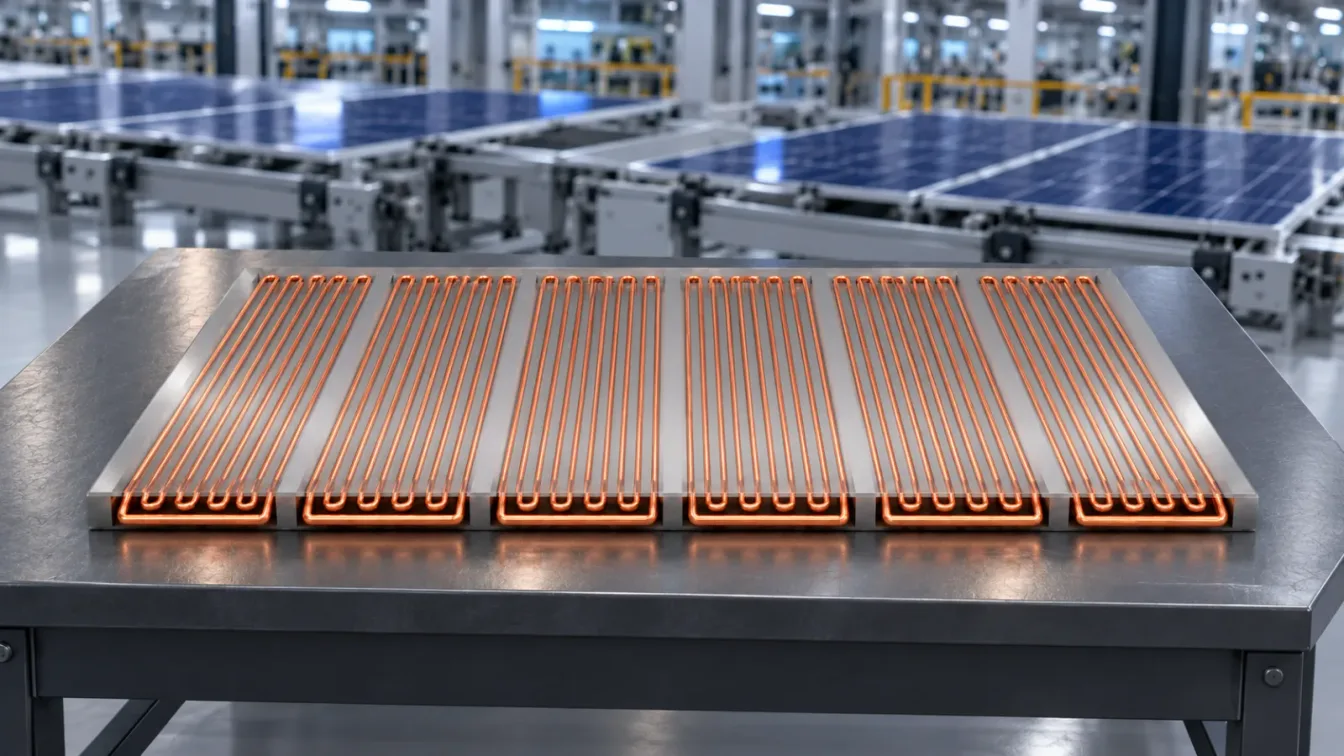
A research team from China’s Hebei Normal University of Science and Technology has developed an electromagnetic-thermal strategy to improve heating uniformity in PV module laminators. Uneven heating can leave encapsulants insufficiently cured in cooler areas while damaging encapsulants or cells in hotter areas. The new approach combines stepped aluminum magnetic shielding, zone-specific currents, and temperature-based current control to distribute heat more evenly across the heating plate.
“Addressing the dual challenges existing in the spatial magnetic field distribution and transient thermal response of a large-scale built-in perforated induction heating system, this paper proposes a complete electromagnetic-thermal collaborative optimization solution based on multiphysics equivalent modeling,” the team explained. “An equivalent finite element model was established to reduce the computational cost of large-scale Multiphysics coupling, with accuracy validated via a physical prototype.”
The researchers used COMSOL to simulate electromagnetic heating and heat transfer in a 4,750 mm × 2,900 mm × 45 mm steel plate comprising six zones with embedded copper coils. A simplified two-zone model accounted for temperature-dependent material properties, heat conduction, and convective and radiative losses.
They selected an excitation current of 38 A and a frequency of 15 kHz, then optimized stepped aluminum shielding to suppress localized overheating. Finally, they adjusted the two zones’ currents to 37 A and 38 A and introduced a control function that reduced current as temperatures approached 150 C.
“Under the baseline electrical parameters, the maximum temperature difference on the working surface was approximately 29 C,” the results showed. “After applying continuous stepped shielding and asymmetric shielding compensation, the maximum temperature difference was reduced to approximately 12 C, indicating that the proposed shielding method effectively weakened edge magnetic flux leakage and local heat accumulation, thereby improving temperature uniformity.”
For experimental validation, the team built a full-scale prototype with 13 surface thermocouples and an estimated measurement uncertainty of ±0.30 C near 150 C. They compared baseline measurements with simulations before testing the optimized shielding and zone-specific currents. A PID controller regulated the prototype’s heating, while temperature recordings tracked overshoot, stabilization time, and uniformity across the monitored locations.
“Full-scale prototype tests showed that the measured temperatures at all 13 monitoring locations were within 148–152 C, with a maximum measured temperature difference of approximately 3.1 C, indicating a substantial improvement in temperature uniformity at the monitored locations,” the team said.
“Electromagnetic-thermal collaborative optimization of a large-scale induction heating plate for photovoltaic module laminators” appeared in Case Studies in Thermal Engineering. Researchers from China’s Hebei Normal University of Science and Technology and the Hebei Technology Innovation Center for Photovoltaic Module Manufacturing Equipment.