The Students Giving Tennis a Second Serve
Happy Eco News The Students Giving Tennis a Second Serve
Reading Time: 4 minutesA student-run nonprofit born in Flower Mound, Texas, now keeps used tennis balls out of landfills in 16 states.
A single tennis ball weighs about two ounces. That is easy to overlook, because nobody throws away just one.
Since 2024, BallBack, a student-led nonprofit based in Flower Mound, Texas, has recycled or repurposed more than 160,000 of them. At roughly 58 grams apiece, that is about 9.3 metric tons of rubber and felt, a little over 20,000 pounds.
Every one of those balls was headed for the trash. According to RecycleBalls, a tennis ball takes roughly 400 years to break down, slowly shedding microplastics into the surrounding soil. Curbside recycling programs do not accept them.
The national picture is larger still. The United States discards an estimated 125 million tennis balls each year, or about 340,000 a day. By comparison, 160,000 balls is less than half a day of the country’s tennis ball waste. What makes BallBack interesting is not only its total so far, but how quickly a model built by high school students is spreading, and how easily it can be copied by anyone with a court, a school, and a car.
BallBack began with Prem Kamasani, a varsity tennis player at Flower Mound High School. After practice one evening, he watched his coach getting ready to throw out roughly 400 used balls. He asked whether he could take them instead.
“I noticed hundreds of balls going to the trash every week, and no one was doing anything about it,” Kamasani says on BallBack’s website.
The balls went home with him. Some went to animal shelters as toys, and others ended up under school chairs. He then began calling local tennis centers to ask whether they had balls to give away as well. Most did. The collection outgrew his family’s garage, then several garages, and teammates joined in.
A Lead4Change grant helped turn the school project into a national organization, spreading to over 310 members in 2026. The funding covered prepaid shipping, so courts anywhere in the country could send in their balls at no cost. Partnerships spread across Dallas–Fort Worth, from public facilities such as Kiest and Samuell Grand tennis centers to SMU’s college tennis program and the Flower Mound Animal Shelter.
BallBack’s process is deliberately simple. A chapter leader places a free, branded collection bin at a partner facility, such as a tennis center, club, school, or homeowners’ association. Players drop off dead balls after practice instead of tossing them in the trash. Nobody on site has to sort or clean anything. Leaders monitor fill levels and stop by once or twice a month before anything overflows.
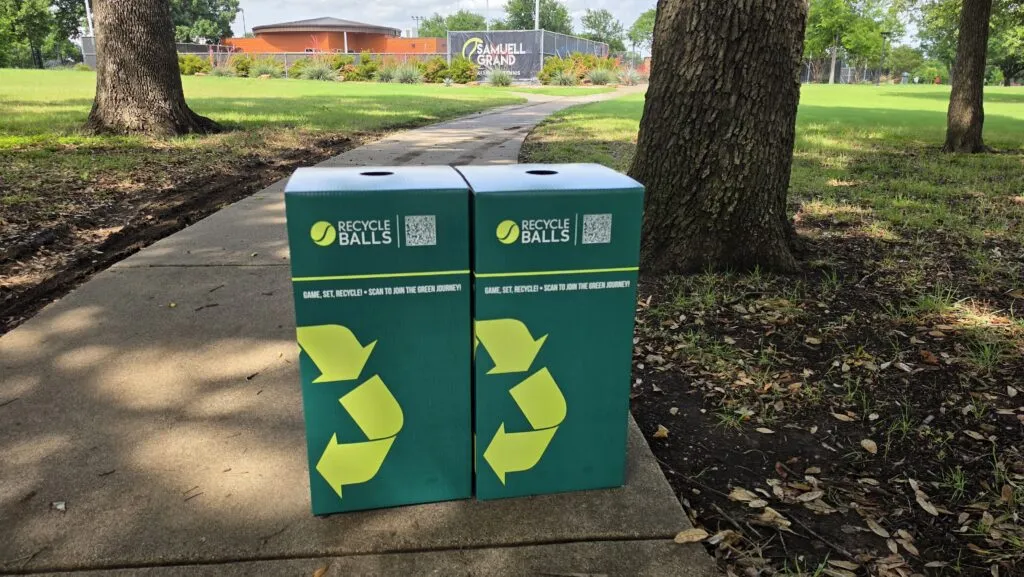
Recycling bins at Samuell Grand Tennis Center in Dallas, one of BallBack’s partner facilities, let players drop off used tennis balls instead of throwing them away. Photo courtesy of BallBack.
Sorting comes next, and it reflects the organization’s priorities. Balls that still bounce are never shredded. They go back into play through youth tennis programs and school teams that cannot afford new equipment, as well as other repurposing partners. Others go to dog shelters as enrichment toys, or to senior living communities, where they serve as walker feet.
BallBack boxes only the balls with no play left in them, labels them with prepaid UPS shipping, and sends them to RecycleBalls or the USTA, BallBack’s national recycling partners. There, they separate the rubber and felt and grind them into crumb rubber that becomes new tennis court surfaces, playground padding, and footing for equestrian arenas. Through RecycleBalls and USTA, BallBack’s shipments help feed a North American collection network of roughly 10,000 locations.
BallBack now runs with a national team of students recruited from across the country, each responsible for a distinct part of the work. The media team shapes how BallBack tells its story, from pickup-day footage to chapter spotlights. The marketing team carries that story to new schools, players, and facilities. The onboarding team brings each new chapter leader up to speed with step-by-step guides, so a student in Seattle or Fort Lauderdale can complete a first pickup within a week of signing up. Leaders trade questions and progress in a shared online community.
This structure lets the network grow without relying on any one person. BallBack now counts 31 student chapter leaders across 16 states, more than 310 members, and over 55 partner facilities. Chapters operate in New York City, Philadelphia, Chicago, Portland, Seattle, Minneapolis, Folsom, and Green Bay, among other cities. In Manhattan, one senior ships roughly 750 balls a month. In Falls Church, Virginia, chapter leader Surya Arivumani has already recycled more than 1,200.
BallBack is set up so that taking part does not depend on where you live.
High school sophomores, juniors, and rising seniors in any U.S. city without an existing chapter can apply to start one at their local school. The commitment is one or two pickup trips a month, an hour or two each, for at least four months. Costs are close to zero, and leaders unlock $60 in credit after their first shipment. New chapter leaders are accepted every quarter.
Tennis facilities near an existing chapter can list themselves as operating partners and receive free bins, pickups, and shipping. Facilities elsewhere can join as affiliate partners and ship their own boxes for free using prepaid FedEx labels. Individuals with a bag of old balls in the garage can also request a free shipping label, pack a box, and drop it off at FedEx. In Dallas–Fort Worth, anyone with 100 or more balls can arrange a free pickup.
BallBack’s next milestone is a world record for the most tennis balls recycled in a single week.
The plan is a coordinated national recycling week in spring of 2027. Chapter leaders, members, and partner facilities nationwide would collect, sort, and ship tennis balls at the same time. The effort is still being organized, as BallBack has yet to choose an adjudicator to set the rules for counting and verifying the balls.
Whatever the final tally, the week is designed to do what no single chapter can: show what happens when hundreds of courts in dozens of cities choose to recycle at once.
Long before BallBack, Kamasani’s father sent him to gather old balls from behind their neighborhood courts instead of buying new ones. Today, Kamasani mentors student leaders he’s never met in cities he’s never visited, who are doing the same thing on a national scale.
In BallBack’s latest milestone update, he wrote that the 160,000 mark showed what “a bin by the fence and a student with a car” can accomplish.
Students interested in starting a chapter, facilities that want to host a bin, and players with balls to donate can find details at ballback.org.