What Happens When Elders Share Their Stories
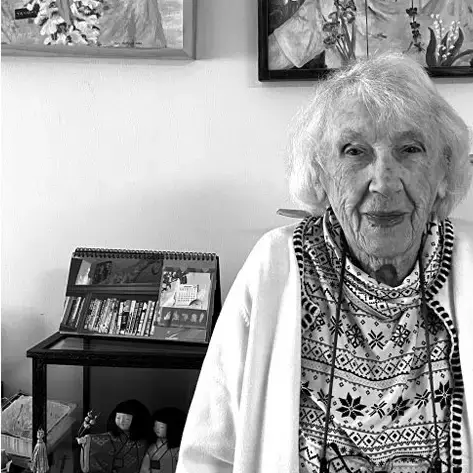
When I moved from the San Francisco Bay Area to a small, rural town in Vermont, I wanted to find a way to contribute to the local community. Knowing there was a significant senior population here, I reached out to the town librarian with hopes of helping elders share their stories.
The local historical society took interest in this idea, which led to an exhibit at the 159-year-old Tunbridge World’s Fair, and a book series entitled Folk Life: Tunbridge Oral Histories. The first two print runs sold out. The second collection of stories has just been published, and people are already asking who will be featured in the third.
What is it about life stories that strikes such a universal chord? And why is it important—and even imperative—to share our stories with others? I interviewed oral historians, teachers, and a digital storyteller to discover more about why the age-old tradition of recording oral histories continues to make such a significant impact for individuals and communities.
Fostering connections and reflection
Storytelling is, according to scientific research, a biological shortcut to human connection. Uri Hasson and fellow researchers at Princeton University discovered that the brains of the storyteller and listener physically sync up while a story is being told, promoting social connection, trust, and empathy.
The more emotionally affecting the story is, the stronger this connection becomes. As emotions and tension rise, hormones are released, including oxytocin, the “bonding hormone”; dopamine, which sharpens focus; and cortisol, which promotes attention and alertness as conflicts in the story arise. These hormonal responses enhance both the listener’s memory and connection to the storyteller.
For Erin Barnaby, a digital storyteller and 11th-generation Tunbridge native, oral histories create a connection not only to people, but also time and place. “My dad recently sold his house to my uncle, a house that he built on land that my grandfather had given to him. I love to hear him tell stories about the shifting of the land, from sheep farms to dairy farms and the shift from open pastures to forests.”
Even when the subject matter might not be instantly relatable, the process of listening to another’s stories still creates a profound interpersonal connection. Esther Ehrlich, who worked at UC Berkeley’s Oral History Center for six years before launching an oral history business of her own, experienced this sense of connection firsthand:
I was assigned an interview with a former medical malpractice insurance guy, which initially didn’t interest me at all. And then lo and behold, after interviewing this man, I found him absolutely fascinating. What I came to discover was that by the time we were done, or even partway in, I came to love every single person I interviewed. I would feel connected to them and them to me.
Providing unique perspectives
From that biological and psychological basis, oral histories make a critical social contribution.
According to the Oral History Association, “oral history is the oldest type of historical inquiry, stemming from the oral traditions of myriad cultures across the globe, predating even the written word.” These personal stories expand upon the narratives of history books, allowing people from varied walks of life to share their unfiltered experiences and perspectives. Indeed, many works by trained historians rely on oral histories.
The founders of Voice of Witness, a nonprofit dedicated to advancing human rights by amplifying unheard voices, believe that oral history “can democratize history, contribute to narrative change, and illuminate issues and events in a profoundly powerful way.” Enabling individuals to safely share their stories opens people’s minds to fresh perspectives and vantage points.
While oral histories are limited to an individuals’ memories and are by nature subjective, they remain incredibly valuable in their ability to paint a portrait of time and place. Plus, their narrative-driven format brings history to life in a more memorable way than date- and fact-focused textbooks.
Helen Marks, a former history teacher who has spoken to thousands of students about her experience as a hidden child in Belgium during World War II, has observed that when a person shares their stories, it brings that part of history to life:
I am among the few surviving hidden children who are willing and able to talk about their experiences in the Holocaust. Reading numbers on a page does not create the same impact as someone standing or sitting in front of you describing a moment that was frightening or was so foreign they didn’t know what to do. . . . I think that when you connect a face, no matter what the face looks like, you get a wholly different reaction than when you read a page full of facts.
Leaving a legacy
Throughout the interviews I conducted for Folk Life, the importance of leaving a meaningful legacy was a common theme. “That’s the reason we share our stories,” says Marsha Higgins, a history teacher for nearly 40 years. “It makes us feel like we matter.”
Higgins taught students to create personal narratives from a young age. Decades later, former students still express their thanks for her guidance in teaching them the importance of recording their experiences.
“I encouraged students to write down things that happened to them. It’s helpful to know at the time, you’re creating chapters in your life, that your story is just as interesting as anybody else’s.”
Like Marks, Higgins grew up around immigrants from Europe. “And they all had stories,” she says. “Whenever we got together, somebody would tell me a story. How do you make conversation without one? It’s just so much a part of who we are.”
“I think everyone wants to know that they have made a positive difference,” says Marks. “That they did some good, that their being here wasn’t just a fleeting moment of nothingness, but that they contributed something. They reacted to something. They gave something. So when you tell stories, that’s where you learn about people and what they value.”
Gaining newfound awareness
Neal Allen, a coach and author (most recently of Good Writing: 36 Ways to Improve Your Sentences with his wife Anne Lamott), spent several years as a hospice volunteer. During that time, he helped a number of people share and record their stories.
“Every week I had one or two clients who were dying, and I spent time fluffing their pillows, listening to their stories and how they approach death. The funny thing is we were always asked, ‘Oh, isn’t that hard?’ It was quite the opposite. It was really quite extraordinary.”
A seasoned journalist, Allen knew how to ask evocative questions. “Oddball memories were coming up that hadn’t come up in 50 years maybe,” he says, which led to more and more stories. “My subjects would get really involved in it. To finish their story, it would take eight to 12 hours, sometimes up to 40 hours.”
Allen wrote a biography about his father, which proved to be a learning opportunity for both him and his brothers:
Once [the book] was bound and we read it all the way through, we had the same reaction, ‘Oh, I didn’t know he had done this. Oh, I didn’t know he had done this. Oh, did you know about that?’ Our second reaction was, ‘We’re not in it,’ and burst out laughing. It was easy to laugh about because he never, ever gave us any sign that he disapproved of us in any fundamental way.
For older adults, sharing stories not only connects them with family, each other, and audiences, it also exercises the brain and fosters a sense of well-being. Story sharing activates memory networks while encouraging reflection on past experiences.
Reminiscence therapy, a structured method of helping individuals recall, organize, and share life stories, has proven helpful in elevating people’s moods, enhancing their self-esteem, resolving conflict, and promoting meaning. This mode of therapy is becoming increasingly popular as a way to support seniors facing cognitive decline as well as mental health challenges.
Storytelling brings us together
Ehrlich notes that more than ever, hearing or reading about others’ stories is a powerful tool for building bridges, especially in this divisive climate.
“We have so much more in common than not,” she says, noting that “there’s a desperate need to understand each other better. Oral history is perhaps a tool for seeing beyond our rigid ideas of who people are and breaking through into a fuller understanding.”
“What always astonished the subject of the memoirs was how many people they had touched,” says Allen. “I think we touch a far greater number of people than we can hold or remember at any one time.”
In this way, sharing stories reminds us that our interactions have more of an impact than we realize, not only in our close-knit circles, but also at work, at school, and even in everyday exchanges.
What sharing our stories boils down to, Ehrlich believes, is that it’s a fundamental human instinct:
How do we live a life? How do we deal with joy and difficulty and disappointment and pleasure? How do we make choices? What do we have control over? What don’t we have control over? Oral histories, at their most basic, include all the stuff that makes us people, including our desire to be seen, heard, and understood. And everybody’s stories matter.