The Ten Kings of Hell
The visual culture of Korea’s Goryeo period (918–1392 CE) paints a resplendent picture of abundance and ease. Full-bodied Buddhist deities in richly patterned textiles, glistening gold accessories, and intricate jade-hued ceramics captivate the senses such that we might forget the turmoil of this opulent era in which ecological disasters, epidemics, and foreign incursion plagued the Korean Peninsula. Uncertain times stoke our natural anxieties toward illness, death, and the afterlife, but these are universal experiences that define humanity across time and space.
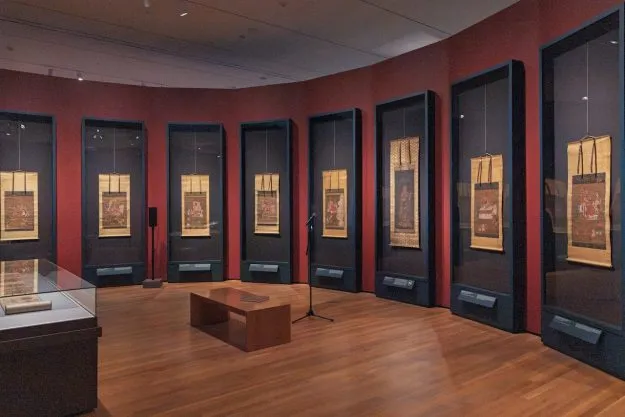
The Cleveland Museum of Art’s “Ten Kings of Hell: The Afterlife in Medieval Korea” is a compassionate exploration of Goryeo-era cosmology. At its core is the groundbreaking reunion of a 14th-century set of Ten Kings of Hell scrolls, internationally dispersed across multiple collections for over fifty years. Known as the Packard Set (after past owner Harry G. C. Packard), these paintings envision the courts of the Ten Kings, who pass judgment upon deceased souls moving through purgatory. Curator Sooa Im McCormick spearheaded the CMA’s 2018 acquisition of the set’s Fourth King of Hell scroll, then set out to bring all ten together. Her efforts led to numerous discoveries, including locating the Third King of Hell scroll in the collection of the Museum of Modern Art, Gunma. Placing these 14th-century masterpieces alongside works by contemporary Korean artists, the resulting exhibition establishes parallel dialogues between medieval and contemporary art forms and their audiences.
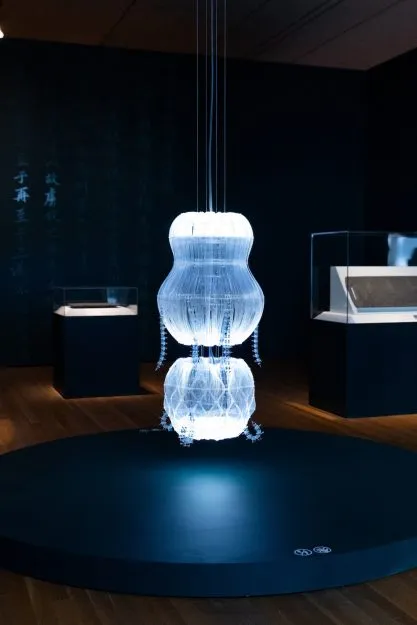
Thematically organized in three sections, “Ten Kings of Hell” sends visitors on a pilgrimage through medieval Korean conceptions of the afterlife. In the first part of the exhibition, “Feast for the Dead,” Anicka Yi’s Bending Willow Branches (2025) stands amid a group of Goryeo-era stone funerary items. This luminous, undulating form evokes a jellyfish, slowly bobbing up and down as it unfurls its tendrils. Yi took inspiration from microbial life-forms whose earliest fossil record dates back approximately 500 million years. Though extinct, these organisms gave life to succeeding generations, a comforting reminder that death is not the end. As McCormick explains, the work sets a hopeful tone, as a “guiding light that accompanies us into the unknown.”
Neighboring Yi’s motorized, LED-lit work, a grouping of medieval funerary wares inspires a different kind of reverie through its stillness. Carved from dark gray stone with light-colored diagonal striations, these coffins and epitaph slabs express the premortem wishes of Goryeo-era elites, who prayed both for celestial protection in the grave and for the well-being of loved ones in the mortal realm. Placing old and new in this tomblike space, McCormick invites us to meditate upon the universal experiences of death, apprehension toward the unknown, and solace for both the living and the deceased.
The adjoining room holds luxury wares that followed their owners into the tomb, evoking the Eurasian steppe’s legacy within medieval Korean cosmology. Celadons with organic designs and heavenly jade-colored glazes provided for luxurious dining, while bronze mirrors and gold adornments furnished ritual needs. A case with small wearable items reveals the talismanic role of personal accessories within elite Goryeo culture. Alongside gold knife sheaths and jade belt fittings are several hosinbul (literally, “Buddha[s] for protection”), miniature sculptures encased in metalwork boxes. Loops atop some surviving hosinbul allowed wearers to tie these portable shrines to their garments.
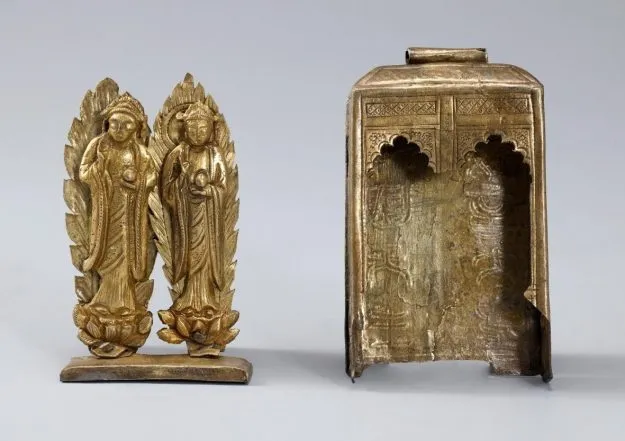
One such example is a pair of gilt silver bodhisattvas whose portable container features a cutout double doorway with scalloped arches. The bodhisattvas stand on lotus pedestals before flaming mandorlas that emphasize their brilliance. Each figure wears flowing robes and a princely crown, while holding a wish-granting jewel in the left hand. Bodhisattvas, though tremendously advanced on the path to enlightenment, forgo nirvana to assist sentient beings still trapped in the six paths of rebirth. As embodiments of compassion, these miniature bodhisattvas may have provided comfort in life and hope for what comes next.
Flanked by bronze incense burners, a red lattice doorway frames the last section of “Feast for the Dead.” Inspired by architectural details in a late 13th-century Korean hanging scroll now at Japan’s Myoman-ji temple, this immersive detail attests to the exhibition’s ingenious design. Beyond these ornate doors, sacred texts unfold in wide vitrines. Among them, the 14th-century booklet Avatamsaka Sutra No. 78 stretches across the room.
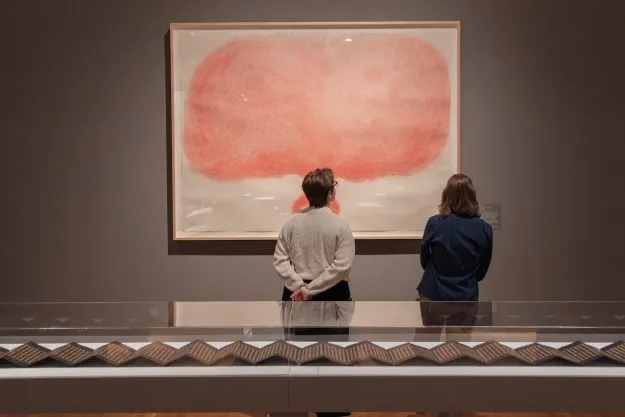
Executed in gold and silver ink on indigo-dyed mulberry paper, this lavishly decorated scripture opens with the young pilgrim Sudhana’s momentous encounter with Maitreya, the Buddha of the future age. Encircling this frontispiece is an elegant design of three-pronged vajras, which keen observers will notice appears on the borders of multiple wall texts throughout the exhibition. Neat columns of elegantly transcribed Chinese characters fill much of the booklet, displaying the astonishing precision and skill of Goryeo-era sutra illuminators. The Avatamsaka Sutra (Flower Garland Sutra) is a foundational text of Korean Buddhism. Patronizing Buddhist texts and images like this generated merit for donors, aiding their efforts to achieve positive rebirth. Paired with Do Ho Suh’s intricately rendered Karma Juggler (2007) on the innermost wall, this space underscores the complex pathways along which our karmic futures are formed.
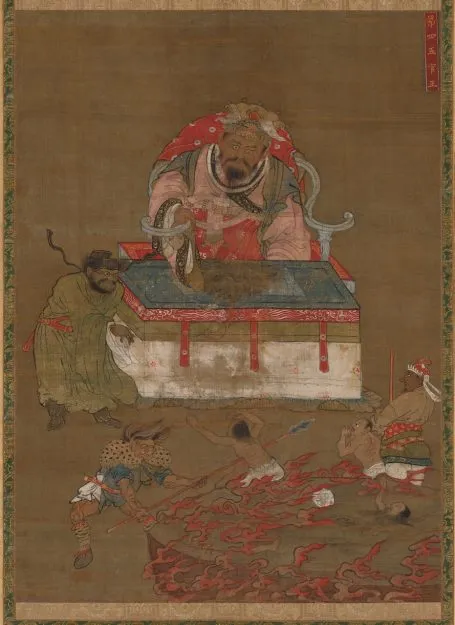
The exhibition’s second section, “Hellbound,” opens with the newly reunited Packard Set. With the exception of the Tenth King of Hell, each scroll pairs scenes of judgment and torture. In the Fourth King of Hell, for instance, the Fourth King leans forward over an ornate, textile-draped table. His imposing figure dominates the upper register, and his stern glare breaks the picture plane, reaching viewers directly. In the lower register, curling flames reach toward a kneeling man who clasps his hands to plead his case. Nearby, a monstrous hell warden poses dramatically while impaling a half-naked figure. Though frightening, this scene occupies far less space than the king above it. In a recent lecture, McCormick noted this hierarchy of scale prioritizes judgment over its potentially gruesome aftermath. As she put it, the kings “are not there to punish sinners but to guide them to live in a more mindful and ethical manner.”
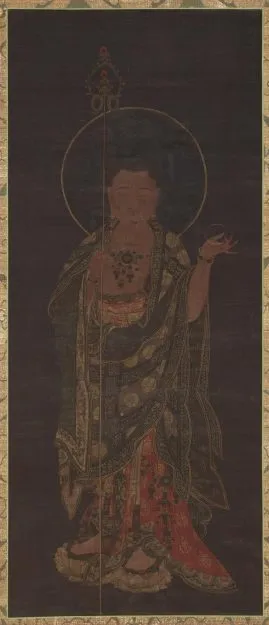
Enshrined at the center of the inner wall, a Goryeo-era painting of the bodhisattva Kshitigarbha makes its public debut. Acquired by the CMA in 2025, this hanging scroll is one of only ten known examples of its kind. Kshitigarbha stands atop a blooming lotus pedestal. His full figure, round features, and rosebud lips radiate elegance as he gazes gently downward through half-lidded eyes. His iconography blends monk and bodhisattva: The shaven head, monk’s staff, and monastic robe (kasaya) recall the humility of a Buddhist cleric, while the meticulous textile patterning, strings of jewelry, and wish-granting jewel confirm his deified status. Kshitigarbha is known for the great lengths he travels to rescue devotees from their hellish trials. By combining celestial splendor with monastic modesty, this iconography may have enhanced his approachability as a foremost figure in Buddhist salvation.
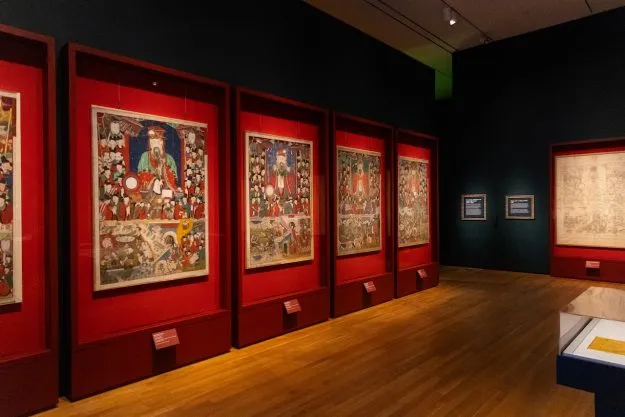
Plunging further into purgatory, the next gallery highlights the fluidity of Ten Kings imagery. Lining the far wall is the Nara National Museum’s set of 13th-century Chinese scrolls, which depict their subjects with magisterial refinement and severity. Along the other two walls, five monumental hanging scrolls (dated 1829) are juxtaposed with their preparatory drawings (dated 1828), a fascinating glimpse into Joseon-era painting ateliers. This 19th-century set reveals a stark shift in priorities: Hell’s horrors appear larger and in far greater detail than in the exhibition’s Goryeo- and Song-era paintings.
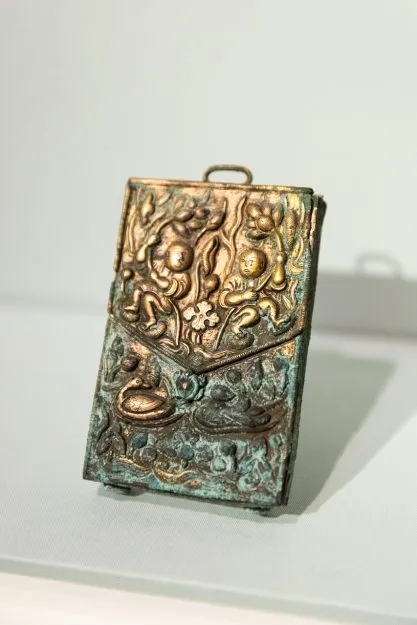
Making their daring escape from the hells, visitors enter the final section, “Salvation in the Pure Land Paradise.” This title refers to the Western Pure Land, a realm of pure bliss overseen by Amitabha Buddha and populated by jubilant celestials. With its palatial architecture, sprawling pleasure ponds, and musical atmosphere, the Pure Land appealed to many Goryeo elites, as visual and textual evidence throughout the exhibition shows. One notable example is a small gilt bronze sutra container adorned with frolicking lotus-bearing children and waterfowl. An animated graphic on the adjacent wall shows it opening to reveal an incised lotus in full bloom. Placed at the section’s entrance, the container evokes the dharma as gateway to positive rebirth and enlightenment.
Vitrines of celadons and bronzes form a flowerlike circle at the center of the first room in this section. Standing in the middle, visitors may feel themselves reborn from the lotus blossoms of Amitabha’s realm. This room also presents visitors with a distinctive facet of Goryeo Buddhist imagery: sculptural and painted triads of Amitabha flanked by bodhisattvas Avalokiteshvara and Kshitigarbha. This grouping has no known scriptural precedent and seems to reflect a strong resonance with Kshitigarbha as a compassionate savior within medieval Korean Pure Land faith.
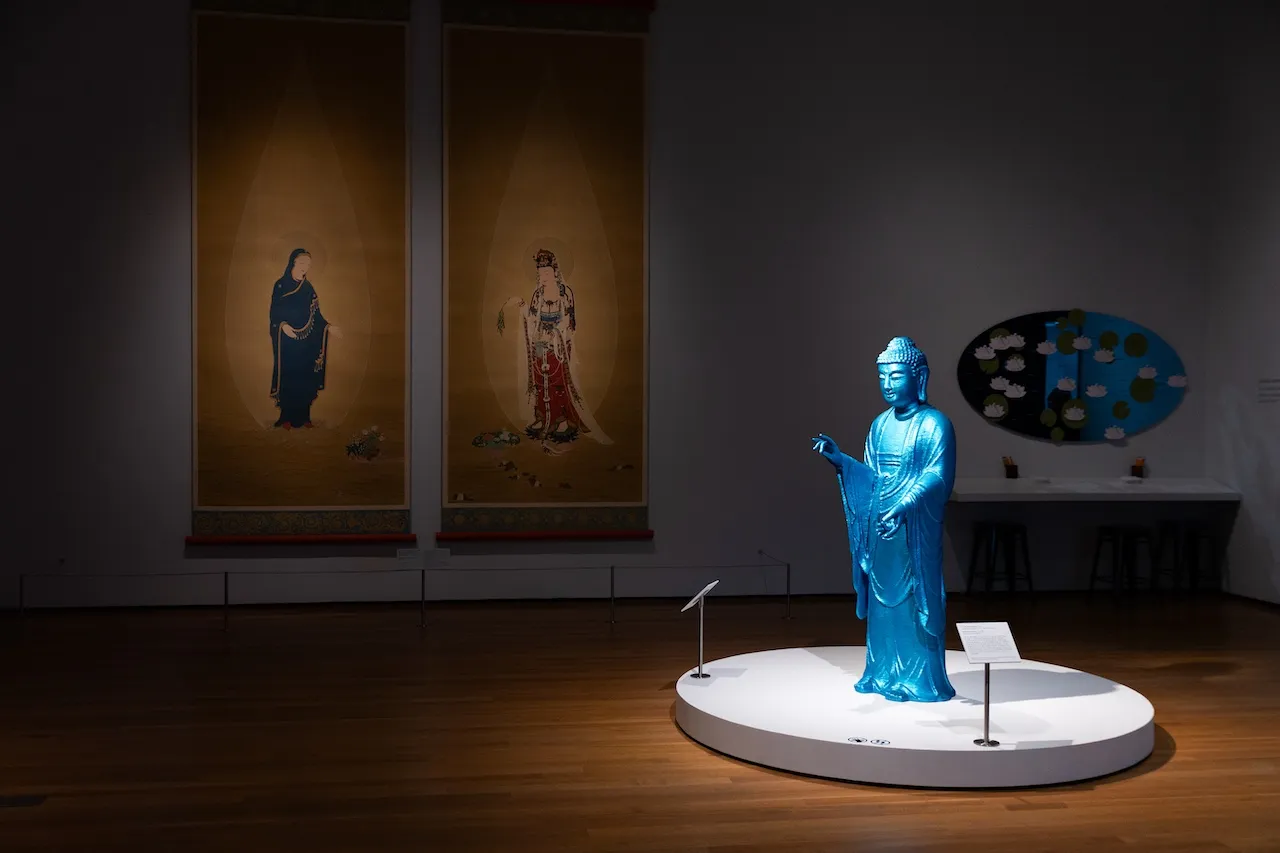
“Ten Kings of Hell” closes with a contemporary vision of sacrality that traverses religious and representational borders. Highlights include Qian Li’s Tidal (2026), an intricately animated video depicting waves ebbing and flowing along the shore. Li painted each frame using watercolor on Chinese paper. Paired with a soothing ocean soundscape, the installation creates a reflective atmosphere in the final gallery. Facing Tidal is Noh Sang Kyoon’s For the Worshipers (2007), a dazzling sculpture of Amitabha Buddha welcoming devotees into the Pure Land. Rows of vibrant blue sequins emphasize his round form and rippling textiles, evoking both the Buddha’s inherent radiance and the materiality of contemporary popular culture. Linking medieval and contemporary understandings of sacrality, this work inspires visitors to conclude their afterlife pilgrimage in the spirit of universal compassion and interconnectivity.
Despite the centuries that separate modern museumgoers from medieval Korean audiences, this exhibition poignantly conveys an existential plight that is shared across temporal and cultural boundaries. By embarking on this immersive journey—from the darkness of the tomb to the uncertainty of judgment, and, ultimately, the solace of the Pure Land—visitors will leave with a newfound appreciation for the emotional depth and sensory richness of Goryeo-era afterlife cosmology. Fundamentally, “Ten Kings of Hell” encourages us to face the unknown with empathy and hope rather than fear.