America’s trade ambassador makes a religious case for Trump economic policies
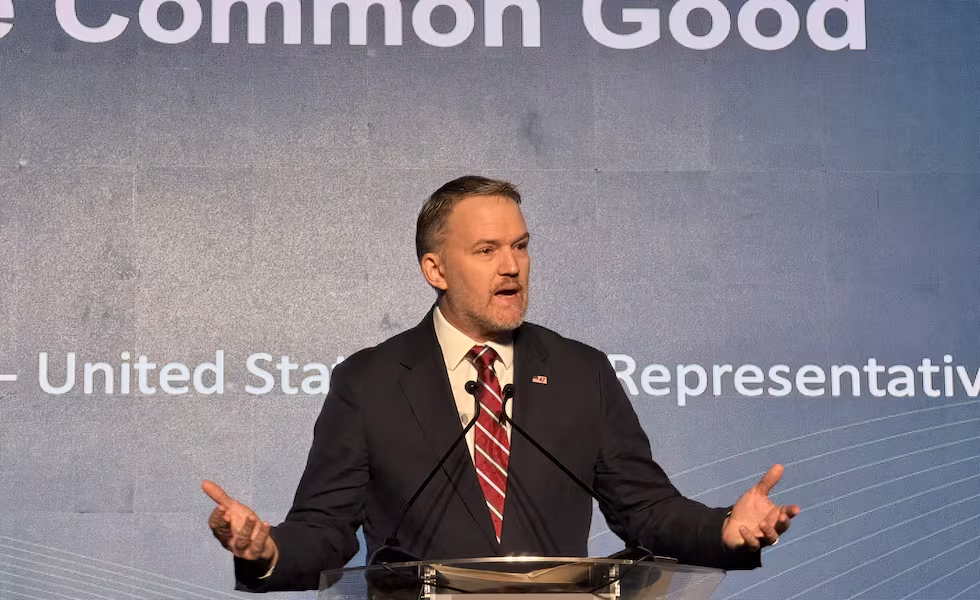
U.S. Trade Representative Jamieson Greer made a religious case Friday for the Trump administration’s economic policies.
Greer asked faith leaders at the G20 Interfaith Forum in Salt Lake City to promote self-reliance, support policies that put families back to work, and discourage addictive gambling and personal debt.
He also said governments and religions should prioritize the idea that all people should contribute to society as producers first and consumers second.
Latter-day Saint leader, world-famous choir host opening ceremony for G20 Interfaith Forum
On Thursday, Greer told the Deseret News that the Trump tariffs he oversees are not the reason for rising inflation two weeks before the midterm elections.
Greer did not directly address them on Friday in his keynote speech during the Interfaith Forum event at the Institute of Religion sponsored by The Church of Jesus Christ of Latter-day Saints on the University of Utah campus.
But he did say the administration’s policies are corrective.
“We are attempting to remedy previous international trade policies that had a negative effect on certain populations in America,” he said. “For several decades, U.S. companies took advantage of laissez-faire trade policies to move manufacturing production from the United States for a variety of reasons.”
Offshoring cost too many Americans the jobs they had in hometown factories, Greer said, when 2021 Pew research found that what they value most is their family, friends and meaningful, sustainable work that allows them to live near those most important to them.
That is the society governments and faith groups should seek to build, he said, one where economic policies lead to careers that support families.
“A thriving society like this results in strong community cohesion and a shared sense of purpose,” he said. “Communities with robust opportunities to work and produce are safer than other communities. They become high-trust societies with lower crime and better health and educational outcomes.”
Greer said that while God does not measure people by their balance sheets, almost all faith traditions believe that he wants and expects people to work. A Latter-day Saint himself, he noted that the Bible’s creation account calls for six days of labor before the Sabbath day of rest.
“So from our earliest days, we were meant to be producers through our labor and not just consumers,” he said. “Work is not only a moral imperative, it is also a blessing to individuals, families and communities.”
He said all economic activity should reflect deeper meaning.
“World religions teach us,” he said, “that God expects people of faith to help the poor and the needy, and not to stand in judgment of them.”
Greer referred to the Latter-day Saint effort in the 1800s to implement a United Order, where participants donated all their material possessions and earnings to the church for an ecclesiastical redistribution.
That and other efforts like it in American history were unsuccessful because of human nature, but they are instructive, he said. One lesson was the need for people to be producers first.
He quoted President Dallin H. Oaks, leader of The Church of Jesus Christ of Latter-day Saints, who observed a year ago the relationship between family life and productive contribution to society.
“Parental influences have also been diluted by the way in which most current members of the church earn a living,” President Oaks said at the church’s October 2025 general conference. “In times past, one of the great influences that unified families was the experience of struggling together in pursuit of a common goal — such as taming the wilderness or earning a living.
“The family was an organized and conducted unit of economic production. Today, most families are units of economic consumption, which do not require a high degree of family organization and cooperation.”
President Oaks at general conference: 'We are a family church'
Greer spoke emphatically to the summit participants about religion calling people of faith to constructive action.
“Religious communities should also highlight and fight human rights violations that create perverse economic incentives, such as the scourge of forced labor, which we’re trying to combat,” he said.
“And they should fight corruption and dishonesty in all its terms. Religious communities should also combat vices that harm the family economy. This can include addictive gambling, which can bankrupt individuals and families with the illusion of generating wealth.”
Greer noted that he sometimes criticizes international organizations that attend forums more often than they engage in practical help.
He joined a panel after his keynote address and said he was impressed by what he called their creative and pragmatic private sector leadership of decisive, faith-based action groups fighting human trafficking, providing education in slums and providing debt relief around the world.
Greer appreciated what he said were concrete, granular solutions.
“I can speak for my administration,” he said. “If you come to us and you have granular ideas, we are action-based.”
The G20 Interfaith Forum is designed to generate concrete action. It meets annually a couple of months before the world’s 20 biggest economic powers meet at the G20 economic forum. The faith leaders, who come from as far away as Constantinople and Sydney, will make faith-based policy proposals to the G20.
This year, Georgetown University is playing a major role as an academic partner to the Interfaith Forum. “We want to make our proposals more rigorous and more relevant to the G20 process,” said Katherine Marshall, vice president of the G20 Interfaith Forum Association.
She said the summit is designed to never forget the marginalized and poor.
“We really want to have an influence on the global agenda,” she said.
While Greer called for action, he also asked faith leaders to preach about self-reliance that builds human dignity, support for the rule of law and the idea that people and governments should live within their means.
While he trumpeted deregulation, he argued for balance.
“Unregulated concentration of production can limit opportunities for new entrants or it can harm consumers,” he said. “Workers may suffer from severe power imbalances in the employment relationship, and firms may engage in business practices that disregard economic or national security or human rights.”
He also made a case that Trump policies are working.
“A long-term commitment to free enterprise has lifted entire generations out of poverty,” Greer said. Last year, in 2025, the poverty rate in the United States dropped to 10.2%, the lowest since data tracking began in 1959.
The panelists who joined Greer were:
- Kim Tan, co-founder of the Transformational Business Network Alliance, which provides education for $5 a month to 4 million primary students in the slums of Africa and Asia
- Anne Simmons-Benton, chair of Women20 USA, which uses metrics and case studies to provide recommendations to policymakers to close gender gaps that hurt families and economies
- Eric LeCompte, executive director of the Jubilee USA Network, which provides debt restructuring to those in extreme poverty, which includes winning over $130 million in debt relief
- Kevin Hyland, who was the United Kingdom’s first anti-slavery commissioner
- Vinya Ariyaratne, president of the Sarvodaya Shramadana Movement, a grassroots development organization in Sri Lanka that has been called “Buddhism in action on social issues”