‘The Goal Is Healing’: Confronting Community Erasure in the Blank Slate Narrative
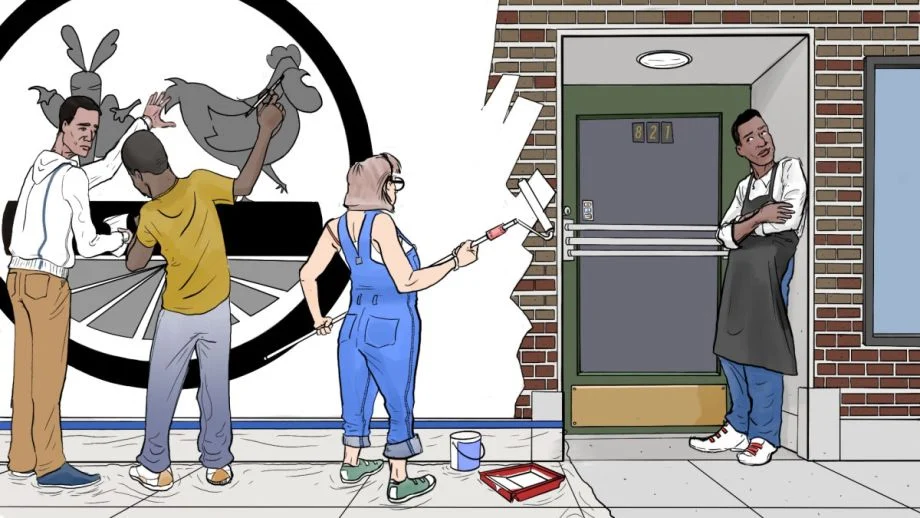
Illustration by Joe Williams (Waȟpethuŋwaŋ Dakota) / (Courtesy of ThirdSpace Action Lab)
Sponsored content from The People’s Practice. Sponsored content policy
In 1960, Robert P. Madison designed the Medical Associates Building on Cleveland’s East Side as a space for Black doctors who wanted to serve the community but who’d been excluded from the city’s medical institutions. It was the first multi-story healthcare facility for doctors of color in Ohio, according to its architect — the state’s first licensed Black architect. And it still stands not only as a symbol of the Black community’s roots and resilience, but also as a signpost for future generations who want to build on its legacy.
Today, it houses the ThirdSpace Reading Room, a community gathering space and bookstore that honors that legacy in its mission: “To create the next generation of free thinkers.” The space is owned and operated by ThirdSpace Action Lab, a grassroots solutions studio created to disrupt the cycle of disinvestment and displacement in communities of color.
This storied history of the Medical Associates Building is among the highlighted destinations on the digital and interactive map from Chocolate City Cleveland, a multimedia “time machine” project from ThirdSpace that documents the history of Black Cleveland to “inspire new visions for Cleveland’s Chocolate City Corridor.”
Mordecai Cargill, ThirdSpace’s co-founder and creative officer, enthusiastically shares the project as one of many counterweights against “the Blank Slate” narrative that dominates community development in the area — and indeed in communities of color nationwide.
“The stories we tell ourselves shape how people interact with a place,” says Cargill. “It’s important for us to tell the right story.”
According to the Blank Slate myth, disinvested neighborhoods (predominantly within communities of color) are effectively an empty canvas for outsiders to test new ideas, when in fact these neighborhoods have living histories, community assets, and residents with their own visions for what their neighborhoods need. Blank Slate is one of 11 dominant narratives that uphold structural racism in the sector, according to research from The People’s Practice, an initiative and digital platform powered by ThirdSpace that builds a more equitable future through anti-racist community development practices and collective action.
The People’s Practice’s research takes a keen interest in how narratives shape development strategies specifically because they inform how developers interpret problems—or choose their solutions.
“The more you say a thing,” says Cargill, “the more it can shape our understanding of reality.”
Through the Blank Slate lens, developers can enter communities and “revitalize” them without consideration for what was there before or the consequences of replacing it.
“One of the things that I find really interesting and challenging about the Blank Slate narrative is that you’re making an agreement that there was nothing there to begin with,” says Lex Draper Garcia, director of community engagement and programs at Black Bottom Archives, a project that documents and retells the story of the Black Bottom neighborhood in Detroit that was erased by urban renewal. “That is not the case for many neighborhoods where this narrative is being applied.”
Both Black Bottom Archives and Chocolate City Cleveland offer a direct rebuttal to that narrative by affirming these rich histories and employing them to re-root a place-based perspective.
“If I live in a neighborhood that’s described as dangerous all the time, then perhaps I start to feel less comfortable going outside,” says Cargill. “But if I start to hear my neighborhood described as a place that my grandparents looked forward to moving into, perhaps that changes the way that I walk down the street.”
That shift not only serves to preserve what remains, but also to create space for anti-racist community development to intervene in what ultimately gets built and for whom.
“Perhaps the reason why narrative is so important is that it touches everything,” says Luis Ortega, director and founder of Storytellers for Change. “Narrative is not just a communication strategy; it’s also a policymaking strategy, a grantmaking strategy, also a community engagement strategy.”
With The People’s Practice, Ortega produced an anti-racist community development narratives toolkit structured to guide practitioners through identifying the narratives that operate in their personal lives before connecting them to a systemic level, beginning with their racist origins.
“The toolkit really invites anyone who cares about community development to center the role that stories and historical narratives play in how we think about what it means to engage in the field,” says Ortega. “Can we understand the historical patterns that have led us to the systems and structures that generate predictable inequity, injustice, harm, and trauma? If we don’t see the pattern, how are we going to intervene?”
The work of abandoning these harmful narratives for restorative ones is twofold: For practitioners from outside the communities they serve, the process requires owning up to harm, plus conceding space for communities to inform what comes next.
“If the Blank Slate narrative is what currently dominates how we think about development, particularly in communities of color,” asks Ortega, then, “what would be not only the mirror-opposite of that narrative but the restorative version of it?”
Envisioning these alternatives is difficult work, especially when dominant false narratives limit our imaginations for what’s possible. That also goes for the communities these narratives harmed.
“These communities experiencing displacement or disinvestment are also experiencing extraction and exclusion,” says Ortega. “Asking folks to talk about history — while also asking them to imagine a future together — creates some tension. But I’ve watched folks create some kind of healing by being included.”
That’s ultimately the goal of narrative shifting, says Ortega: Acknowledging the harm — and doing the work of remedying it — generates healing.
“The goal is not difficulty,” he says. “The goal is healing.”
Ultimately, projects like Black Bottom Archives and Chocolate City Cleveland not only preserve the past for the communities, but also use the past as a point of departure to inspire a new vision for the future.
“We have examples that we can remix and use as inspiration,” says Cargill. “It’s not just about community development. It’s really about how we live together as neighbors.”
Learn more about The People’s Practice
The People’s Practice is an initiative and digital platform, powered by ThirdSpace Action Lab, building a more equitable future through anti-racist community development practices and collective action. Explore its research, community stories and tools at thepeoplespractice.org.
Frances Nguyen is a freelance writer, editor of the Women Under Siege section (which reports on gender-based and sexualized violence in conflict and other settings) at the Women's Media Center, and a member of the editorial team for Interruptr, an online space for women experts to disrupt discourse in traditionally male-dominated focus areas. She is currently working on a creative nonfiction portfolio on race, identity, and the American Dream.