Gallium-doped zinc oxide enables 24.92%-efficient HJT solar cell
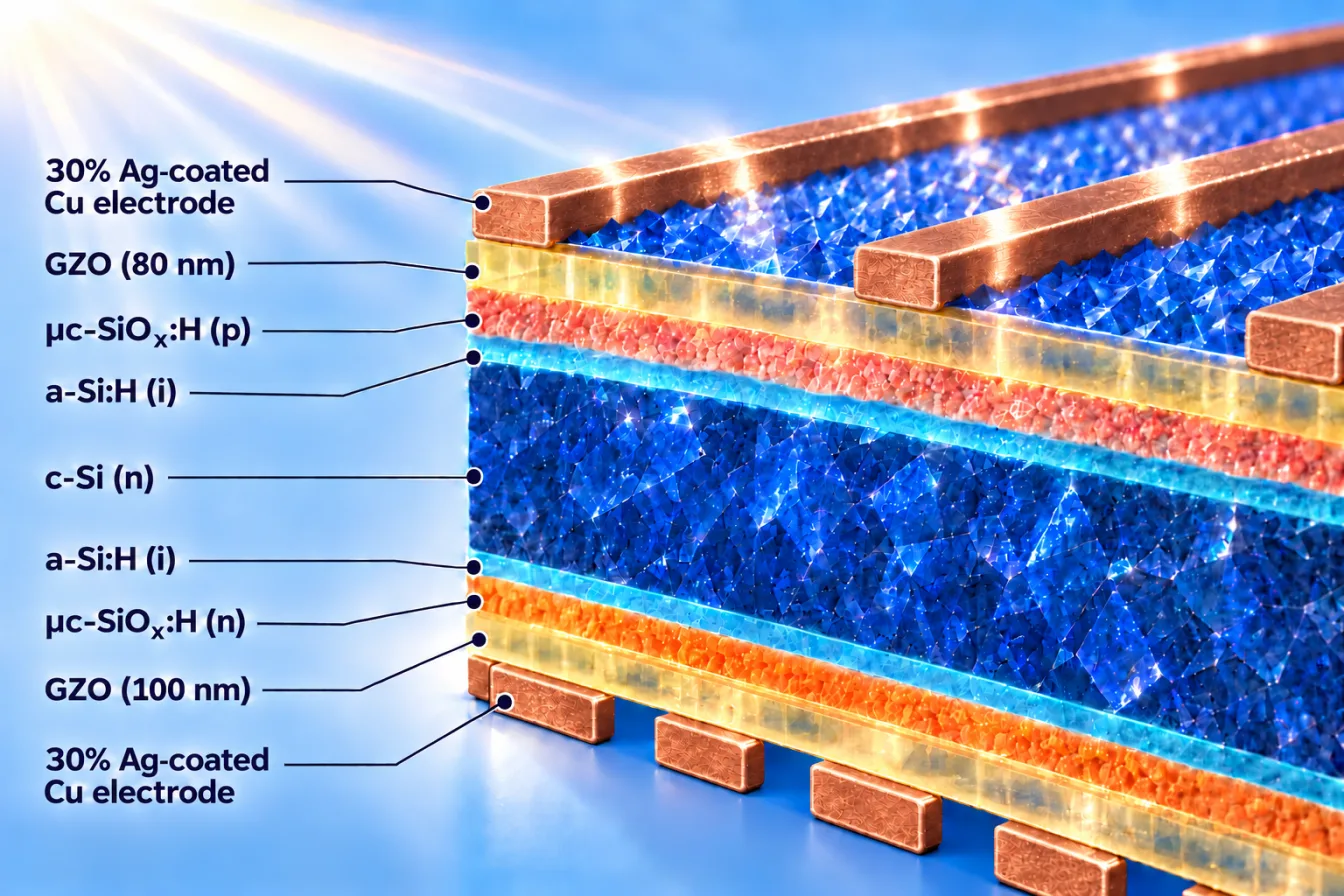
Researchers in China have investigated gallium-doped zinc oxide (GZO) as an indium-free transparent conductive oxide (TCO) for silicon heterojunction (HJT) solar cells. The approach aims to reduce manufacturing costs and reliance on scarce indium used in conventional transparent electrodes.
“The high cost of indium has driven the development of indium-free alternatives to conventional TCOs for HJT solar cells,” the group explained. “In this study, the structural, morphological, electrical, optical, and chemical properties of GZO films were investigated by combining in situ optical emission spectroscopy (OES) with ex situ characterization.”
The researchers fabricated HJT solar cells using n-type crystalline silicon wafers measuring 210 × 105 mm and approximately 130 μm thick. They chemically cleaned and textured the wafers, then deposited intrinsic amorphous silicon passivation layers and doped microcrystalline silicon oxide layers on both sides by plasma-enhanced chemical vapor deposition.
They then deposited GZO transparent electrodes at room temperature using reactive plasma deposition, with thicknesses of 80 nm on the front and 100 nm on the rear. The team varied the oxygen fraction in the oxygen-argon deposition gas from 5% to 25%, while keeping the total gas flow constant, and screen-printed contacts using 30 wt% Ag-coated Cu paste.
They monitored the plasma using optical emission spectroscopy and characterized the films’ crystal structure, surface morphology, oxygen chemical states, electrical properties, and optical transmission. Finally, they measured the cells’ current-voltage characteristics under simulated sunlight at 1,000 W/m² and 25 C, comparing their performance with a reference HJT cell featuring indium-based transparent electrodes on both sides.
“The film deposited at an oxygen content of 10% exhibited the optimum electrical properties, with a minimum resistivity of 4.902 × 10⁻⁴ Ω cm and an average optical transmittance of 83.45% in the 400-1100 nm range,” the results showed.
“The GZO film deposited at 10% oxygen showed the typical hexagonal wurtzite structure with a pronounced preferred orientation,” the group added. “When the optimized GZO films were applied as TCO electrodes in HJT solar cells, a conversion efficiency of 24.92% was achieved. Compared with the HJT solar cell with double-sided ICO, the efficiency was only 0.68% lower.”
The article “24.92% efficient crystalline silicon heterojunction solar cells with Ga-doped ZnO transparent conductive oxide films by RPD” has appeared in Solar Energy Materials and Solar Cells. Researchers from the Chinese Academy of Sciences, the University of Chinese Academy of Sciences, China’s Dinto Solar and Anhui Huasun Energy have contributed to the research.