Who Gets to Protect the Ocean? Coral Catch is Expanding the Circle of Marine Conservation
Happy Eco News Who Gets to Protect the Ocean? Coral Catch is Expanding the Circle of Marine Conservation
Reading Time: 3 minutesIn Indonesia, Coral Catch is helping women gain the skills, confidence, and opportunities to become divers, researchers, educators, and leaders in marine conservation.
Marine conservation is often measured in numbers: corals planted, reef area restored, biodiversity returning. Those numbers matter, and Coral Catch tracks them closely. But as the Indonesian nonprofit’s work grew, so did a different question: who gets the opportunity to protect these ecosystems?
Coral Catch began in Indonesia’s Gili Matra Marine Protected Area with a focus on coral restoration. Over time, the team saw that its impact was reaching beyond the restoration sites. Women were growing more confident underwater, pursuing roles in marine conservation and research that once felt out of reach, and finding opportunities to become educators, advocates, and mentors.
As more women moved through the program, these individual experiences began to form something larger: a pathway into marine conservation that connects training and diving opportunities with research, restoration, community engagement, and professional development. Coral Catch began to see that its impact was not only about how much reef it could restore, but also about who had the opportunity to become an ocean protector and what could happen when that opportunity continued beyond the initial training.
Tania’s experience is one example of what that pathway can make possible. She grew up in Tangerang, a city far from the ocean, and arrived on Gili Air in January 2025 determined to become a marine researcher. Over nine weeks, she trained as a diver and graduated as a scientific diver, gaining not only technical skills but also the confidence to pursue a place in marine conservation.
Today, Tania leads shark research in the Gili Matra Marine Protected Area, studying how tourism affects white-tip reef sharks using underwater cameras and acoustic monitoring. She has secured her own research grant and now mentors new Coral Catch participants, becoming part of the same network that helped her move forward.
Cenna’s experience reflects another side of the access challenge. Growing up in Surabaya, she saw diving as something women around her did not commonly pursue. At university, she joined a diving club and loved being underwater, but field positions often required experience she had not yet had the opportunity to gain.
In 2022, an online talk by a Coral Catch alumna showed Cenna that marine conservation could be a path for her too. She joined Coral Catch’s second group of participants and later worked in sustainable fisheries and community development. Today, she is Coral Catch’s Project and Partnerships Manager, supporting the program and the women coming through it.
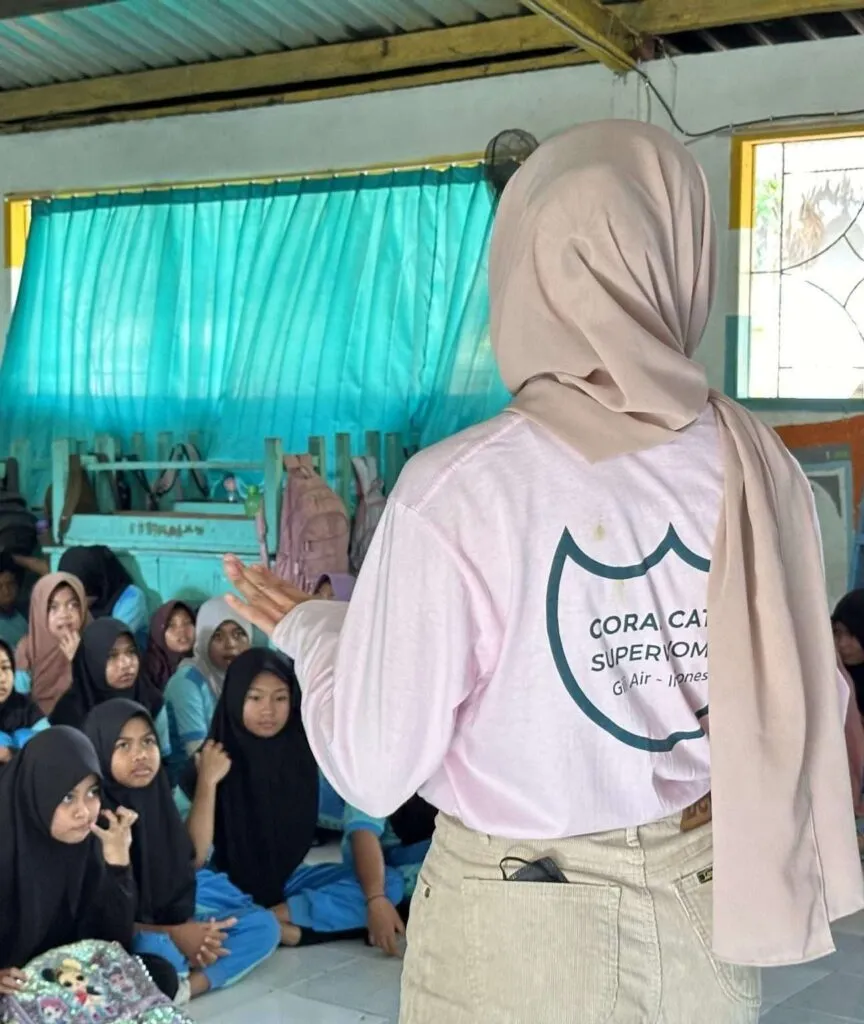
A Coral Catch Superwoman shares marine conservation lessons with local schoolchildren, extending the program’s reach far beyond the reef. Photo courtesy of Coral Catch
Their journeys are now part of a much larger network. Coral Catch has trained 44 Indonesian women, with around 50% progressing to professional-level diving qualifications, and the organization aims to reach 100 women by 2030. Many alumni continue working in marine conservation or sustainable tourism, sharing what they know with their communities, returning to Coral Catch as mentors or taking on new roles, and becoming examples for younger women who may not have previously seen themselves in conservation.
This network is central to how Coral Catch approaches conservation. Through its Academy and other programs, participants can move from learning and hands-on training into research, restoration, community engagement, and professional opportunities. The goal is not simply to provide access to the ocean, but to create pathways that allow people to build skills and continue contributing long after their initial training.
That approach matters because access to marine conservation is not equal. Through its work, Coral Catch has seen women face barriers to marine education, diving, field experience, and conservation careers. At the same time, coral reefs support livelihoods, food security, tourism, and coastal protection, making the health of these ecosystems closely connected to the communities around them.
Coral Catch’s work therefore extends beyond its training programs. The Gili Dive Club gives local community members access to diving and marine conservation training every Sunday, creating another entry point for people who want to develop practical skills and become involved in protecting their local marine environment. Coral Catch also organizes conservation expeditions twice a year, giving participants opportunities to turn travel into meaningful, hands-on experiences in marine conservation.
The same approach is now being explored beyond Indonesia. Through its collaboration with Universiti Malaysia Terengganu, Coral Catch is looking at how lessons and approaches developed through its work in Indonesia can be adapted to support women and coastal communities in a different regional context.
That does not mean simply copying the Indonesian model. Malaysia has its own cultural, ecological, and institutional context, so Coral Catch is working with local partners and listening to what communities and women there need. What carries forward is the broader foundation of conservation, empowerment, local capacity building, and community ownership.
For Coral Catch, restoring reefs remains essential. But conservation is also about creating the people and pathways needed to sustain that work. When women have access to training, field experience, research, mentorship, and professional opportunities, they can become not just participants in conservation, but divers, researchers, educators, mentors, and leaders shaping the future of the world’s oceans.
The post Who Gets to Protect the Ocean? Coral Catch is Expanding the Circle of Marine Conservation appeared first on Happy Eco News.