‘Cotton Rose Pavilion’
In August of 805 CE, court eunuchs in the Tang dynasty capital at Chang’an ended the six-month rule of high-ranking official Wang Shuwen’s political reform group. Shortly afterward, the new emperor, Xianzong, exiled ten of the group’s key members. Among them was 32-year-old Liu Zongyuan (773–819), the politically ambitious descendant of a declining aristocratic family. Recognized in Chang’an as something of a child prodigy, Liu had passed the highest imperial exam (becoming a jinshi) at only 20 years old. From an early age, he was widely regarded as a literary master, and people from near and far visited him to receive tutoring, articles, poems, or even a few brief lines of writing. Together with Han Yu, Liu led the burgeoning Classical (Guwen) Movement, which advocated clear, concise, structurally simple, and relatively free writing (which had been popular before the Jin dynasty), often for social, moral, and political ends. At the same time, Liu rose quickly through the ranks of the central government. But when the reform movement failed, Liu was sent a thousand miles away to Yongzhou Prefecture in modern South China’s Hunan Province. Except for a brief month in Chang’an in 815, Liu would spend the rest of his life as a demoted official on the southern margins of the Chinese empire: first in Yongzhou Prefecture (805–815), then farther south in Liuzhou Prefecture, modern Guangxi Province (815–819). Trapped in an alien landscape, Liu went on to write many prose and verse pieces in the Guwen style, almost all of them imbued with the environment of South China or the experience of exile, as well as Liu’s flickering (but never extinguished) political ambition. Though Liu died in exile, through his writings he secured a place for himself in Chinese history—something he had failed to do in politics—one deeply intertwined with the landscapes of South China.
When Liu arrived in Yongzhou in 805 to serve as a minor official, he found himself houseless and took up residence in two local Buddhist temples, Longxing Temple and Fahua Temple. He befriended the heads of both temples, as he expresses in “A Poem Composed in Return for the Reverent Monk Xun’s Gift, the Fresh Tea He Gathered from among Bamboo.” Liu found life in Yongzhou very difficult. His mother died soon after they arrived in the area. His friends and connections in the north seemed to have abandoned him. Moreover, with few official duties, Liu had no way to realize his political ambitions. He soon developed thiamine deficiency, a condition common among northerners exiled to the south. The condition weakened his legs and, eventually, contributed to his death in Liuzhou in 819. However, in late 808, Liu’s symptoms subsided.
Over time, Liu explored Yongzhou’s distinct landscape. In his poetry and prose from this period, he reflects on his discoveries and his complex relationship with his new home. He describes plants that are rarely if ever mentioned in Chinese poetry, such as white myoga ginger and the tree of longevity, as well as climate phenomena distinct to South China, such as the plum rain season. Eventually, he set up residence beside Ran Creek, a stream he discovered on one of his hikes in the region, and set about cultivating the surrounding landscape. While still a rising official in Chang’an, Liu had received high praise for his writing. As Liu’s friend Han Yu writes, “He won fame immediately. Out of admiration, people were eager to make his acquaintance.” But it was in Yongzhou that Liu’s literary talent, sparked by suffering and nurtured by imposed leisure, short journeys, and painful meditation, reached its height. Readers today can still glimpse Liu’s remarkable life through this poetic garden.
–Nathaniel Dolton-Thornton & Yu Yuanyuan
A Poem Composed in Return for the Reverent Monk Xun’s Gift, the Fresh Tea He Gathered from among Bamboo
Xiang bamboo shades a fragrant thicket
where pearls of dew form, clear and bright.
At dawn, the snowy mountain’s hermit
gathers the rare tea’s early leaves
where rising mist shrouds rocky rapids,
hardly a foot below the red cliff’s ledge.
Round or square, his fine, lacquered boxes
hold tea like flawless court jade.
I call my servant to light the bronze stove.
The lingering scent reaches distant retreats.
Purifying thoughts, it reveals one’s true self,
returning to the source to clear foul and evil.
It’s like Buddha’s holy meal, sweet dew,
with a scent that fills the whole of Vaisali.
O! These companions from the immortals’ islands—
aren’t they worth more than Rose-Light Wine?
Cotton Rose Pavilion
The new pavilion overlooks a red railing.
Fine cotton roses unfurl their blossoms.
Their pure scent travels far on the dawn breeze
while pearls of cold dew sharpen their damp colors.
Free, at ease, they transcend this mortal world,
lifting and drooping in countless lovely poses.
I’ve heard the teaching on the emptiness of forms;
as for everything’s creation: who’s the craftsman?
I linger in the clear autumn moonlight.
The temple bell drifts from far-off mountains.
After an Early Summer Rain, Exploring Foolish Creek
As soon as the long rain has ended,
I trace Foolish Creek’s bends alone,
using my cane to gauge wild springs,
untying my sash belt to corral young bamboo.
So why do I still drift and waver?
I’ve wanted this solitude a long time.
Feeling lucky I’ve left the social ladder,
I chant to quiet the blistering heat.
♦
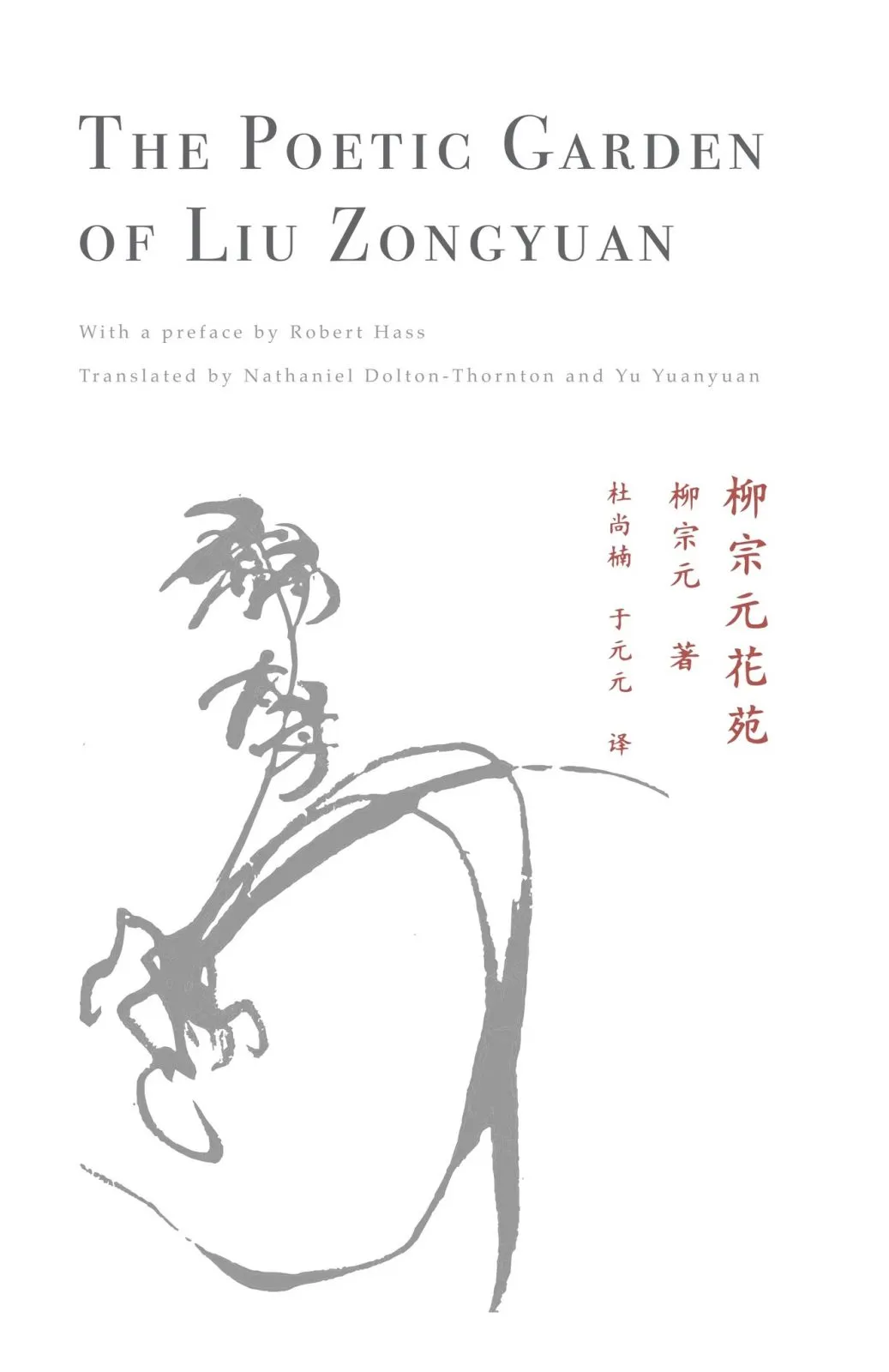
From The Poetic Garden of Liu Zongyuan by Liu Zongyuan, translated by Nathaniel Dolton-Thornton and Yu Yuangyuan. Translation © 2025 by Nathaniel Dolton-Thornton and Yu Yuangyuan. Reprinted with permission from Deep Vellum Publishing.