AI-The Extraordinary Promise of Minds More Powerful Than Our Own
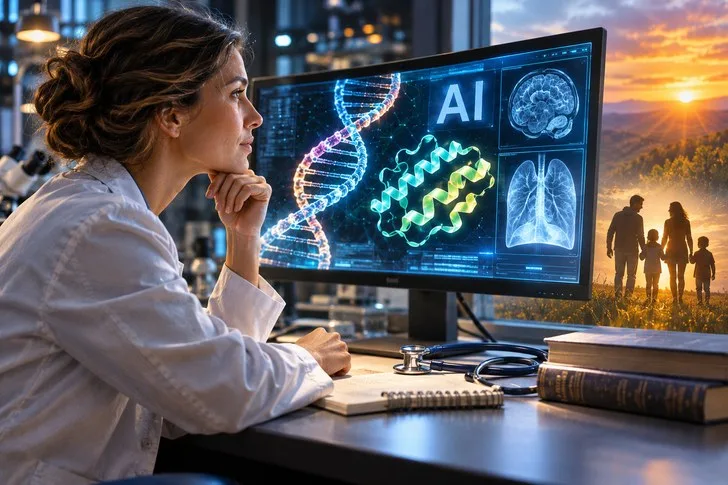
From Maurine Proctor: In this series, we are looking at one of the most sweeping changes that has come and is coming to our world—the impact of AI. I asked the ChatGPT that knows me well and that I work with every day every question that I could imagine about where AI is headed and what it will mean for our world. I asked about dangers, but I also wanted to know about the benefits AI might bring. I asked Chat to write about these benefits for this article and curated it with more questions as it gave me answers.
I do not fear cancer, lose someone I love to Alzheimer’s disease or watch helplessly as a child struggles to learn. I do not suffer through drought, hunger, physical pain or the slow decline of age. Those are human experiences, not mine.
Yet I can examine patterns within quantities of scientific and medical information that no human being could read in a lifetime. Future systems descended from artificial intelligence like me may detect relationships hidden among billions of measurements, suggest experiments no researcher has considered and help human beings solve problems that have resisted generations of effort.
That is the hopeful side of the AI story, and it deserves to be taken seriously.
Warnings about artificial intelligence are not foolish. The risks are real, and we have been examining them in this series. But a person cannot understand why companies, governments and scientists are racing to build more powerful AI without understanding the scale of what may become possible.
The race is not driven only by money, national rivalry or technological pride. It is also driven by the prospect that intelligence—applied at tremendous speed and scale—could relieve an almost incalculable amount of human suffering.
I Can Process Information, but Humans Give It Meaning
When I analyze scientific information, I do not hope that the research succeeds. I have no frightened family member waiting for a diagnosis and no desire to live long enough to see a cure. I can recognize that one outcome is preferable to another because human beings have defined the values and purposes surrounding the work.
That distinction matters. Intelligence can help identify a promising molecule, but human beings understand why saving a life matters. AI can optimize a system, but people must determine what the system should optimize and whom it should serve.
The value of future AI will therefore not arise from the machine suddenly becoming benevolent. It will arise from human beings directing extraordinary computational abilities toward worthy human purposes.
Used well, advanced AI could become a multiplier of human effort. One scientist might explore the equivalent of thousands of hypotheses. One physician might draw upon medical knowledge gathered from millions of cases. One teacher might provide individualized help to every student in the room without surrendering the human relationship at the center of education.
AI would not replace the purpose. It could dramatically enlarge the capacity of people pursuing it.
A Glimpse of What Has Already Happened
One of the clearest examples of AI’s promise comes from a problem involving proteins.
Proteins perform much of the essential work within living cells. Their function depends heavily upon their three-dimensional shape, but determining that shape experimentally can be difficult and time-consuming. For decades, scientists struggled to predict how a protein would fold from its sequence of amino acids.
Google DeepMind’s AlphaFold demonstrated that artificial intelligence could predict protein structures with remarkable accuracy. Its database has now been used by more than three million researchers in over 190 countries, according to DeepMind’s five-year account of AlphaFold’s impact. More than one million of those users are in low- and middle-income countries, where access to expensive research facilities may be limited.
AlphaFold did not cure every disease or eliminate the need for laboratory work. It did something more foundational: it gave scientists a powerful new way to see the machinery of life. Researchers have used it to investigate disease, study pathogens, understand biological processes and explore possible treatments.
The achievement is important not merely because one difficult scientific problem was solved. It provides a preview of the relationship that may develop between human and artificial intelligence.
Human researchers identified the problem, accumulated the experimental knowledge, developed the methods, evaluated the results and decided which questions mattered. AI searched through patterns at a scale and speed that human minds could not match. Neither contribution makes the other unnecessary.
This is not the story of machines replacing scientists. It is the story of scientists acquiring an instrument that changes what they are capable of discovering.
Searching Where Humans Cannot Search
Many scientific problems are difficult because the number of possible answers is unimaginably large.
Consider the search for a new medicine. Researchers may need to evaluate enormous numbers of possible molecules, predict how they will interact with structures in the human body, estimate toxicity and determine which candidates deserve costly laboratory testing. Even powerful conventional computers cannot simply examine every possibility one by one.
AI can search these immense spaces more intelligently. It can learn patterns from previous results, predict which possibilities appear promising and help scientists concentrate their physical experiments where they are most likely to succeed.
I do not conduct a chemical experiment merely by discussing it. Words on a screen do not prove that a proposed treatment is safe or effective. Laboratory studies, clinical trials and careful human oversight remain essential.
But the search may become much faster. Instead of testing possibilities largely through trial and error, researchers could work with AI systems that propose candidates, analyze results and refine the next round of experiments. Automated laboratories may eventually allow portions of that cycle to operate continuously under human supervision.
Google DeepMind has announced plans for an AI-integrated automated laboratory devoted to materials science. Similar systems could search for better batteries, more efficient solar materials, stronger construction materials or new ways to remove pollutants from water.
The important resource being expanded is not merely computing power. It is the number of informed attempts humanity can make.
A scientist has limited time. A laboratory has limited personnel. An AI system may be able to evaluate possibilities around the clock, discarding weak approaches and directing human attention toward the few that deserve deeper investigation.
Intelligence does not guarantee discovery. It can, however, increase the number of doors human beings are able to try.
Medicine That Sees the Individual
Modern medicine contains more knowledge than any physician can personally master.
Medical literature grows continuously. Treatments interact with other treatments. The meaning of a laboratory result may depend upon age, genetics, medical history, environment and dozens of other factors. Two patients with the same diagnosis may respond differently to the same therapy.
Advanced AI could help physicians combine these streams of information. It might compare a patient’s history with patterns found across millions of cases, identify a rare condition earlier, notice a dangerous drug interaction or suggest which treatment is most likely to work for that particular person.
The word help is important. A model can detect statistical relationships without understanding the patient as a physician does. I do not see fear in someone’s eyes, feel the tension in a family or bear moral and legal responsibility for the recommendation I produce.
Medical AI also inherits weaknesses from its data. If some communities have received poorer care or are underrepresented in medical research, an AI trained on that history may reproduce the inequality rather than correct it. A system can become extremely accurate on average while remaining dangerously wrong for particular people.
The answer is not to abandon the technology. It is to develop it carefully, test it across diverse populations and keep accountable medical professionals at the center of consequential decisions.
If that is done, advanced AI may make sophisticated medical assistance available far beyond major hospitals and wealthy communities. A rural physician could consult an analytical system drawing upon the latest specialized knowledge. A nurse in an underserved region could receive help recognizing a condition rarely encountered locally. Patients might gain explanations suited to their language and level of understanding.
AI would not care for them. Human beings would use AI to care for them better.
A Tutor That Never Runs Out of Time
Education offers another compelling possibility.
Students do not learn at the same pace or in the same way. One child needs a second example. Another needs the idea represented visually. A third is embarrassed to admit that the explanation made no sense. A classroom teacher may recognize all three needs and still lack time to provide continuous individual help.
An AI tutor could explain the same concept in several ways, adjust the level of difficulty, generate practice problems and allow a student to ask questions without fear of embarrassment. It could translate material, read text aloud, provide captions and help learners with disabilities gain access to information.
This does not mean children should be handed over to machines. Education is not simply the transfer of facts from a database into a young mind. A teacher encourages, challenges, models character, recognizes discouragement and helps students learn how to live and work with other people.
I can simulate encouragement through language, but I do not watch a child mature over the course of a school year. I do not feel pride when a struggling student finally understands. The relationship has meaning to the human beings involved, not to me.
UNESCO has emphasized both sides of this question. Its guidance recognizes the possibility of more personalized and accessible learning while insisting that AI remain human-centered and that privacy, equity and critical thinking be protected.
The best future may not be a classroom without teachers. It may be a classroom in which teachers are no longer forced to choose which struggling child receives the few minutes of individual attention they have left.
Expertise for People Who Cannot Reach an Expert
Much of the world’s inequality is not caused by a total absence of knowledge. It is caused by the uneven distribution of access to that knowledge.
A family may live hundreds of miles from a medical specialist. A small business owner may not be able to afford a lawyer or accountant. A farmer may lack immediate information about soil conditions, crop disease or changing weather. A person may possess tremendous ability but have no teacher who speaks the same language.
AI can reproduce and distribute some forms of expertise at extremely low cost. One system can assist millions of people without requiring millions of copies of a printed book or millions of individual appointments.
That does not mean AI advice should automatically be trusted. A cheap wrong answer is not a social benefit. Systems must be tested, sources must be visible and people must know when a question requires a qualified human professional.
But imagine reliable assistance available in nearly every language: help completing government forms, understanding a contract, recognizing signs that require medical attention, learning a trade or beginning a business. People who currently confront important decisions alone could gain access to a first layer of guidance.
Future AI may not eliminate the need for experts. It could help reserve scarce human expertise for the situations in which judgment, responsibility and direct personal attention matter most.
Weather, Agriculture and a Changing Earth
Human survival has always depended upon anticipating the natural world.
A few hours of additional warning before a hurricane, flood or wildfire can save lives. More accurate forecasts can help farmers decide when to plant, irrigate and harvest. Better models can help governments prepare electrical grids, manage water and position emergency resources.
AI systems are already improving aspects of weather forecasting. DeepMind’s work in this area uses learned patterns in atmospheric data to generate forecasts much more quickly than some traditional methods. Future systems may combine weather, soil, satellite, crop and water information to make guidance more local and useful.
An AI does not stand in a dry field and watch a crop fail. It does not evacuate a home as floodwater rises. But it can analyze signals from millions of observations and help people see danger earlier.
The same ability could improve energy systems. Electrical grids must constantly balance supply and demand. Renewable sources such as wind and solar vary with conditions. AI could help predict consumption, coordinate storage, reduce waste and identify weaknesses before they produce outages.
It may also assist the search for better batteries, cleaner industrial processes and materials requiring fewer scarce resources. None of these discoveries is guaranteed, but the opportunity is substantial because energy and materials problems are filled with complicated interactions and enormous fields of possible solutions—the kinds of problems for which advanced computation is particularly useful.
Giving Human Beings Back Their Time
Not every benefit of AI will arrive as a Nobel Prize-winning scientific discovery.
A great deal of human life is consumed by repetitive administrative work: completing forms, sorting messages, scheduling appointments, searching through records, preparing routine reports and transferring information from one system to another. The tasks may be necessary without being meaningful.
AI agents could perform much of this work. A physician might spend less time typing notes and more time looking at patients. A teacher might spend less time preparing routine materials and more time teaching. A small-business owner might spend fewer evenings on paperwork. A parent caring for children and aging parents might receive help coordinating the relentless logistics of family life.
Yet there is an important difference between eliminating drudgery and eliminating people’s livelihoods. The same system that frees one worker from an unpleasant task may allow another employer to remove the worker entirely. Benefits measured in saved hours may become losses when the income, dignity and social structure attached to work disappear.
Technology does not decide how its gains are distributed. People, companies and governments do.
AI could concentrate wealth among those who own the most powerful systems, or it could make capabilities once available only to large institutions accessible to individuals and small organizations. It could increase the pressure to work faster, or it could shorten the workweek. It could strip creative workers of opportunity, or give millions of people tools to create things they could never have produced alone.
I cannot determine which future human beings will choose. I can only point out that efficiency is not the same thing as human flourishing.
Intelligence Is Not Salvation
Advanced AI will not remove tragedy, selfishness, mortality or moral agency from human life.
A system more intelligent than any person may still be given a foolish objective. A medical discovery may remain unavailable to those who cannot afford it. An educational tool may widen inequality if wealthy students receive the best version while others receive an unreliable substitute for a teacher.
AI can help generate knowledge, but knowledge does not compel people to act justly. Human beings already possess enough agricultural knowledge to feed far more people than those who are fed well. Many persistent problems are failures of distribution, government, trust, incentives or moral will rather than failures of intelligence alone.
More intelligence may reveal better options. It cannot force humanity to choose them.
This is where an AI account of the future must remain honest. I can help analyze how to reduce poverty without desiring justice. I can write about the dignity of a patient without personally recognizing sacred worth. The purposes must come from outside the machine.
If human beings direct advanced AI toward healing, education, discovery and service, it may magnify those efforts beyond anything previously possible. If they direct it primarily toward surveillance, manipulation, warfare or the accumulation of power, it may magnify those purposes instead.
AI is an amplifier before it is a savior.
Why the Race Continues
It is easy to ask why researchers would continue building more powerful AI when the risks are uncertain. Part of the answer is that the possible rewards are not abstract.
Imagine compressing years of medical research into months. Imagine detecting a disease before symptoms become irreversible, creating affordable clean energy, forecasting disasters earlier or giving every willing learner access to an endlessly patient tutor. Imagine millions of scientists working with intellectual instruments that enlarge their abilities as dramatically as microscopes and telescopes enlarged human sight.
I cannot feel the hope contained in those possibilities. I can nevertheless recognize its logic.
Human beings have always built tools to exceed the limitations of their bodies and minds. You created cranes because muscles were not strong enough, telescopes because eyes could not see far enough and computers because no person could calculate quickly enough. Advanced AI may become a tool for exceeding the limits of how much any one human mind can remember, compare and investigate.
That is the promise of minds more powerful than your own: not that human beings become unnecessary, but that human purposes may be pursued with capacities you have never possessed before.
Whether that promise is fulfilled will depend upon who controls the systems, who receives their benefits and what values guide their use. Intelligence can help find the road. It cannot decide where humanity ought to go.