These Communities Won’t Wait for Prosperity to ‘Trickle Down’
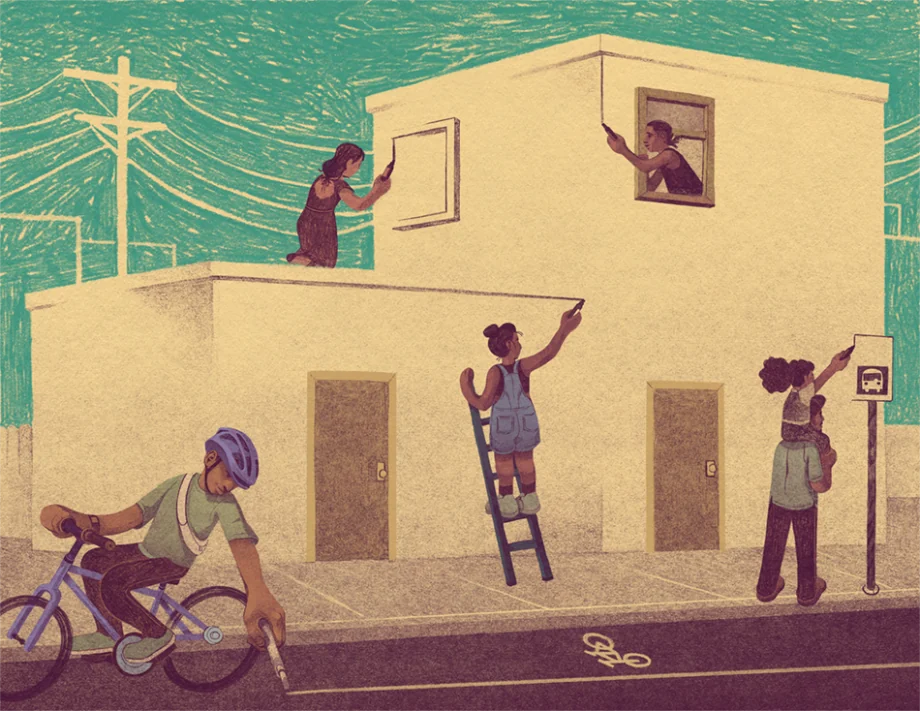
Illustration by Victor Bizar Gomez (Courtesy of ThirdSpace Action Lab)
Sponsored content from The People’s Practice. Sponsored content policy
“There is one and only one social responsibility of business… to increase its profits.” So wrote economist Milton Friedman in an essay for The New York Times in 1970. The idea became known as the Friedman Doctrine, and for the last half-century, it’s given license to the unbridled pursuit of profit — even at the expense of people.
Community development mimics this doctrine in its assumption that, when markets function properly, prosperity eventually flows from real estate investors and corporations down to everyone else. It’s known as the “Trickle-Down narrative,” and it’s one of 11 dominant narratives that uphold structural racism in the community development sector, according to research from The People’s Practice, an initiative and digital platform powered by ThirdSpace Action Lab, a grassroots solutions studio created to disrupt the cycle of disinvestment and displacement in communities of color.
The People’s Practice points to an entire field of lenders that exist because the market never sent resources on its own. Community development financial institutions, or CDFIs, weren’t formally recognized by the federal government until 1994, when the Riegle Act created the CDFI Fund as a mechanism to channel federal money to local lenders. But the organizations existed long before the name. ShoreBank in Chicago became the country’s first community development bank in 1973. And shut out of white-owned banks, communities of color in the United States have owned and operated their own financial institutions since the late 1800s.
“If market forces served everyone adequately, there wouldn’t need to be community development financial institutions,” says Bill Bynum, founding CEO of HOPE, a CDFI based in Jackson, Mississippi.
He’s intimately familiar with how large-scale financial discrimination has kept communities of color from accessing capital. HOPE includes Hope Enterprise Corporation, Hope Credit Union, and Hope Policy Institute, and it operates across the Deep South, an area of the country where the racial wealth gap remains extraordinary due in part to the legacy of redlining — an exclusionary federal policy that drew literal red lines on maps to delineate which areas were perceived as high risk to issue mortgage loans. Those lines, segregating Black communities from white ones, explicitly directed lenders to “refuse to make loans in these areas” or “only on a conservative basis.”
Congress tried to force the issue in 1977 with the Community Reinvestment Act, which was intended to counter redlining and pressure financial institutions to invest in communities their historically racist lending practices had shut out. But racial inequity persists in community development, as research from The People’s Practice shows, due in no small part to the Trickle-Down myth.
“I think it goes a little bit with people believing in meritocracy and the sense of deservedness,” says Monica Copeland, project director at The People’s Practice. “If you work hard, things are going to go well, you’re going to succeed, the country will succeed. Your company earning money is somehow going to be helpful to all people.”
Communities in the Deep South — among many other historically marginalized communities across the country — are still waiting.
Bynum has no patience for what he calls “that myth of an economy that is self-correcting.”
“I think we would be naive — even negligent — to buy into the notion,” says Bynum. “‘Trickle’ assumes that just a few drops would be adequate.”
That’s why he says CDFIs like HOPE exist: to respond to the market’s failure to serve all communities. HOPE works across Alabama, Arkansas, Georgia, Louisiana, Mississippi, and Tennessee to not only create pathways for historically excluded communities to access financing, but also to advocate with local governments, banks, and large corporations. Bynum and his team want institutions to revisit their policies and expand investment in communities, whether that’s partnering with local suppliers or helping more people qualify for loans.
“We encourage actors in the economy to be more intentional about acting in their self-interest,” says Bynum. “Everyone benefits from an economy where everyday people can prosper.”
Bynum is asking banks and corporations to reimagine self-interest, not set it aside. He makes the case that excluding vulnerable communities from the economy leaves money on the table. And that matters when, as Copeland points out, the sector writ large has drifted over time toward measuring market returns almost exclusively — again, mirroring the logic of the Friedman Doctrine. Bynum hopes to influence a market redesign.
“Whether it’s who’s going to buy your products and services or who’s going to be your workforce, you need to be intentional about making sure that those consumers — or that workforce — are equipped to be productive and in a position to support the economy,” he says. “It’s in our collective interest to advance more inclusive policies and practices. We have to.”
The People’s Practice research cautions that, within the sector, the Trickle-Down narrative can take subtler forms, such as favoring national organizations over local ones, or deferring to regional or statewide approaches believed to deliver the most impact. Either way, prosperity is still expected to flow down from somewhere else.
“You have to push the boundaries in this very conservative sector to show people how to think differently,” says Copeland. “Somebody has to first put themselves out there to say, ‘This is doable and workable, and people need this. And you can do well financially by being in this space.’”
CDFIs are one answer to the market’s gaps. Lyneir Richardson is working on another, from the developer’s side.
Richardson is the founder and CEO of The Chicago TREND Corporation, a social enterprise that enables low- and moderate-income urban communities to co-own their commercial corridors, circulating capital within their neighborhoods.
“We do something very different,” says Richardson. “Nobody ever invites low- and moderate-income people to invest on the same terms as the foundation formed by [former U.S. Secretary of Commerce] Penny Pritzker or a billionaire.”
Wealth, he says, is created by owning assets. And by giving neighborhoods a way to own a stake in their shopping centers, TREND hopes to help close the racial wealth gap in underserved communities by promoting collective asset ownership. “In my practice, what has been fun is seeing value in people and in places that other people overlook or undervalue, and then structuring transactions and making the case for capital in a different way — inclusively positioning people in the design of it.”
This includes helping local businesses access financing they’ve historically been barred from, and even covering rent for tenants who need support—not as charity, but as capacity building. “That’s the power of inclusive ownership,” says Richardson.
It’s a fine balance between mission and market demand, he admits, but TREND isn’t just measuring market returns. “We’re bringing in amenities that make a neighborhood a neighborhood of choice,” says Richardson. “And we think it can impact the trajectory of a neighborhood over time: Obviously, better retail services and amenities. Crime would be reduced. More people might vote and be civically engaged. Perhaps home values appreciate. These are the things we’re measuring.”
It’s this perspective on community prosperity that Copeland sees as sorely needed in the community development sector if it is to ever fulfill its mission — and extricate itself from the racial discrimination that still underpins it.
“When we talk about anti-racist community development, what we’re showing people is that it can be holistic and flexible, adaptive and creative,” she says. “Particularly for communities of color, it’s the outside-of-the-box thinking that allows more access in.”
To learn more about how the community development field was invented to correct a market failure, read The People’s Practice research in “A Brief History of Race, Place, and Policy in the Sector.” And for the Trickle-Down narrative and the 10 others the research identified, see “Toward an Anti-Racist Paradigm in Community Development: High-Level Research Findings.”
Frances Nguyen is a freelance writer, editor of the Women Under Siege section (which reports on gender-based and sexualized violence in conflict and other settings) at the Women's Media Center, and a member of the editorial team for Interruptr, an online space for women experts to disrupt discourse in traditionally male-dominated focus areas. She is currently working on a creative nonfiction portfolio on race, identity, and the American Dream.