Maintaining trust in new tech
Standards are often invisible to the people who rely on them, yet they underpin the confidence that products will work together, operate safely and perform as expected. But rapid technological change resulting from digitalization and the widespread use of AI is challenging traditional ways of assessing conformity to standards.
“Standardization and confirmity assessment (CA) bring tremendous value by providing trust in new technology,” says Wolfram Zeitz, executive secretary of two of the IEC CA systems, IECEE, which is the IEC System of Conformity Assessment Schemes for Electrotechnical Equipment and Components, and IECRE, which is the IEC System for Certification to Standards Relating to Equipment for Use in Renewable Energy Applications.
“What has changed is the speed of development. In the past, product cycles took up to three years before prototypes appeared,” he adds. “Now change happens far, far quicker and this creates a feeling of uncertainty. Consumers lose trust when they think development was rushed and conformity is not being adhered to.”
Henrike Gördes, head of governance at DKE, the organization hosting this year’s IEC general meeting, agrees: “A product that conforms to relevant standards provides assurance that it will behave in predictable ways and interact appropriately within a wider technological ecosystem. This ability to create trust has been one of the foundations of the success of standardization over many years. But maintaining that trust is becoming more challenging as technology changes at an accelerating pace.”
The potential undermining of a standards-based order is particularly acute when software, data or AI can alter a product’s behavior. The question is no longer simply whether the product was safe when it was tested. It is also how organizations can ensure that it remains safe and operates as intended following updates, changes in data or advances in AI, which are happening faster and faster.
Keeping pace with AI
The problem with attempting to standardize systems and products in an emerging environment is that the technology may not be mature enough to stabilize. “Particularly for AI, we don’t yet have industrial consensus on the technological framework,” says Zeitz. “AI tools are using different technological setups almost daily. Standardization and conformity assessment are struggling to keep up with the speed of development.”
Progress is being made, however. CASCO, the ISO committee for CA, is working with ISO/IEC SC 42 on ISO/IEC 42007, a draft standard offering a high-level framework and guidance for the development of CA schemes for AI systems.
Cybersecurity is one of the challenges related to AI, and in this area the IECEE Industrial Cyber Security Programme, which is based on the IEC 62443 series of standards, is already well established. A new pilot CA program has also recently been initiated with IEC TC 62, the technical committee that prepares standards for medical devices, to look at how AI can be assessed.
All new technologies need to be trusted
While AI is very much the focus of global attention, a host of new technologies required in our evolving world – notably to meet net-zero targets – also require standards and CA to be used safely and effectively. Different countries around the world need to trust that manufacturers providing the technology and products meet the appropriate benchmarks.
The difference is that these technologies are not evolving at the same pace as AI-based systems and are therefore easier to assess. For instance, IECEE provides a testing and certification scheme for electric vehicle (EV) battery systems, assessing their safety, performance, interoperability, energy efficiency, electromagnetic compatibility and hazardous substances. It also operates a specific EV program, which can test and certify charging systems, stations and plugs against relevant IEC standards, including IEC 62196-1 and the IEC 61851 series.
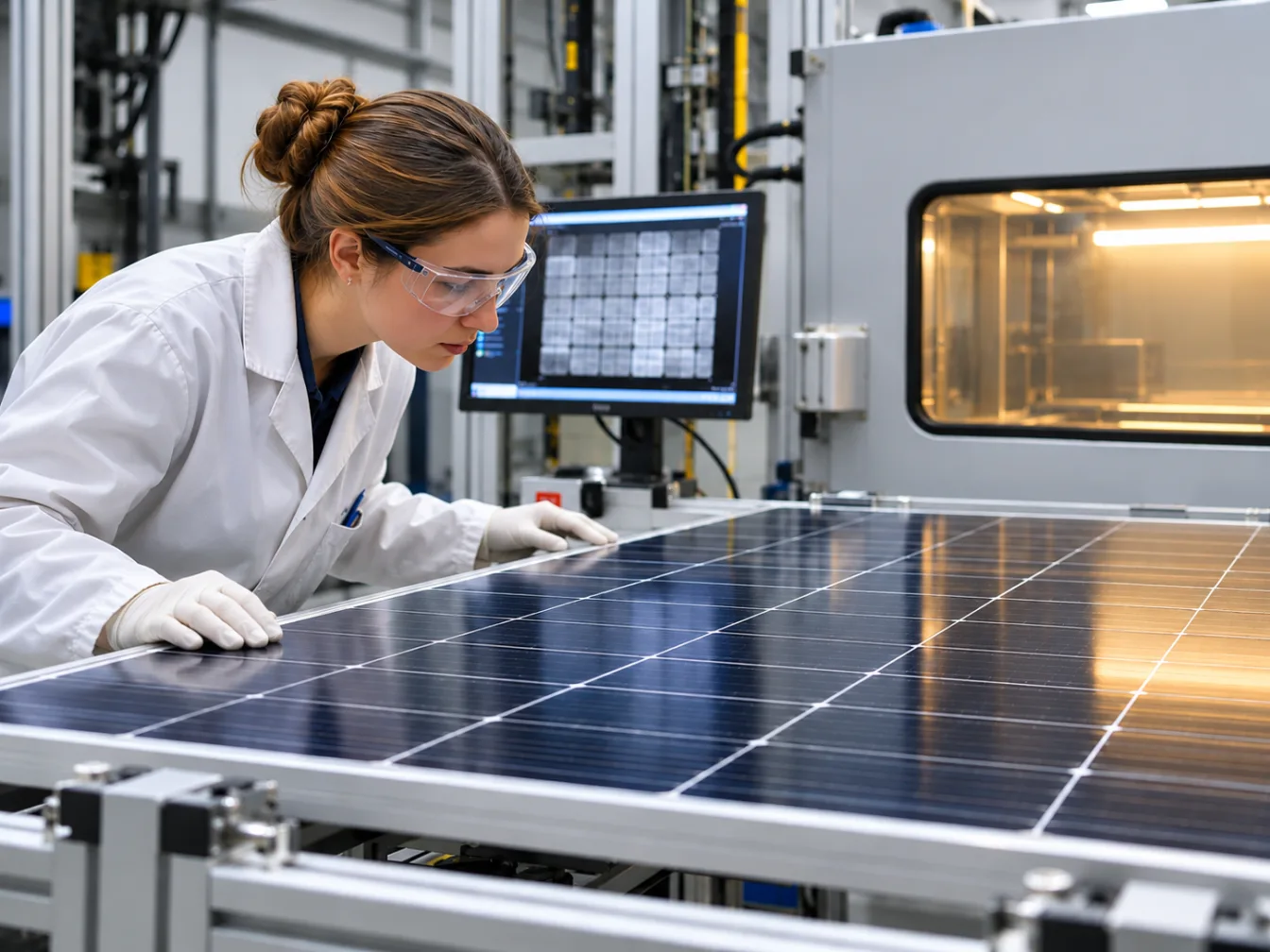
IECEE is also the go-to body for ensuring that solar panels and components are safe and perform as planned through its national certification bodies and recognized testing laboratories. The system relies on IEC standards for module performance, durability and safety. IEC 61215 covers design qualification and type approval of terrestrial photovoltaic modules, while IEC 61730 addresses electrical and mechanical safety through construction and testing requirements.
IECRE was established a little more than 10 years ago to help provide third-party certification and testing services for all power plants producing, storing or converting energy from wind, marine and solar PV energy. The CA system ensures that the essential quality and safety requirements in standards are met and, as a consequence, that reliable performance can be expected from all these systems.
For the wind sector, for example, that means checking that the industry aligns with the IEC 61400 standards, developed by IEC TC 88, the technical committee that produces standards for wind energy systems.
Conformity assessment is evolving
Traditionally, CA has often followed a relatively linear model: a product is developed, tested and assessed, and then the assessment provides assurance about that product. Digital and AI-based technologies complicate this.
“Take the introduction of autonomous control in cars, for example. You could have a software update that basically changes the way the self-driving vehicle operates,” says Gördes.
This raises an important question for conformity assessment: What does it mean to demonstrate that a product remains safe and performs as intended when the product itself can continue to change?
“Rather than assessing a product only at a particular point in its development, assessment needs to take account of what happens throughout the product’s lifecycle,” Gördes says.
DKE advocates a shift from a linear model of CA toward a more continuous, cyclical approach. “Such an approach could help connect CA more closely with the reality of digital products, where development, deployment, updating and monitoring can form an ongoing process rather than a sequence that ends when a product is first assessed.”
The aim, as outlined in this DKE white paper, is to develop an approach that better reflects products and technologies that can change throughout their operational life.
DKE is working with stakeholders from different industries and in cooperation with DIN and VDE, Germany’s national standards bodies, to develop the concept. “DKE has a strong interest in ensuring that emerging thinking can ultimately contribute to international standardization,” Gördes says.
Independent assessment is essential to ensure trust
The international dimension matters because standards and CA operate across markets. Manufacturers, regulators and users need confidence that assurance mechanisms are meaningful not only within individual national systems but also across increasingly global technology ecosystems.
“Our entire framework of requirements is based on international agreements and consensus,” explains Zeitz. “Every member country, no matter how big or small, has the same voting rights. The voice of Germany or the US has the same weight as Kenya. This is embedded in our governance and this matters because the community and the public need to know that a requirement – whether technical or procedural – is not just the opinion of one party. International agreement and consensus building is a strong factor in trust.”
“Only third-party assessment gives full independence,” Zeitz insists. “That’s why our CA systems rely on completely impartial laboratories, certification or inspection bodies. Only such a set-up can give the market full trust and confidence in the safety, efficiency and interoperability of the different products.”
Author: Adrian Pennington
The International Electrotechnical Commission (IEC) is a global, not-for-profit membership organization that brings together 174 countries and coordinates the work of 30.000 experts globally. IEC International Standards and conformity assessment underpin international trade in electrical and electronic goods. They facilitate electricity access and verify the safety, performance and interoperability of electric and electronic devices and systems, including for example, consumer devices such as mobile phones or refrigerators, office and medical equipment, information technology, electricity generation, and much more.