‘Second Morning in West Texas’
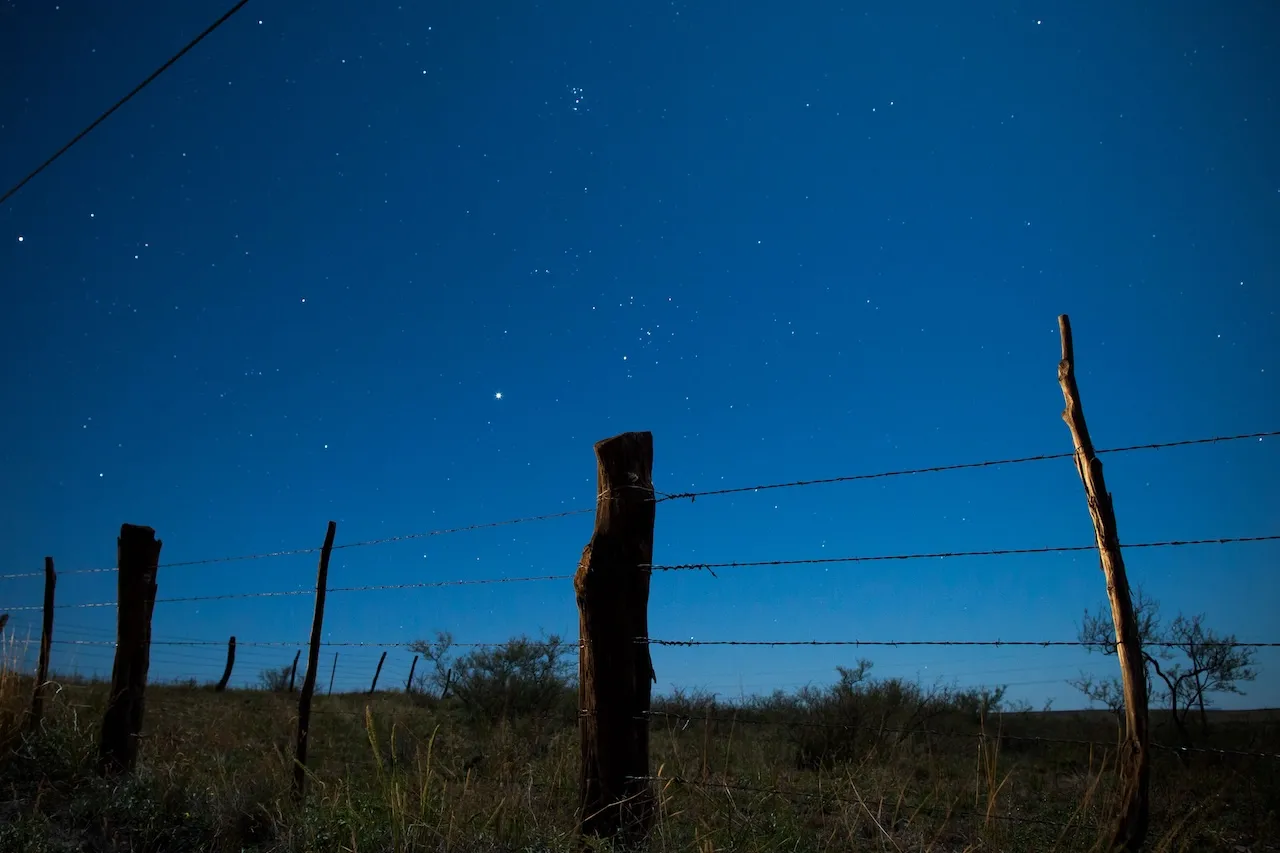
In the fall of 2016, Yang Licai traveled to the States from China and spent a few months in our home in West Texas while we were away for work. It was there that he finished Pee Poems. The train that tries to wake him again and again in these poems is the same train that succeeds in waking us each morning, and perhaps this serves as a metaphor for the biggest challenge we faced as translators of this book: how to bring forth the wonderful spirit of its author, who chooses the difficult dream over an easy life.
We became friends with Yang in 2012, when we all lived at Akademie Schloss Solitude, an artist residency in Germany. He was there as a music/sound fellow, but beyond his performances and various other creative practices, he is known as a gardener, builder, teacher, and promoter of experimental music. For many years Yang Licai ran an art space and music store in the 798 district in Beijing, and in fact we first crossed paths with him there, very briefly, in 2009. By that time, financial and political forces had pushed out nearly all the other artist-run spaces, so his tiny store, with a wall of floor-to-ceiling CDs, was particularly memorable. We both recollect him calling out a greeting from the loft above. Within a year, authorities would ransack this space and violently force him out.
In an interview conducted during the protest he staged immediately after the destruction of his store and home, Lao Yang stated: “This is not performance art. Art is like a lame act of charity in the face of life’s cruelty. When someone sets himself ablaze with gasoline, just to illuminate his sabotaged home, it naturally eclipses the impact of any work of art. . . . Until we have secured our rights, we cannot practice art, cannot live with art, cannot think artistically or observe this world with an artistic eye.” Years later he explained his own creative practice to us in this context, saying that it is not art, but what comes before, when art is not possible. “Don’t call me a poet, call me a piss person,” he writes at the beginning of this collection.
Yang has also called himself a “noise maker and its noise.” From his writing it is clear that the clamor he makes is directed beyond the ear, to the social and spiritual origins of the listener’s attention. One of our easier tasks was conveying the urgency of Pee Poems, but what proved much more difficult was rendering the mix of subtlety and straightforwardness in his language. In his Chinese text, there is often an orthographic interrogation of characters. Take for example the aphoristic fragment “人 从 众 / 众 从 人” (literally: “person from multitude / multitude from person”), which simply shows us the movement from the pictograph for “person” (人) to the compound ideographs “from” (从) and “multitude” (众). This is a particularly beautiful palindrome in which the movement from person to multitude is mirrored, to show both creation and decreation; or, there is a contract in the language itself (the formation of the characters) between the singular and the plural, which the author is helping us remember. The multitude is built from the person, and that conjunction itself—from—requires a movement from one (person) to two. Our thoughts went first to the seventh section of George Oppen’s “Of Being Numerous” (“Obsessed, bewildered // By the shipwreck / Of the singular // We have chosen the meaning / Of being numerous.”), but this and other references would be politically misleading, so in the end we decided to make the simplest translation we could think of: “One of many / many of one.”
Language play and puns are frequently used in Pee Poems, and readers of our English translation might think of this book in conversation with works by Marcel Duchamp and John Cage. Seeing as Yang Licai was one of the early apostles of sound art and experimental music in China in the 2000s, these readers would not be wrong—one can imagine him nodding in agreement to Cage’s “Farting, don’t think, just fart,” or Duchamp’s “Art is not about itself but the attention we bring to it.” Or one might think of the Black Mountain poets or the anti-poems of Nicanor Parra. But focusing on Western aesthetics obscures this young Chinese poet’s radicality, as well as his place in traditions that go back many hundreds of years. In the style of some Tang dynasty poets, Yang Licai writes intensely about solitude, longing, and friendship, but like Zhuangzi, he is concerned primarily with the most complex and elusive of concepts: freedom and peace. Having a creative practice that actively promotes these ideas and denounces their antagonists, Yang lives with risks that most of us can’t imagine.
Tied closely to these themes of freedom and attention is Yang Licai’s spiritual inquiry, which recalls Chan and Zen thinkers like Shiwu, Hanshan, Dogen, and Ryokan. The association is made explicit in Yang’s short piece “Poetry,” in which he takes apart the title character, shi (詩). The constituent parts, or radicals, are thus made to speak for themselves: “言寸土 / 言寺” (“Shallow-dirt speak / Temple speak”). As Red Pine points out in the preface to his wonderful translation of Poems of the Masters, the second part (寺) of the word for poetry (詩) was originally written zhi (詩), “meaning ‘from the heart,’ and the later form was simply the result of calligraphic shorthand and subsequent convention. Hence the word for poetry does not mean ‘language of the court/temple’ but the ‘language of the heart.’ ”
In working together to translate this book by our friend, we were constantly reminded of Yang’s great kindness, humor, and intelligence. We thought back on conversations about philosophy, plants, food, travel, love, and so much more, and we reminisced about his unique combination of fierceness and grace. Over the years, Yang Licai’s bravery and integrity have inspired us to examine our own beliefs and choices, so it’s been a distinct pleasure to discuss and think about his writing. In a speech translated by Rosmarie Waldrop, Paul Celan said that “a poem, being an instance of language, hence essentially dialogue, may be a letter in a bottle thrown out to sea with the—surely not always strong—hope that it may somehow wash up somewhere, perhaps on a shoreline of the heart.” The act of translation may be an answer to and an echo of that hope, and we thank you for reading our version of Yang Licai’s Pee Poems.
–Joshua Edwards & Lynn Xu
Midnight Train Love Letter (Part I)
The potato flings farmer into field
The stone tosses the primordial into time
The planet hides galaxies in nebulae
Eyes are led by the gaze into love
O!
Great compassionate Buddha
Buddha who has long been compassionate My dearest
Look at that
How can I show you my heart
Having lost my footing in the water
Step by lotus-flower step
Midnight Train Love Letter (Part II)
If night is gentle
Evil will fall away
In succession the landscape turns
The singing voice that steel unfolds
This restless journey continues
And my heart is filled with tenderness
For you, spirited and vivacious
And for the souls of the lonely multitude
For this world bright with evil
And for our love, I can turn away from it all
Except there’s not simply gentleness
And yet there is a means to be at peace
With the suffering of sentient beings
And the discord of the mundane world
I experience this moment quietly
Heart like a lotus flower
Second Morning in West Texas
The train left my childhood
Not knowing its destination
Hometown at my back
I try to catch up, running barefoot
Thirty years west of the river
Thirty years east of the river
In Marfa
The train tries to wake me again and again
But my dreams, not yet over,
Are determined to last until morning
The train carries away dream and hometown
Morning and I
Remain in Marfa
*
I’m that anxious farmer
Seeds in hand
Ceaselessly walking barefoot
Searching all over for land
He says
The ruins are solemn and endless
Buddha is without limits
Civilization and its funerals
I have no choice but to sow seeds in rubble
He says
Greet the sightless to see
Let the deaf hear
Wait for the silent to speak
When twilight is nigh
I’m going to lose him
You’re going to lose me
We’re going to lose everything
♦
These selections are from Pee Poems, which is available from Circumference Books. Reprinted with permission from the authors and publisher.