Joel Sartore Photo Ark Wildlife Portraits Document 18,567 Species in 25-Year Mission
Happy Eco News Joel Sartore Photo Ark Wildlife Portraits Document 18,567 Species in 25-Year Mission
Reading Time: 3 minutesJoel Sartore Photo Ark wildlife portraits mark two decades of documenting captive species, giving a naked mole rat, a snowy owl, and thousands of others equal time in the spotlight before any could vanish without being seen.
Joel Sartore Photo Ark wildlife portraits began in 2006 at the Lincoln Children’s Zoo near Sartore’s home in Nebraska, with a single photograph of a naked mole rat. Twenty years later, that modest beginning has grown into the largest archive of its kind, totaling 64,436 individual pictures spanning 18,567 species photographed across more than 60 countries. Sartore envisions the project as a 25-year effort to document every species living in human care worldwide.
The project’s methodology has remained deliberately consistent over two decades. Joel Sartore’s Photo Ark wildlife portraits are captured against plain black or white backgrounds, stripping away habitat and context so a tiny frog gets the same visual weight and dignity as an elephant or tiger. This approach levels the playing field between charismatic, widely recognized species and overlooked creatures that might otherwise never capture public attention, such as the Palawan stink badger of the Philippines.
Sartore does not handle the animals himself during shoots; instead, he relies on zookeepers and animal care staff to safely position each subject. Some aquatic species are photographed through glass enclosures. At the same time, mammals, birds, reptiles, and insects each present their own logistical challenges, from keeping a chimpanzee calm with a caregiver just out of frame to capturing a camera-shy nocturnal porcupine mid-rest.
Joel Sartore Photo Ark wildlife portraits document animals in zoos, aquariums, and wildlife sanctuaries, not creatures photographed in the wild. This focus reflects the project’s core strategy: captive populations often serve as insurance against extinction, and photographing them creates a permanent visual record regardless of what happens to wild populations facing habitat loss, poaching, or climate pressures.
The project’s growth trajectory reveals an accelerating pace. Sartore reached 8,000 species roughly a decade into the project, climbed past 11,000 by 2021, surpassed 16,000 by August 2024, and now stands at 18,567, inching toward documenting the full scope of species held in captivity worldwide. Nearly half of all primate species face extinction risk, underscoring the urgency behind photographing vulnerable groups before populations disappear entirely.
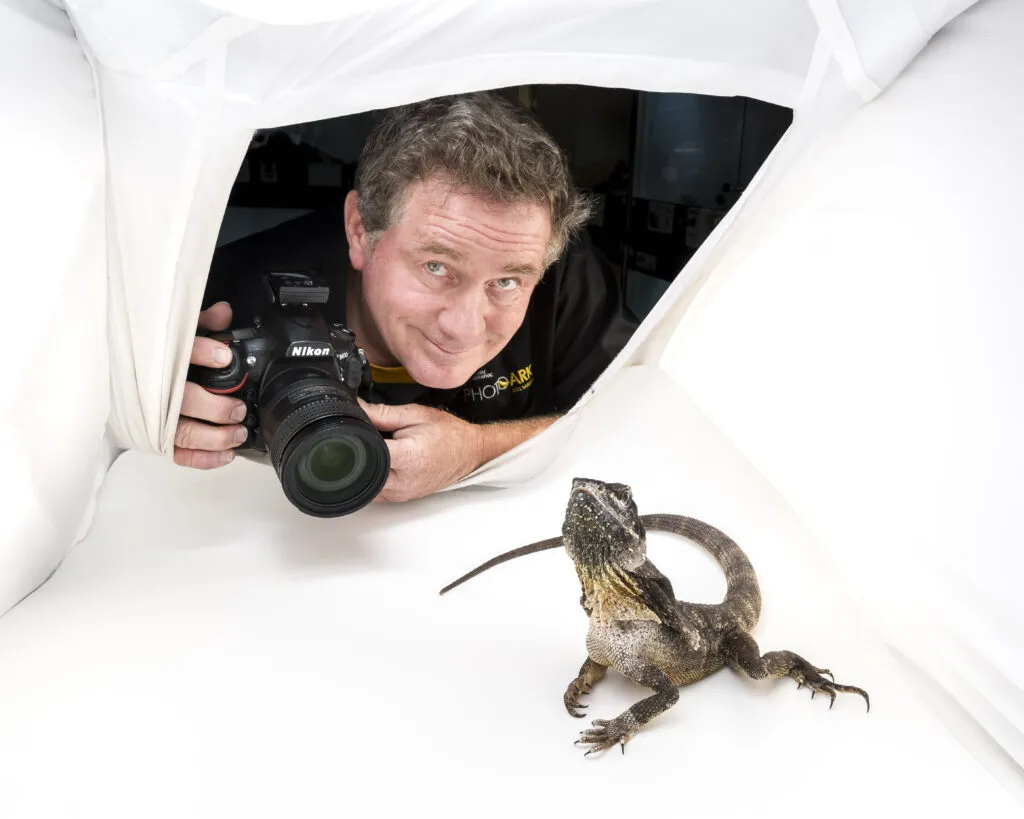
Portrait of National Geographic photographer and PhotoARK founder Joel Sartore with a frill necked lizard, Chlamydosaurus kingii. Photo by Douglas Gimesy, courtesy of the National Geographic Society.
Beyond still photography, Joel Sartore Photo Ark wildlife portraits have expanded into books including Birds of the Photo Ark and National Geographic Photo Ark Insects, alongside a three-part documentary series titled Rare: Creatures of the Photo Ark. The United States Postal Service further extended the project’s reach by issuing a pane of 20 stamps featuring endangered species drawn directly from Sartore’s portfolio.
Public exhibitions have carried the work well beyond magazine pages and museum walls. The Museum of the Shenandoah Valley hosted more than 40 Photo Ark portraits in 2021, and the project’s 20th anniversary brought a dedicated exhibit, Animals of Earth, to the National Geographic Museum of Exploration in Washington, D.C., featuring approximately 17,000 individual wildlife portraits.
Among the project’s notable discoveries, Joel Sartore Photo Ark wildlife portraits have documented entirely new species, including a wild cat native to Bolivia, the first new wild cat species formally described by researchers in over a century, and an undescribed stick insect photographed at the Budapest Zoo. Such discoveries underscore that even as Sartore races to photograph known captive species, new biodiversity continues to emerge from poorly understood corners of the planet.
Sartore has been candid about the scale of the task remaining and his own mortality relative to the project’s ambitious scope. He has said a successor will continue the work if he cannot finish, framing the Photo Ark as an effort designed to outlast its founder, with the portraits intended to serve conservation education long after Sartore is gone.
The underlying philosophy driving Joel Sartore Photo Ark wildlife portraits centers on a simple but urgent principle: no species should disappear before it has a chance to be documented, however humble or unfamiliar it may seem to the public. Each portrait serves as a scientific record, a conservation advocacy tool, and an artistic statement, insisting that every living creature, regardless of size or popularity, deserves recognition as a living work of art worth saving.