Notes on Women, Priesthood, and General Conference
This article appears courtesy of Daniel C. Peterson’s blog Sic et Non. Visit his blog HERE.
A few days ago, I saw a comment from a critic of The Church of Jesus Christ of Latter-day Saints about the just-concluded October general conference of the Church. He pointed out — and I’ll assume that his count is correct — that only three of the conference’s thirty-seven speakers were female, and used this to illustrate the Church’s devaluation of women.
There is no serious question that The Church of Jesus Christ of Latter-day Saints is, in some very important senses, a patriarchal organization. Its priesthood is exclusively male, for example, which means that the central leadership positions in local congregations and in the Church as a whole are held entirely, or almost entirely, by men.
Presumably, members of the Church want to hear, at each semiannual general conference from its apostolic leadership. There are, typically, fifteen ordained apostles in the Church at any given time. Assuming thirty-six conference speakers — thirty-seven was an atypically high number, and an even number is easier for my purpose here — an equal gender distribution for general conference would be eighteen men and eighteen women. So the participation of the apostles alone would leave eighteen speaking slots for women and only three additional slots for men (e.g., for members of the Seventy and the Presiding Bishopric). Would members of the Church like that? Are they clamoring for it? Not that I’ve noticed.
On the whole, though, I would argue that the fact that the priesthood of the Church is exclusively male may not be quite as important or lethal as some on the outside assume.
For example, while the Catholic hierarchy is likewise all-male, there is this crucial difference between the Catholic and Latter-day Saint churches: The Catholic hierarchs are celibate. Which is to say that, while they obviously all have mothers and may well have sisters, they have no wives and no daughters, and they’re spiritually formed in all-male institutions such as seminaries and monasteries and they live and work very largely in an all-male and all-celibate world of fathers superior, abbots, bishops, archbishops, and cardinals.
By contrast, all Latter-day Saint leaders are married, and most have daughters and/or daughters-in-law and/or granddaughters. In fact, the Church teaches that the highest degree of heaven is available only to those who are married. (It also makes provision for those who have died unmarried to enter into marriage after death.)
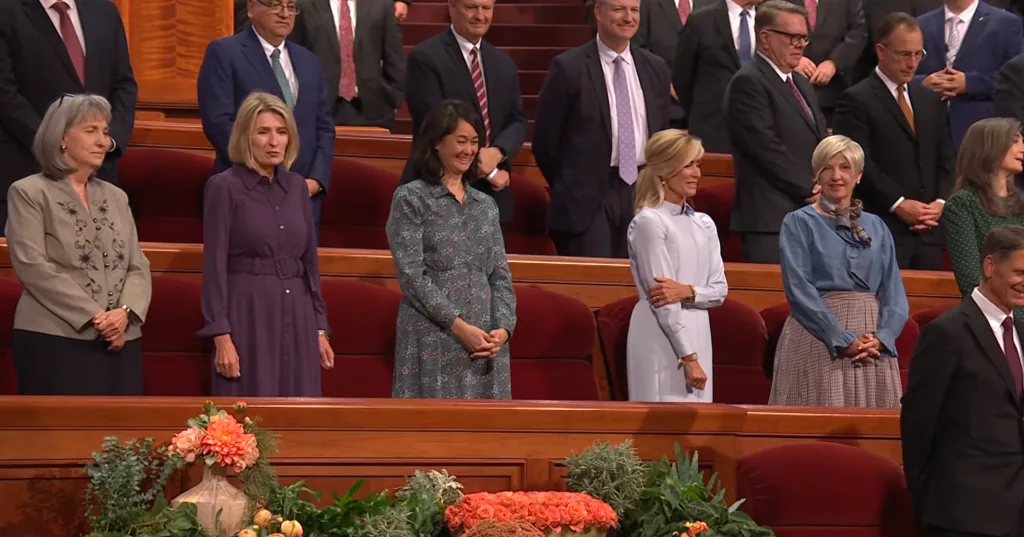
Further, I suspect that many outsiders assume, hearing that Latter-day Saints have an all-male “clergy,” that sermons in our worship services are always given by men, and that women are silent in our churches. But such an assumption is entirely baseless. We have no professional clergy, and our bishops don’t give sermons every Sunday, or even on most Sundays. Rather, ordinary members of our congregations give the “sermons,” with several such “sermons” being given on just about any typical Sunday. And, in fact, it’s a very rare Sunday when there isn’t at least one woman speaking in our main worship service. Often, in fact, there will be more than one — perhaps, in addition to one or two men, a young woman (a teenager) and an older, married woman. And women routinely teach our Sunday school classes, too. (Even in the worldwide general conferences of the Church that are broadcast globally — the recent one, for example, that drew the critic’s attention — women speak to the entire church from the podium of Salt Lake City’s Conference Center.)
Moreover, women are represented in the ward leadership councils of each local congregation, and in councils for the Church as a whole.
And they serve as missionaries for the Church. More of them, in fact, are now serving than ever before, representing the Church to the world — which will eventually help (I hope) to lessen the Church’s reputation for patriarchal sexism.
As I’ve noted here before, I can think of no real reason not to ordain women — except for the simple and (to me, entirely sufficient) reason that the Lord has not authorized us to do so. Women are typically just as intelligent and just as competent — if not more so, in many regards — as men commonly are, and at least as committed, on average, to the Lord and the Gospel.
But nobody has a “right” to receive the priesthood. Not women, not men.
Being the right to act in the name of God in certain particular regards, the priesthood is God’s to confer or to withhold.
A commenter on my blog insisted, some years back, that it’s unjust to restrict priesthood to males. If, however, there is no “right” to priesthood ordination, that argument seems to lose much of its force. It’s also not unjust that, so far as I know, Warren Buffet hasn’t included me in his will. It’s not unjust that my wife receives far more invitations to lunch than I do.
This critic contended that we no more need revelation to ordain women than we did to ordain blacks of African descent. However, the leaders of The Church of Jesus Christ of Latter-day Saints believed that they did require such revelation before ordaining blacks, and, in June 1978, they believed themselves to have received it. Here, for example is a quotation about it from Adventures of a Church Historian, the memoirs of the late Dr. Leonard J. Arrington:
Those in attendance said that as he began his earnest prayer, they suddenly realized that it was not Kimball’s prayer, but the Lord speaking through him. A revelation was being declared. Kimball himself realized that the words were not his but the Lord’s. During that prayer some of the Twelve—at least two who have said so publicly—were transported into a celestial atmosphere, saw a divine presence and the figures of former presidents of the church . . . smiling to indicate their approval and sanction. Others acknowleged the voice of the Lord coming, as with the prophet Elijah, ‘through the still, small voice.’ The voice of the Spirit followed their earnest search for wisdom and understanding.
At the end of the heavenly manifestation, Kimball, weeping for joy, confronted the [other members of the First Presidency and the Council of the Twelve], many of them also sobbing, and asked if they sustained this heavenly instruction. Embracing, all nodded vigorously and jubilantly their sanction. There had been a startling and commanding revelation from God—an ineffable experience.
Two of the apostles present described the experience as a ‘day of Pentecost’ similar to the one in the Kirtland Temple on April 6, 1836, the day of its dedication. They saw a heavenly personage and heard heavenly music. To the temple-clothed members, the gathering, incredible and without compare, was the greatest singular event of their lives. Those I talked with wept as they spoke of it. All were certain they had witnessed a revelation from God.
The critic also argued that we don’t need revelation to ordain women any more than we need specific revelation to be kind or to be good parents to our children. But such things as the latter are matters of general revelation, accessible to and known by Buddhists and Hindus and Sikhs and animists and irreligious people and atheists as well as Latter-day Saints. This is simple conscience. If, however, there is anything at all that’s uniquely within the province of divine special revelation, the conferral of the Lord’s priesthood would certainly seem to be a candidate for inclusion within that set.
Of course, revelation is the issue. Elsewhere, this critic described my view as holding that we must wait for our leaders to decide for us what is right. But she had that wrong.
Her view seemed to be that the Church is merely governed by committees, for whose decisions we borrow the language of religion — including such words as revelation and inspiration — although it’s all really just a matter of ordinary human politics.
By contrast, and with many, many other faithful Latter-day Saints, I believe that our leaders are uniquely called and chosen to seek out and to discover (for the Church as a whole) what the Lord wants, and I believe that what the Lord wants is, yes, right. That’s, in my view, a presupposition that’s essential to genuine faith in the Restored Church. And I’m confident, not only on general principle but from what I’ve studied in Latter-day Saint history and from personal interactions with them, that the leaders of the Church themselves hold the same belief. They do not feel that the Church is there for them to take in any direction they like, but, instead, that they are bound to obey what the Lord dictates.
If I didn’t hold this view, The Church of Jesus Christ of Latter-day Saints would hold little interest for me.