Living While Mourning Those Impermanence Will One Day Take
Boom, boom, boom, boom. Lying in my husband’s arms, close to his chest, I feel anxiety rise in my body, growing with every beat of his heart. I resist the urge to move away for a few seconds, then hurriedly shift to lie beside him, sad that I can no longer rest in the silent communion this closeness once invited.
His steady heartbeat, a sound that once soothed me, now sounds like a ticking clock—one that could stop without warning at any moment. The first time I abruptly pulled away like this, he was taken aback. Now, he simply reaches for my hand and holds it tight, knowing why I have moved away. In his own way, he knows this fear too.
At times like this, part of me wishes I could go back to not being so deeply aware of impermanence—to forget, if even briefly, what I know to be true.
I was surprised to find this same impulse reflected back to me in an unlikely place. In the 2026 comedy-mystery film The Sheep Detectives, some of the titular sheep choose not to carry the memories of painful losses because remembering hurts too much. The film even makes the bargain visible: If they erase the grief, they also erase the one they once loved. That stayed with me, because I recognized a quieter version of the same impulse in myself. I was not trying to forget the people I loved; I was trying to forget that they could be taken from me.
I hadn’t realized how much I had been trying to keep impermanence—and my own mortality—at the edges of my day-to-day awareness until I visited Varanasi in 2013. It is believed those who are cremated in this sacred town gain instant liberation from the cycle of birth and death. At my spiritual teacher’s suggestion, I asked a boatman to take me near Manikarnika Ghat, one of the eighty-four ghats of Varanasi and widely known as Varanasi’s principal cremation ground. As our boat approached the blackened primeval cremation site and came to rest, I gazed somberly at the holy orange flames devouring the wooden funeral pyres. A body wrapped in glittering cloth arrived on a stretcher and was laid down to await its turn. So this is how it all ends. One day, that will be me—the realization hit me with a jolt.
I was overcome by deep sorrow. It was the beginning of a long and difficult reckoning with impermanence—and with how to keep living while grieving what I knew it would take: those I hold most dear.
For years, the awareness of impermanence frightened me terribly. If nothing could be held on to, if everyone I loved would one day be gone, what was the point of any of it? Often, the thought opened into a kind of despair in which life felt dark, fragile, and almost meaningless, and I was left with the terrifying image of myself utterly alone and bereft. There were periods of deep anxiety and depression, and days when, once I had done what needed to be done, I would retreat to bed for hours.
And yet I did not want to turn away from the truth. I wanted to learn how to live with impermanence and gently prepare for the losses it would bring, without being entirely undone by them when the time came to let go.
Over the years, I have been learning that there is no neat way through this. I have searched online, listened to dhamma talks, and returned again and again to spiritual teachings. The guidance is often to accept impermanence, and though I understand the wisdom of it, I am still learning what acceptance looks like when dread grips my body and my mind races ahead to loss. Over time, the question has shifted for me from how to stop fearing loss to how to keep living fully while knowing that loss will come.
Over time, the question has shifted for me from how to stop fearing loss to how to keep living fully while knowing that loss will come.
Perhaps there is no single map for that. Mine is still taking shape, slowly, as I meet the fear and grief again and again. And yet, over time, a few guideposts have emerged along the way, pointing to steps one can take in learning how to keep living and making the most of life while grieving what impermanence will take.
The first step has been to stop fighting grief simply because the loss has not yet happened. I used to get annoyed with myself: Don’t get carried away into a future that has not yet happened. Come back to this moment—he is right here with you. Initially, I thought mindfulness of the present meant pushing the grief of the future aside. But I have come to see that the grief about losing him is also part of what is here now, and forcing it away does not make me more present.
In fact, at times, it helps me cherish the life I still have with him more fully—when my husband leaves for work and we kiss goodbye at the door, the knowledge that I may not see him again adds a sweet poignancy and tenderness to the moment. The same awareness also softens me after a disagreement. I may still be hurt, but knowing that our time together is finite makes me less willing to let resentment harden into distance.
The second step has been learning to discern when to lean into grief and when to set its burden down. When it feels overwhelming, I choose to lie down and allow sorrow to take over. As its force softens, I may choose to sit up, breathe with it, and look more closely at what hurts. What am I afraid of right now? Growing old alone? No longer having him beside me to share the small joys and sorrows of an ordinary day? Naming the fear helps me mourn what I stand to lose rather than remaining engulfed by an unnamed dread.
At other times, I realize I have reached my limit. I check what I have the energy and inclination for and may try to do some art, knit, or disappear into a period drama. I used to feel guilty about such choices, but I have come to understand that distraction is not always avoidance. Some guilt still arises—especially when I am binge-watching a show—but I am learning to honor the changing rhythm of grief: to lean in when I have the capacity and to rest from its weight when I do not.
Naming the fear helps me mourn what I stand to lose rather than remaining engulfed by an unnamed dread.
Along the way, it has been reassuring to discover that I do not have to force my own way back out of grief. Whenever the dishwasher beeps, my dog waits for his walk, it is time to prepare for an online therapy session, or I hear my husband’s key in the door—I come back to the present. I have begun to trust the movement of grief: to let it carry me out for a while, knowing that, in its own time, the same tide will return me to the shore of the present moment.
The third step has been to notice what awakens curiosity, wonder, or joy, and then to deliberately nourish that. It may be the tiny Indian silverbills at the bird feeder outside my room, or the wispy clouds floating across a pink-purple evening sky. When something holds my interest, I try to linger in it, practice gratitude, and remember Thich Nhat Hanh’s teaching—present moment, wonderful moment. One moment of aliveness often opens into another—I may open my sketchbook to draw the birds or play with the pinks and purples of the sky, or simply make myself a cup of tea and sit on the balcony to share the passing hour with my plants, the birds, and the sunset.
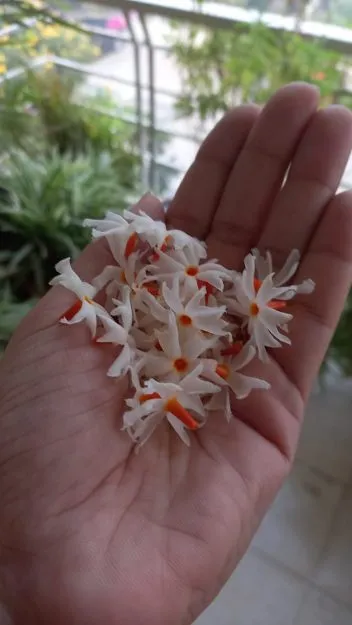
Sometimes, the very knowledge that something will not last deepens this sense of aliveness. Each morning, I pluck the small, fragrant flowers of my parijat, or night-flowering jasmine, and carry them to my altar. With one hand, I remove yesterday’s flowers, now dry and shriveled; with the other, I place the fresh ones down, their white petals and bright orange centers still vivid and alive. The faded flowers remind me what will become of the ones I am holding now, and somehow that knowledge makes me more grateful for them. Perhaps this is part of what I am learning about the people I love too: that their fragility does not have to diminish my joy in them; it can make their presence matter even more while they are still here.
The fourth step has been to try to become more of a refuge to myself. “Be an island unto yourself,” the Buddha taught. Part of my fear of losing my husband comes from knowing how much of my emotional life I have built around his presence—he is the person I instinctively turn to—to share what has moved me, seek comfort, feel understood, have fun.
So I have been trying, gently, to build more of a life within myself too. I travel on my own sometimes, allowing some experiences to belong just to me, and practice staying with loneliness rather than immediately reaching for him.
The more I discover that I can be at home in my own company, the more I trust that the future-me will in time find her way through loss when it comes.
And yet, after all these years of contemplating impermanence, I still catch myself reaching for certainty. Recently, Joey, my seven-and-a-half-year-old Shih Apso, had a sudden bout of seizures, and we have since learned that there may be a problem with his heart.
Up until then, he had been in robust health, and without quite realizing it, I had been living with the expectation that losing him was something I wouldn’t have to face until five or six years down the line. I realized that while I had not erased the possibility of loss, I had placed it far enough into the future to feel a false sense of security.
Perhaps the practice is neither to brace for loss nor to tuck it safely away in some distant future but to let hope remain hope—without mistaking it for a promise.
Now, when Joey settles into my lap, I stroke his back and take comfort in his familiar weight. My husband’s hand comes to rest on him, too, and for a while we sit there together—not knowing how many more ordinary evenings there will be.
For now, Joey is warm and solid in my arms, and the three of us are here together. I let myself feel both the grief of knowing this will end and the precious tenderness of being inside it while it is still here.