Web3Auth attacker loses 64 Osmosis accounts to a validator freeze with no end date
On November 20, 64 accounts linked to the Web3Auth attacker were frozen by the Osmosis validators using the v32.0.1 patch.
There is no expiration date for the freeze.
Block 75,640,600 cut off sends, delegation and fee payments
The freeze began in block 75,640,600. The v32.0.1 release notes state that frozen accounts are no longer able to use authz permissions, send tokens, delegate, or pay or grant fees.
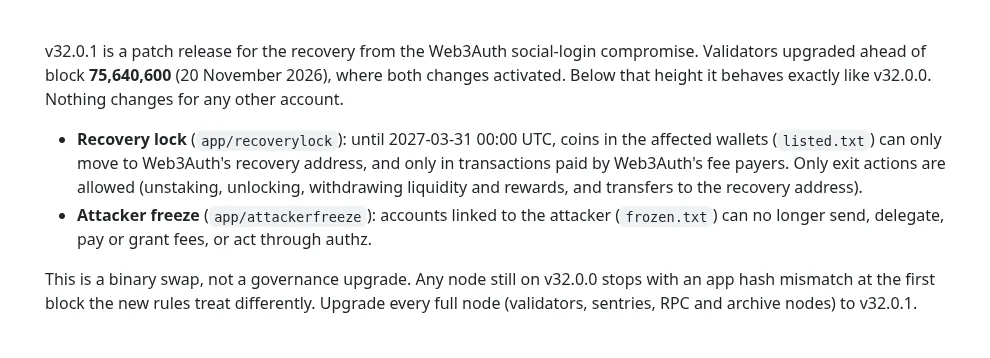
Furthermore, the developer commit states that messages sent on behalf of a frozen account via authz, a smart contract, or another chain are rejected.
There are 64 Osmosis addresses in the patch’s frozen list. Developers first froze 48 accounts and added 16 validated attacker accounts on November 19, the day before activation.
Each of the 16 either transmitted and received funds from a previously frozen account or sent funds to the attacker’s Ethereum wallets via the Squid router. None of them are on the recovery list.
The same fix locks 84,002 exposed wallets. Until 00:00 UTC on March 31, 2027, the coins may be sent only to Web3Auth’s recovery address, in transactions paid by one of two Web3Auth fee payers.
Owners can still unlock, cancel unbonding, unstake, and withdraw rewards and liquidity. The patch’s design notes state that the upgrade itself does not transfer any funds.
The end date includes a seven-day buffer and two 14-day unbonding intervals. The recovery undelegation may take up to one period to begin since an attacker could fill all seven unbonding slots on a delegation prior to activation.
Every other Osmosis account is operating as it should. At the time of writing, OSMO was trading at $0.0285, down 3.5% in the past 24 hours.
v32.0.1 went live as a binary swap with no governance vote
Osmosis provided the change as a binary swap, so a governance vote was not required. Nodes that remain on v32.0.0 terminate with an app hash mismatch on the first block on which the new rules apply differently.
Below the activation height, v32.0.1 is identical to v32.0.0.
The wallets that were exposed were Google and Apple social logins in Keplr, which managed their keys via Web3Auth. Some of them had their private keys leaked due to an issue with Web3Auth’s service.
The drain across over 44,000 wallets in eight Cosmos chains, including Osmosis, is estimated by Bitquery to be at least $6 million. The amount is disputed by Web3Auth, which says that some of the withdrawals were its own whitehat sweeps into recovery wallets under its control.
Keplr says that wallets constructed on a hardware device or from a recovery phrase were never vulnerable.
According to Cryptopolitan, Cosmos Hub validators were able to retrieve 1.23 million ATOM from the Neutron exploiter in September. In a separate event, THORChain reopened swaps chain by chain.
Don’t just read crypto news. Understand it. Subscribe to our newsletter. It's free.