Arbitrum price prediction 2026-2032: Will ARB reach $1?

Key takeaways:
- Our ARB predictions anticipate a high of $0.21 in 2026.
- In 2028, the range is expected to be between $0.61 and $0.74, with an average price of $0.63.
- In 2030, it will range between $1.24 and $1.52, with an average price of $1.28.
Arbitrum price prediction points to a modest near-term outlook and a stronger long-term move: our ARB forecast sees a high of $0.21 in 2026, with the token potentially reaching between $1.24 and $1.52 by 2030 and averaging $1.28, which suggests it could reclaim and move past $1 by the end of the decade.
Layer 2s have generated considerable buzz for their efficiency, and the Arbitrum network is in the top 10 pack, with a total value locked (TVL) of $1.4 billion. Arbitrum is an Optimistic Rollup solution that shifts network operations off the Ethereum mainnet while maintaining Ethereum-level security, keeping ARB relevant to investors tracking Ethereum scaling adoption and long-term token demand.
For crypto investors, traders, and enthusiasts weighing ARB’s upside, this analysis examines Arbitrum’s current price action, technical indicators, market trends, competition, historical sentiment, recent news, and the key factors shaping its forecasts from 2026 to 2032. Is Arbitrum a good investment? Will it go up? Where will it be in 5 years? Let’s answer those questions with a data-driven Arbitrum price prediction to help you make more informed decisions in a volatile market.
Overview
Arbitrum price prediction: Technical analysis
Arbitrum price analysis
On November 17, Arbitrum’s price fell 1.74% over 24 hours and 27.22% over 30 days. The 24-hour run was accompanied by rising trade volumes (7.48%), while broader market conditions also saw Bitcoin dominance rise to about 60% recently, which can weigh on altcoins like ARB.
ARB 1-day chart analysis
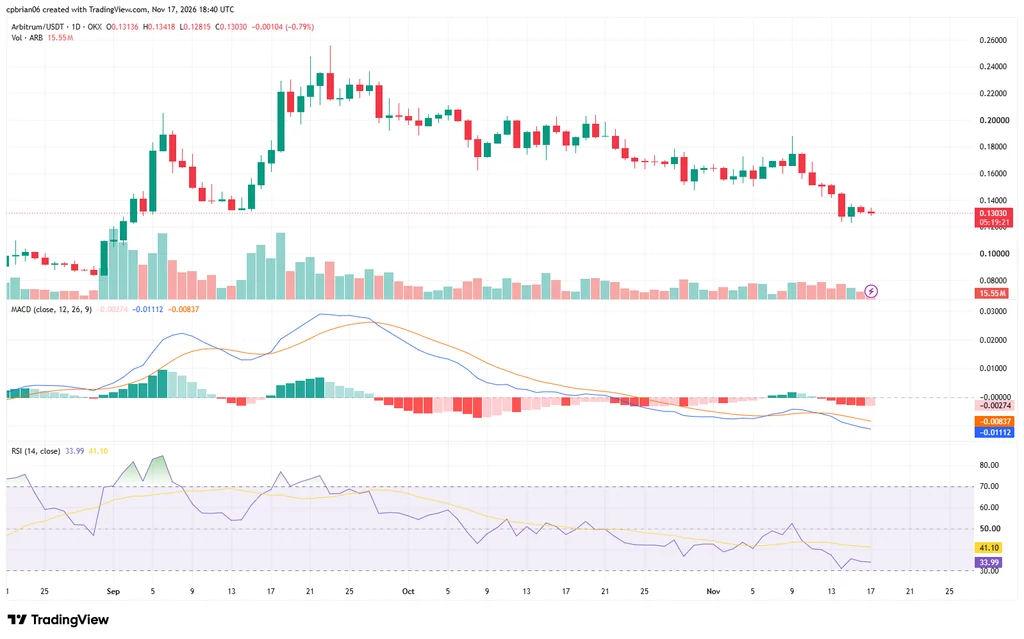
ARB trades downwards, reflecting a short-term bearish trend. The run tracked the broader altcoin rally. The move came after ARB pulled back from the $0.18 resistance level. The MACD histograms show it had negative momentum over the last 7 days.
Arbitrum price 4-hour chart analysis
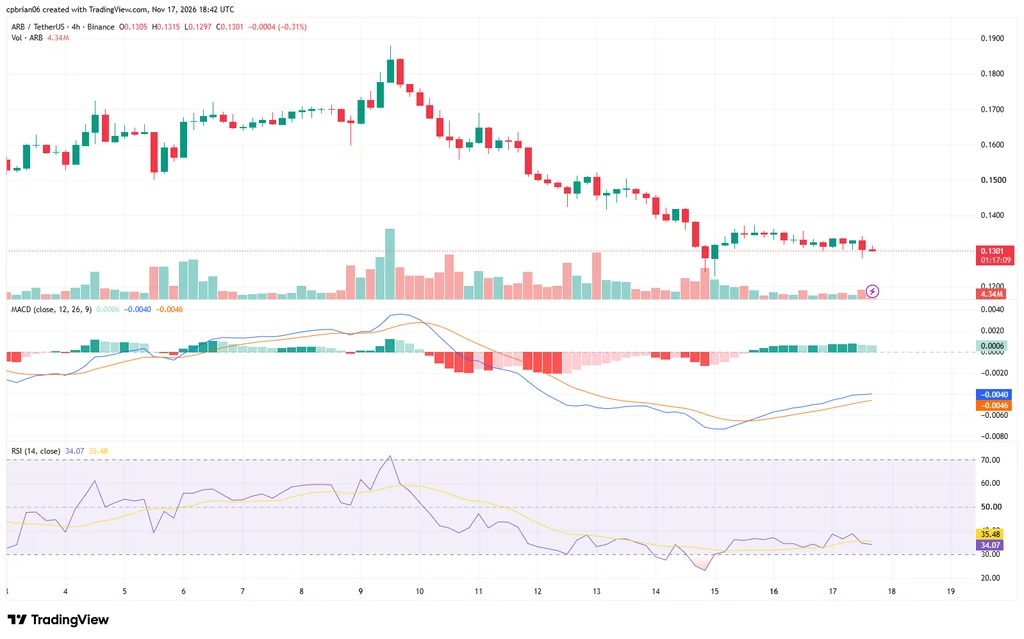
The chart highlights ARB has been moving sideways over the last two days but with a bearish slant. Its Relative Strength Index is now at 34.07, in neutral territory. It is oversold when the RSI value drops below 30.
Arbitrum technical indicators: Levels and action
Daily simple moving average (SMA)
Daily exponential moving average (EMA)
What to expect from the ARB price analysis next?
Arbitrum’s near-term outlook is bearish; shorter timeframes support a consolidation before the next leg down.
Why is Arbitrum down?
Arbitrum maintained a bearish stance over the last 30 days. Its recent correction was a result of a market-wide pullback and possible after-market effects of the Binance hack and token unlock.
Does Arbitrum have a future?
As a Layer-2 scaling solution for the Ethereum network, Arbitrum uses optimistic rollups to process transactions off-chain and submit proofs back to Ethereum, helping improve Ethereum’s scalability. Future ARB value depends on maintaining developer adoption and user activity; better market infrastructure can enhance access to Arbitrum and may benefit the broader crypto market, though token demand still matters. Network adoption and total value locked directly affect Arbitrum’s utility.
Ongoing token release schedules pose a continuous dilution risk to the asset. It also faces intense competition from other Ethereum Layer-2s like Optimism, Base, and zkSync, with rivals competing for developers and liquidity; any loss of developer mindshare could weaken sentiment, while Optimism is pushing a Superchain strategy and StarkNet offers faster finalization than Arbitrum. Future performance also depends on whether governance activity improves value capture relative to network activity, but governance token ARB does not directly capture network transaction volume, which is why uncertainty around ARB’s value capture remains a significant concern among analysts. Arbitrum DAO accrued $6.19 million in H1 2026, a potentially attractive sign if ecosystem revenue keeps improving. Institutional adoption could improve Arbitrum’s long-term growth prospects. Franklin Templeton holds $56.1 million in tokenized treasuries on Arbitrum, offering one example of institutional use.
Recent news
Arbitrum’s Security Council moved over 8,425 ETH and 74 million ARB out of an address tied to the Binance exploit without any action on the hacker’s part.
The Security Council is a 12-member group elected by ARB holders, with emergency powers to upgrade the network’s contracts if nine of them agree.
ARB price prediction November 2026
The Arbitrum price forecast for November is estimated to range from $0.13 to $0.19, and this monthly outlook is one of several short-term price predictions investors may track to better understand broader scenarios.
Arbitrum price prediction 2026
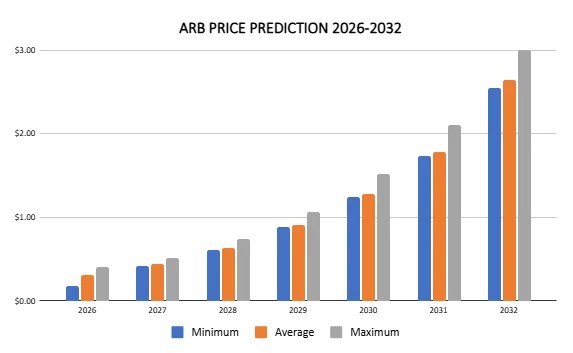
For 2026, ARB’s price will range from $0.06 to $0.21. The average price for the period will be $0.21. Some forecasts put the predicted price at $0.15 by the end of 2026. Other late-2026 projections place Arbitrum between $0.09 and $0.17.
Arbitrum long-term price prediction 2027-2032
These forecasts are heavily influenced by market trends and broader market cycles. A strong crypto market can provide a tailwind, while macro and crypto market conditions significantly affect ARB’s valuation.
Arbitrum price prediction 2027
Arbitrum market price prediction climbs even higher into 2027. Some external forecasts place ARB’s price in a much more bullish $5.00 to $8.00 range across 2027-2028. Some crypto analysts place 2027 in a wider comparative range of $0.157 to $0.446, with an average near $0.3015. According to Arbitrum’s price forecast, ARB’s price will range from $0.22 to $0.51, with an average of $0.34. Bearish scenarios could see ARB drop to €0.071629 by the end of 2027, which is worth keeping in mind.
Arbitrum coin price prediction 2028
Our analysis indicates a further acceleration in ARB’s price. It will trade between $0.61 and $0.74 and an average price of $0.63.
Arbitrum price prediction 2029
According to the 2029 Arbitrum forecast, ARB’s price will range from $0.88 to $1.06, with an average of $0.91.
ARB price prediction 2030
The ARB price prediction for 2030 is 1.24-1.51, with an average of $1.28. Broader 2030 projections place ARB between $2.46 and $5.78, with an average of $4.12. In a bullish scenario, some forecasts extend toward $12.00, though the long-term impact depends on several factors, including on-chain metrics, market conditions, Layer-2 adoption, Ethereum scaling upgrades, TVL, and competition.
Arbitrum price prediction 2031
The Arbitrum price forecast for 2031 is a high of $2.10. It will reach a minimum price of $1.73 and an average price of $1.78.
Arbitrum ARB price prediction 2032
The year 2032 will also be bullish. Our analysis estimates a price range of $2.55 to $3.00, with an average price of $2.64. A conservative model suggests ARB could be around $0.13 by 2036 and $0.26 by 2051.
ARB market price prediction: Analysts’ ARB price forecast
This table compares analysts’ market analyses of Arbitrum’s price across leading platforms and serves as a simple price-prediction tool for reviewing external analysts’ forecasts. As a basic benchmark alongside these market indicators, a simple growth-based model would put ARB at around $0.18 over three years, assuming 5% annual growth.
Cryptopolitan’s ARB price prediction
Cryptopolitan’s Arbitrum price forecast indicates that ARB will reach a high of $0.21 in 2026, and whether it’s a good buy depends on your risk tolerance and time horizon. At its current price below $1, ARB would need a 1000% surge to reach $10. Any path faces potential short-term constraints from supply growth, large token unlocks that can create downward price momentum, and market sentiment, so it would likely take several years even in favorable conditions.
Scheduled vesting schedules can introduce sell pressure, so valuation metrics should account for supply pressure from unlocks when making investment decisions. Since its launch, ARB has peaked at $2.40, so a $10 target at the current price level seems highly implausible.
In 2028, the range is expected to be between $0.61 and $0.74, with an average of $0.63. In 2030, the range is likely to be between $1.24 and $1.52, with an average of $1.28. ARB can be treated as a high-risk asset and should make up only a small percentage of a diversified portfolio, as macroeconomic trends shape risk appetite for digital assets, including Arbitrum.
This analysis is for informational purposes only, not investment advice; do your own research before making investment decisions and invest at your own risk in this highly volatile market, keeping the risks in mind.
Arbitrum historic price sentiment
- The Arbitrum airdrop snapshot occurred on Feb 6, 2023, and eligible participants, including early users, started claiming ARB tokens on Mar 23, 2023. The claiming period ended on September 24, 2023.
- The airdrop granted 11.5% of the total supply to eligible users, 1.1% to DAOs operating in the Arbitrum ecosystem, and 44% to employees and Offchain Labs investors. The 44% is subject to lock-up periods and a vesting schedule, while whales control 57.13% of the supply, which can influence price movements when large holders reposition. The rest was sent to the Arbitrum DAO treasury.
- ARB is the native token of the network, with a total supply capped at 10 billion, annual inflation of 2%, and 12.75% of the supply initially distributed to eligible users and DAOs. ARB holders use it as a governance token to vote on protocol upgrades rather than to pay gas.
- A significant share of supply remains locked, and scheduled token unlocks increase circulating supply and can pressure price if demand does not keep pace.
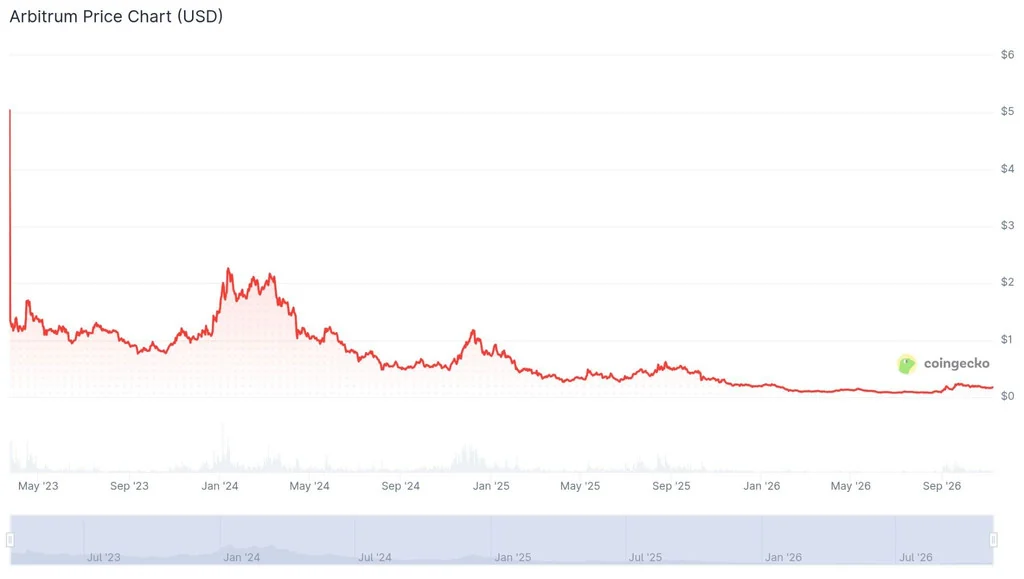
- On Sep 11, 2023, it fell to its all-time low at $0.7453.
- Bitcoin’s halving and the hype around crypto ETFs helped the coin recover from its October slump. By the end of the year, it had risen to $1.4.
- The run continued into 2024. On Jan 12, it reached its all-time high at $2.40.
- According to CoinMarketCap data, ARB fell below its listing price in June 2024.
- On August 5, 2024, it registered a new all-time low of $0.4317
- It then recovered in September, reaching a high of $0.67.
- The bullish run continued into November, reaching $1.12 in December.
- The coin entered 2025 trading at $0.72 before entering a bear run, falling to a low of $0.40 in February.
- It recovered later and crossed into October, trading at $0.45. The trend later reversed, and by date 11, it had fallen to $0.136.
- In December, it traded at $0.20.
- ARB then entered a bear market in 2026 and, on Mar 30, 2026, hit an all-time low of $0.08653.
- It later began to recover, and by May it had crossed above $0.12. The trend reversed in June, with the price trading at $0.08. It maintained the level into August.
- In September, ARB broke out to the upside, rising 16.8% over 24 hours to $0.13, then reaching a high of $0.19. In October, it rose above $0.2 and corrected into $0.16 into November.