Gold's road back to $5,000: four big banks bet on recovery, but the Fed sets the pace
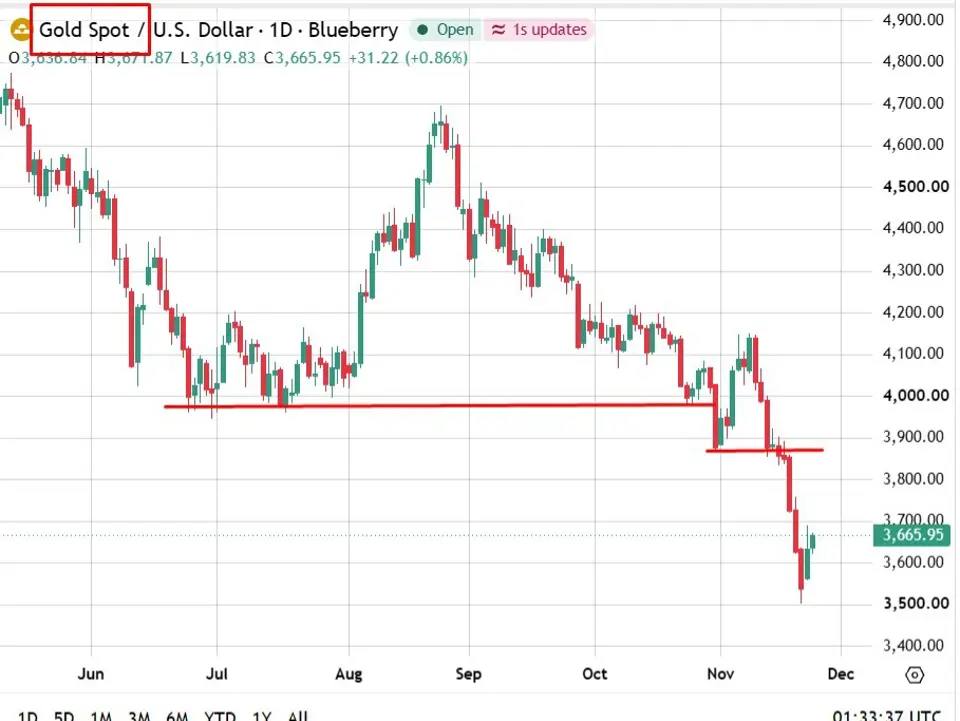
The banks' common message is that gold's direction in the coming months depends on the Fed, not on geopolitics. Throughout the Iran war, higher oil has fed rate-hike expectations and weighed on bullion. That makes upcoming US inflation data and the December Fed decision the key near-term drivers, with any signs of a peak in tightening likely to bring dip buyers back. Oil is the swing risk: BofA's stress case shows a renewed energy spike could keep gold under pressure well into 2027. Central bank buying, which Goldman estimates at around 60 tonnes a month, is the main floor beneath prices.
---
- The banks still believe in gold's recovery, but each target has been pushed back as the Fed keeps hiking, and the main question now is how long they'll have to wait.
Summary:
- Gold rebounded above $3,600 on Monday after a 9% drop last week to a 14-month low, about 35% below January's record
- Goldman Sachs sees $4,650 by end-2027 (cut from $4,800) and $5,600 by end-2028, with central banks buying around 60 tonnes a month
- UBS cut its end-2026 target to $4,500 but keeps $5,000 for end-2027, and upgraded gold to attractive
- Bank of America sees a recovery only in the second half of 2027, and gold averaging $3,500 in 2027 if oil hits $150
- Societe Generale keeps a 10% gold allocation and a $5,000 end-2027 target, and sees the US debt ceiling as a catalyst
Gold bounced back above $3,600 an ounce on Monday after a 9% slide last week took it to a 14-month low, and the major banks broadly agree on what comes next: a difficult few months while the Federal Reserve keeps hiking, followed by a recovery later in 2027. Where they differ is on how long the wait will be and how high the metal can go.
The common thread is the Fed. Expectations of further rate increases, high Treasury yields and a firm dollar have pushed gold down roughly 35% from its record near $5,600 in January. Throughout the Middle East conflict, gold has fallen rather than rallied on rising tension, because higher oil prices have fed inflation fears, rate hike expectations and higher yields. Every bank forecast below is, in effect, a call on when that pressure eases.
Goldman Sachs: central banks set the floor
Goldman Sachs sees gold at $4,650 by the end of 2027, after trimming its target from $4,800 this month. Its economists expect the Fed to raise rates in December and again in March 2027, which the bank says will keep weighing on Western ETF demand. The support comes from official buyers: Goldman assumes central banks will buy around 60 tonnes a month from 2026 through 2028, against roughly 17 tonnes a month before 2022, and says that structural demand will help gold outperform silver. Once the Fed turns to rate cuts and Western investors return, it sees gold reclaiming $5,600 by the end of 2028.
UBS: buy the dips, target unchanged
UBS cut its year-end 2026 target to $4,500 last week but kept its forecast of $5,000 by the end of 2027, with $4,600 expected by mid-2027. In its 2027 outlook, it upgraded gold to attractive and recommended using pullbacks to add exposure, arguing that central bank buying, Chinese demand, resilient ETF holdings and concerns over government debt continue to support the metal. UBS described Monday's rebound as a stabilisation after last week's drop, helped by a softer dollar and bargain hunting, but expects volatility to stay high.
Bank of America: a delayed recovery
Bank of America is more cautious on timing. It expects gold to stay under pressure in the first half of 2027 and recover only in the second half, citing inconsistent physical buying, softening demand for gold-backed ETFs and its rate strategists' expectation of further Fed tightening in the first half of next year. BofA has also flagged a severe stress scenario, not its base case: if prolonged Middle East tensions push oil to $150 a barrel, it estimates gold would average just $3,500 in 2027.
Societe Generale: the fiscal case
Societe Generale has kept a 10% gold allocation in its multi-asset portfolio and recommends buying on dips, with a target of $5,000 by the end of 2027. It sees the US debt ceiling as the next catalyst. CIBC Capital Markets estimates the government could reach the $41.1 trillion limit as early as late February and that Congress may need to raise it by nearly $5 trillion to fund borrowing through the 2028 elections. SocGen expects another standoff to weigh on the dollar and revive concerns over US fiscal credibility, supporting gold. Its own $5,000 target has, however, been pushed back several times this year as rate hikes have taken their toll.
What the forecasts say, and what they don't
Taken together, the banks see gold ending 2027 somewhere between $4,650 and $5,000, which would mean gains of roughly 28% to 38% from around $3,630. All of them lean on the same pillars: central bank demand, an eventual peak in Fed tightening and, for some, US fiscal strain. The risk is in the timing. Each target has slipped as the Fed has stayed hawkish, and BofA's oil scenario shows how a renewed energy shock could push the recovery out further. For now, the question is less where gold ends up than how much more pain the Fed's hiking cycle has left to deliver.
This article was written by Eamonn Sheridan at investinglive.com.