Shield AI just agreed to pay $5.3B for Echodyne. Here are 6 more companies it should buy to become a prime.
Shield AI wants to sell more than software.
On Nov. 5, Shield AI agreed to buy radar maker Echodyne in a deal valued at up to $5.3B. It also announced $2.5B in new financing, including a $1B Series H at a $28.8B valuation. Two days earlier, CEO Gary Steele had told Bloomberg that more acquisitions would follow.
Shield AI made its name on Hivemind, AI-pilot software that flies drones and jets without GPS, communications, or a human at the controls. It also builds its own drone, V-BAT. Its next aircraft, X-BAT, is an autonomous fighter jet that takes off vertically.
Its hiring shows how much that involves: Shield AI is recruiting across aircraft design, weapons integration, and manufacturing, according to CBI Hiring Insights.
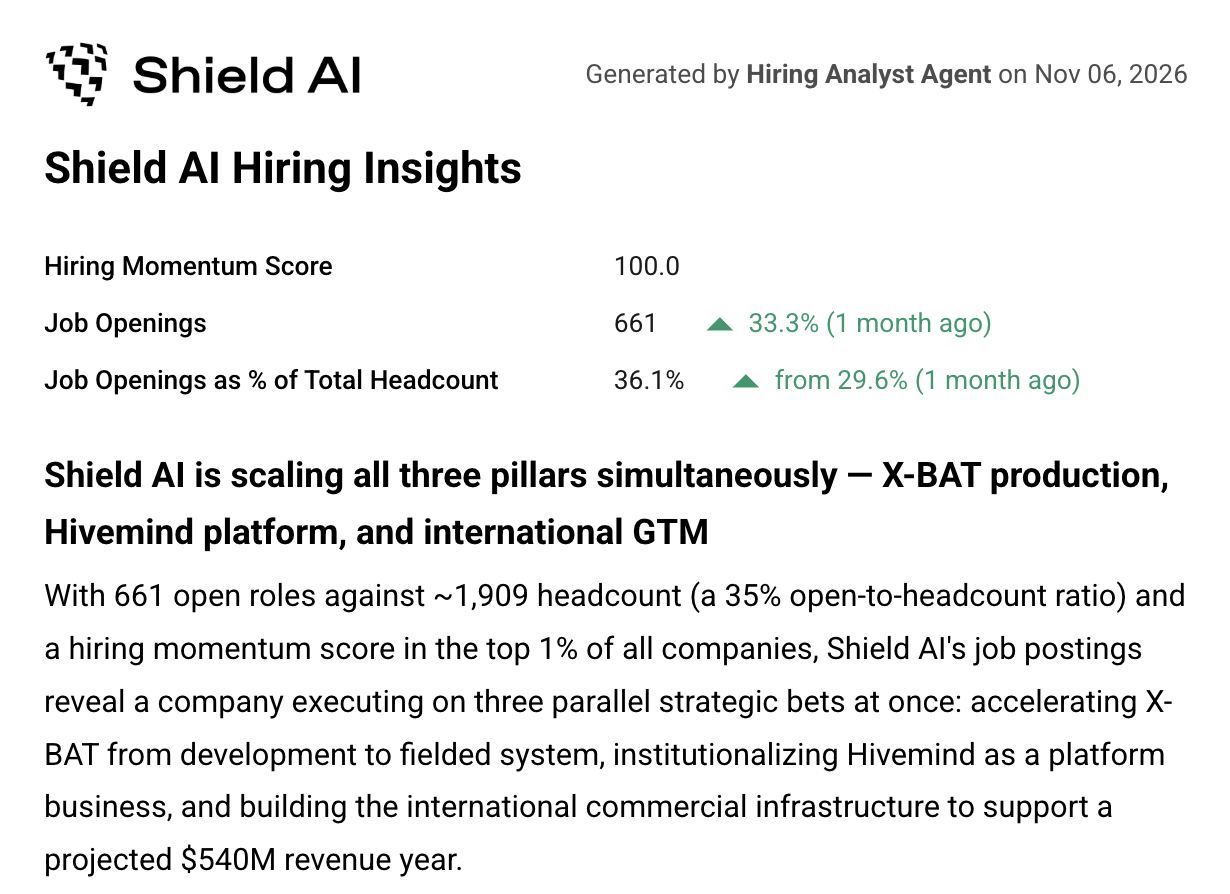
Shield AI has an estimated $400M in 2025 revenue (up 49%), and its valuation has more than doubled since March. But Germany-based Quantum Systems grew revenue 195% over the same period on European and Ukrainian deployments, and cheaper drone makers are hiring faster. Acquisitions are the quickest way to close those gaps.
How Shield AI buys
Shield AI has agreed to buy five companies since 2021. The first four each brought in a working product with little outside capital behind it:
- Heron Systems (2021): the AI pilot that became Hivemind. It had raised $680K.
- Martin UAV (2021): the V-BAT drone.
- Sentient Vision Systems (2024): Australia-based AI detection software, funded by $1.59M in grants. It had supplied V-BAT for a year before the deal.
- Aechelon (2026): simulation software, bought from a private equity firm. Steele said it would help deliver “more capable manned-unmanned teaming to our customers.”
- Echodyne (2026, pending): compact radars used in counter-drone systems in more than 40 countries. It had raised $202M. The deal is valued at $4.8B at closing, plus up to $500M tied to performance targets.
Echodyne shows Shield AI will now pay for scale when a company brings revenue and a factory. Echodyne’s new Washington plant can build about 30,000 radars a year, and X-BAT will also be built in Washington. But most of the new Series H goes to Echodyne, and X-BAT production still needs funding, so the next deals will likely look more like the first four.
Where Shield AI should buy
Shield AI already partners for a lot of what surrounds Hivemind: RTX, for one, supplies the electronic warfare (EW) systems for X-BAT, while Honeywell Aerospace works with it on navigation.
Buying makes sense when Shield AI sells the capability as part of its own aircraft and needs control over how it’s built and integrated, which is how Sentient went from V-BAT supplier to subsidiary. Each of these areas meets that test:
- Teaming with crewed jets. Hivemind won a production contract for the Air Force’s Collaborative Combat Aircraft (CCA) program in February. Owning the pilot’s side of that teaming would let Shield AI sell both halves of it.
- EW and imaging for its smaller drones. Echodyne will add radar and Sentient adds detection software, but Shield AI still gets its EW from L3Harris and RTX. Owning more of what V-BAT and its swarms carry would let Shield AI sell them as complete systems.
- Testing autonomy in space. Steele has said “every action, by human and machine, must be tested and validated in simulation.” Aechelon does that for aircraft. Hivemind now runs on satellites too, and owning space simulation would let Shield AI test and sell it there the same way.
- Cheaper drones and a European base. The Quantum Systems gap and the European hiring both point to a market where Shield AI has neither a low-cost drone nor a factory. Buying a company with both would be faster than building them.
6 companies Shield AI should buy
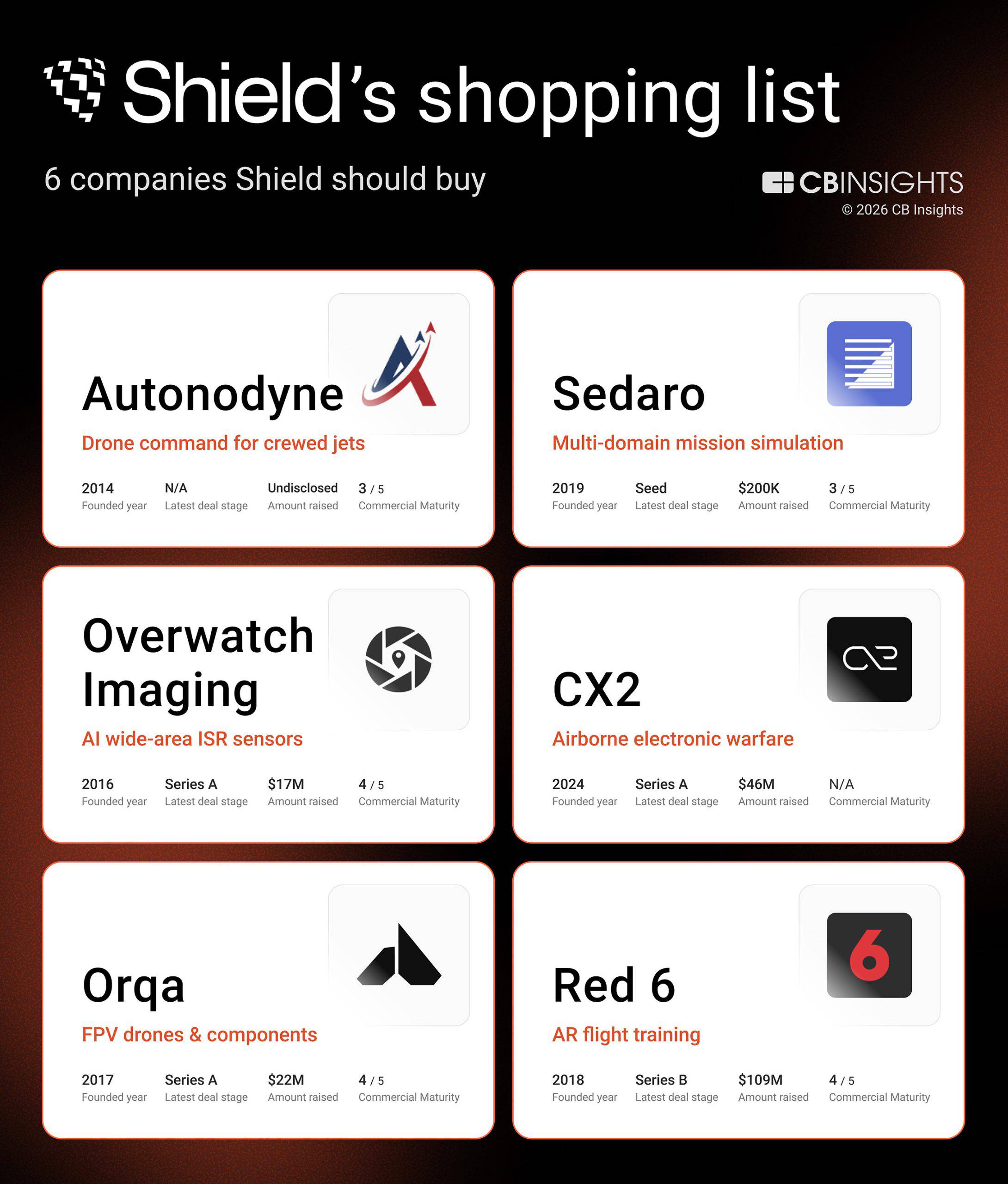
- Autonodyne makes the software that fighter pilots use to command drone wingmen.
-
- Why Autonodyne: Its software lets a pilot task drones from the cockpit, the part of crewed-uncrewed teaming Shield AI doesn’t sell. Autonodyne says it holds a sole-source Air Force contract for this interface, and its software has let F-22 and F-35 pilots task a General Atomics MQ-20 this year, a drone Hivemind already flies. The software is built to work with many drone makers, so owning it would keep the cockpit interface out of a rival CCA bidder’s hands.
- Why now: Autonodyne has no disclosed outside funding, so a buyer would deal directly with Autonodyne’s founders, with no venture investors to win over. Each new jet-and-drone demo also makes Autonodyne more valuable to other CCA bidders.
- Sedaro builds simulation software for satellites and other systems across space, air, land, and sea.
-
- Why Sedaro: It’s already Shield AI’s main environment for testing Hivemind in space, and its software checked Hivemind’s commands when Hivemind first ran on orbit in August, aboard a NOVI satellite. Owning Sedaro would let Shield AI sell space customers the pairing of simulation and autonomy that Aechelon gives it for aircraft.
- Why now: Sedaro was selected for a $45M Space Force award in September. That money will grow the company and its price in the future.
- Overwatch Imaging makes AI-driven wide-area cameras and the software that spots targets in their imagery.
-
- Why Overwatch Imaging: Sentient’s best-known product, ViDAR, spots small objects at sea. Overwatch adds its own multispectral cameras and software for searching and mapping over land, and that software already runs on L3Harris turrets. Shield AI is one of the companies selected to compete for Navy surveillance orders worth up to $800M combined, and owning Overwatch would let it bid V-BAT with its own sensors and detection software. It would also round out the Mission Systems unit Echodyne is joining, pairing radar with wide-area cameras.
- Why now: Overwatch has raised $17M, a fraction of Echodyne’s $202M. Headcount is up 46% in a year, and a company growing that fast will cost more with every new contract, so it’s worth approaching sooner rather than later.
- CX2 builds airborne EW systems that find and locate enemy signals while jammed and without GPS.
-
- Why CX2: In May, the Pentagon picked Shield AI’s Hivemind to run swarms in its LUCAS one-way attack drone program. CX2 would give those swarms and V-BAT an EW payload Shield AI owns. And two Shield AI backers (Point72 Ventures and a16z) are already on CX2’s cap table.
- Why now: Headcount doubled in the past year to 70. The price rises with every new contract, so it would likely be cheaper to buy before CX2’s next round.
- Orqa, a Croatia-based company, makes small first-person-view (FPV) drones and builds most of their parts in-house.
-
- Why Orqa: It would give Shield AI a cheap drone line below V-BAT and a factory in Europe, the two things behind Quantum Systems’ growth. Orqa also produces drones in the US through a partnership with By Light and a teaming deal with an Army depot. Those are partner agreements, and the US factories belong to the partners.
- Why now: It raised a $14.7M Series A in March, and headcount nearly doubled in a year. It’s still small enough to buy, but a European defense startup growing this fast won’t stay that way.
- Red 6 makes augmented reality headsets that put virtual aircraft in front of pilots during real flights.
-
- Why Red 6: It lets pilots rehearse with drone wingmen in the air, not just in a simulator, which would extend the training Shield AI sells through Aechelon into live flight. Red 6 is integrating into the Leonardo M-346 trainer, and Leonardo picked Hivemind for its Proteus helicopter in October. SnowPoint Ventures, which led Shield AI’s Series E, also led Red 6’s Series A.
- Why now: Red 6 last raised equity in 2023 ($70M Series B) and took on debt in May. A company funding its growth with debt may welcome a buyer that can pay for production.
How we built this
We used the CB Insights MCP to pull Shield AI’s acquisitions, business relationships, funding, news, and Hiring Insights.
We reviewed all 58 of Shield AI’s business relationships. We screened the portfolios of its investors and its partners’ venture arms, and the relationships of four partners (Leonardo, L3Harris, Kratos, and Honeywell), for shared ties.
We then reviewed every company in roughly 25 CB Insights markets tied to Shield AI’s products, including autonomous flight software, tactical drone swarm management, mission planning systems, counter-unmanned systems, electronic warfare UAVs, and synthetic robot training data.