Pi Network Price Prediction 2026–2032: Will PI Recover Further?

Key Takeaways:
- Pi is trading below $0.070.
- Our Pi Network price prediction anticipates the Pi price reaching a maximum of $0.0900 by 2026.
- In 2032, the Pi price prediction projects a maximum of $1.71.
Pi Network price prediction: our outlook sees PI reaching as high as $0.0900 by 2026 and up to $1.71 by 2032, with that long-term upside tied to adoption, ecosystem growth, and broader crypto market conditions. For crypto investors, traders, and PI followers weighing the token’s investment potential, that makes current network developments especially relevant.
Pi Network continues to expand its ecosystem through infrastructure upgrades, developer tools, and new partnerships. The network recently released Protocol 28 and introduced improvements to its desktop applications. These developments aim to simplify app development and strengthen PI’s real-world utility.
The Pi Core Team has also released Pi Desktop version 0.6.4, improving the SoloHost experience. The update removes the need for manual router configuration when enabling remote access. Pioneers can now access desktop-hosted applications more easily through Pi Browser on their phones.
With PI recovering from its July low, this forecast examines historical price action, technical analysis, short- and long-term projections from 2026 to 2032, key valuation drivers such as upgrades and adoption, and analyst views to help readers assess both the opportunity and the risk.
Overview
Pi Network price analysis
TL;DR Breakdown
- Today, Pi Network price analysis shows Pi has dropped by 2.42% to $0.05570.
- PI faces support near $0.055.
- Resistance for Pi is at $0.05822.
Today, November 19, 2026, the Pi price analysis shows Pi trading at $0.05570. The token is down 2.42% at the time of writing, extending a weekly decline of about 20%. Pi recorded a slight increase in trading volume at $6.39 million, showing an increase in activity as sellers took control.
Pi Network price analysis on the daily chart
On the daily chart, it shows PI opened at $0.05708 and climbed to $0.05822 before sellers pushed it back toward $0.05550. The initial rally didn’t reach the $0.062 level, which was seen on Tuesday and Wednesday. That lower high keeps the daily trend bearish
The Relative Strength Index (RSI) has dropped to 22.94, well below the oversold level of 30. The RSI is also lower than the moving average of 29.34, indicating that the downside momentum has not yet faded. A recovery above 30 would be an early sign that selling pressure has slowed down.
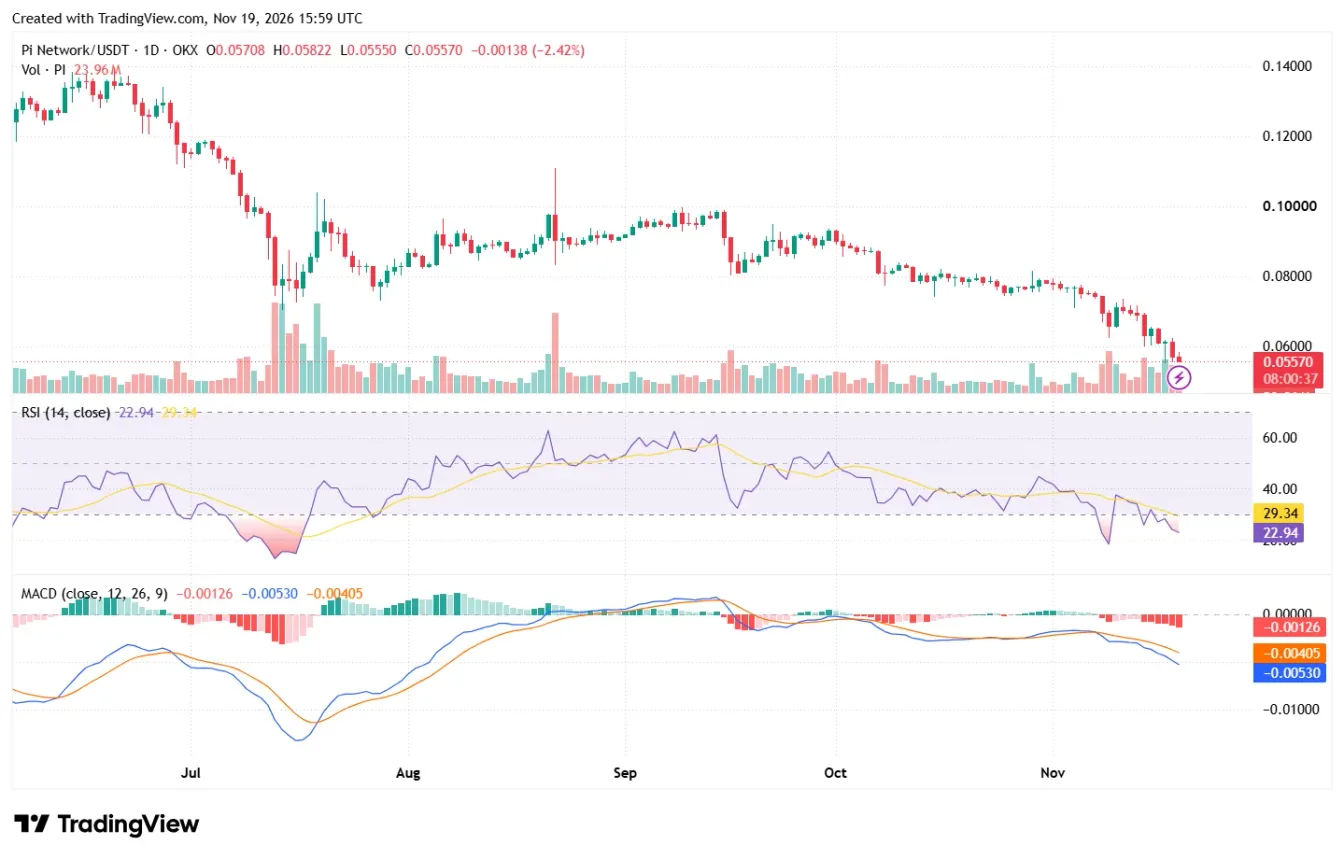
The MACD line stood at −0.00530, below its signal line at −0.00405. The gap between the two lines increased, bringing the histogram down to −0.00126. That increasing gap between lines shows bearish momentum building as PI approached support.
The initial support area is found between 0.05515 and 0.05550, where buyers were present again this week. A drop below $0.05515 would put $0.05500 under pressure. On the positive side, the $0.05822 level is the first resistance level; a break above this level would bring $0.06000 into the picture.
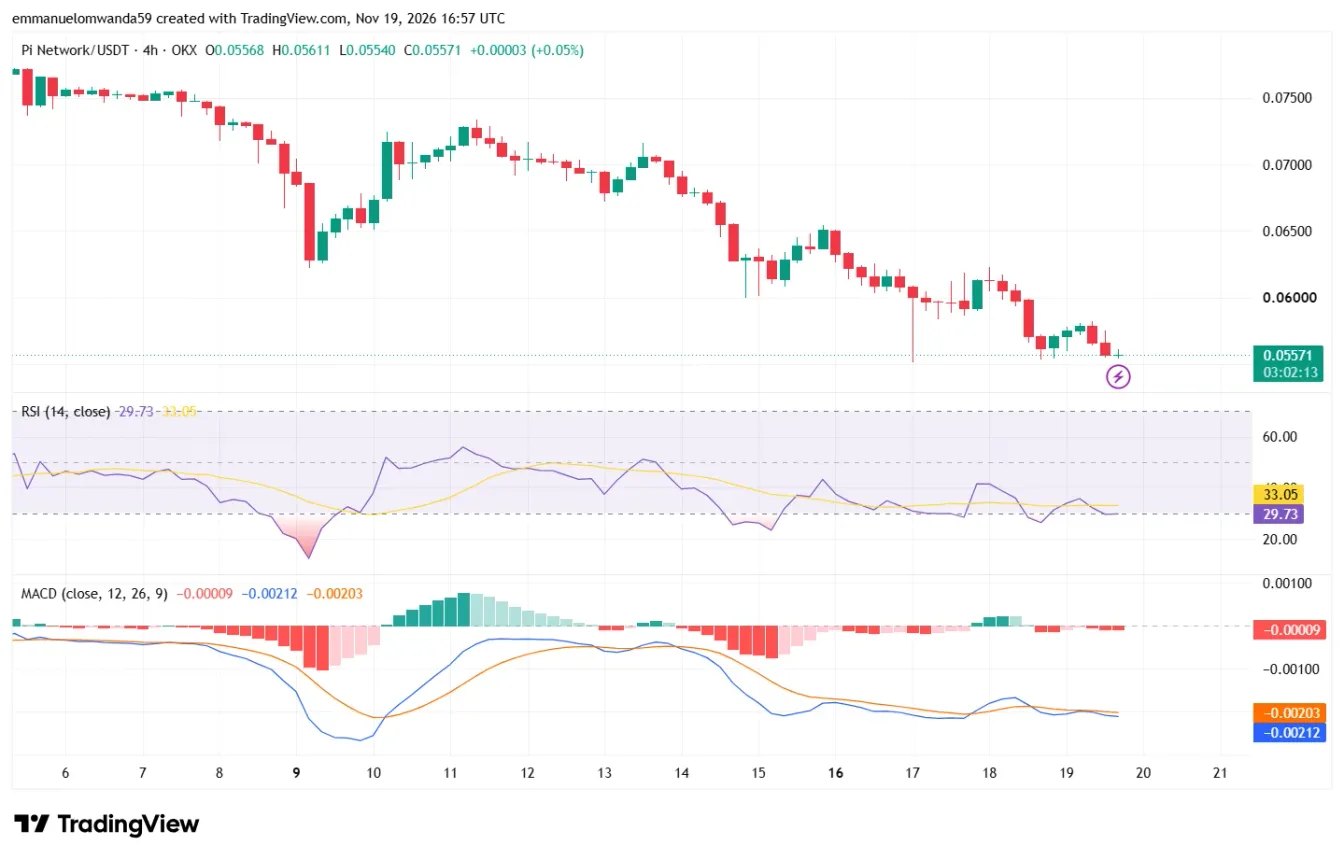
PI/USDT 4-hour price chart: Buyers attempt a recovery near $0.05540.
Looking at the 4-hour chart of the Pi Network, it appears to be recovering slightly from $0.05540. PI climbed 0.05% to $0.05571, with immediate resistance at $0.05611.
The RSI is currently at 29.73, which is slightly below the oversold level of 30. This reading suggests buying momentum remains weak despite the small price recovery.
Meanwhile, the MACD line sits at −0.00212, below its signal line at −0.00203. The histogram is slightly negative at −0.00009, meaning that the sellers still have a slight advantage.
Pi Network Price Prediction: Technical Analysis
Pi Network Price Prediction: Levels and Action
Daily Simple Moving Average (SMA)
Daily Exponential Moving Average (EMA)
Is Pi a Good Investment?
Pi Network’s long-term success will depend on Mainnet adoption, developer activity, ecosystem utility, broader exchange listings that could significantly improve liquidity and accessibility, transaction activity, and the network’s ability to attract and retain active users. Since Pi entered its Open Network period in February 2025, external connectivity has allowed its ecosystem and applications to interact with the broader blockchain environment, while token circulation and migrations can also affect liquidity as more balances move into the market.
Real-world adoption and transaction volume remain critical to PI’s long-term valuation. Greater merchant usage, decentralized applications, and transaction activity across the chain could strengthen demand, while weak liquidity, supply growth, broader market conditions, regulatory uncertainty, inflation, and competition from established cryptocurrencies are among the factors that could continue to pressure the token and weigh on confidence in its long-term valuation, making successful inflation absorption crucial for price growth.
Can Pi Network Reach $1?
At the current circulating supply of roughly 11.14 billion PI, a $1 price would correspond to approximately $11.14 billion in circulating market capitalization, assuming the supply remains unchanged.
Will Pi Price Reach $5?
Pi Network’s long-term value will depend on real-world utility, user adoption, and demand for PI as its ecosystem expands. Some analysts suggest Pi Coin’s price has the possibility of reaching $1.50 by 2032 under optimistic conditions. Protocol 26 is complete, while Protocol 27 is moving toward its September 15 mainnet target, alongside new tools such as SoloHost and AI-focused integrations.
However, PI still faces significant supply pressure, with a 100 billion maximum supply and ongoing token unlocks. A $5 target would require sustained adoption, stronger ecosystem activity, and much higher demand than the network currently has.
Will Pi Reach $10?
Analysts suggest that even optimistic forecasts place this milestone more than a decade away, if at all. Investors should treat such projections as forecasts with no guaranteed outcomes and conduct their own research before making investment decisions, as Pi remains a high-risk coin with uncertain long-term value; conversely, if adoption or demand weakens, it could stay far below that speculative target. In bearish scenarios, some analysts estimate a 50% chance Pi Coin could drop to $0 by 2026.
Does Pi Network Have a Good Long-Term Future?
Pi Network’s long-term prospects depend on its ability to convert the millions it has attracted, including its claimed base of over 60 million total users, into active, verified participants, while continuing to attract new members who later become active ecosystem participants, into a KYC-verified community the project puts at 11 million pioneers, though some reports cite 18.1 million KYC-verified users.
Pi Network uses the Stellar Consensus Protocol for transactions, a design intended to support faster transactions than Bitcoin. If developer adoption, merchant integration, and real-world use cases continue to expand, the project’s progress could strengthen its position within the cryptocurrency market, but engagement and retention still matter because sentiment can influence long-term adoption.
However, investors should also consider risks related to token supply growth, market competition, regulatory developments, regulatory uncertainty, and overall crypto market conditions. As with any digital asset, future performance will
Recent Pi News/Opinions
Ahead of its inaugural Ecosystem Summit, Pi Network unveiled several improvements for developers and businesses. The changes include a redesigned Developer Portal, testnet price history on Pi BlockExplorer, AI-powered app packaging through SoloHost, and stronger identity verification with PiVerify. These updates aim to simplify development and support broader ecosystem adoption. Traders should monitor summit-related announcements as potential catalysts for price action.
Several technical updates have been released to support developers!
— Pi Network (@PiCoreTeam) October 31, 2026
– An improved Developer Portal simplifies app configuration and management
– Pi BlockExplorer now tracks historical prices for Launchpad Testnet tokens
– A new SoloHost skill enables AI assistants to prepare… pic.twitter.com/DWyDBgxjzB
Pi Network’s first online Pi Ecosystem Summit is scheduled for November 17–19, 2026. The event will feature platform announcements, technical demos, and appearances by co-founders Chengdiao Fan and Nicolas Kokkalis. A key component is the “Pi Next” hackathon, offering developers a 200,000 USDT prize pool to build applications, with a particular focus on artificial intelligence integrations.
Pi's first Ecosystem Summit streams on YouTube: technical demos, new feature announcements, developer conversations and Pi Network founders Chengdiao Fan and Nicolas Kokkalis.
— Pi Network (@PiCoreTeam) November 7, 2026
Nov 17 and 18: 8:00 AM PST / 4:00 PM UTC
Nov 19: new 200,000 USDT hackathon kickoff
Check out your Pi… pic.twitter.com/fMkxhnwDKa
At its 17–19 November Ecosystem Summit, Pi outlined plans to bring its testnet decentralized exchange, automated market maker, and Launchpad to Mainnet in Q1 2027. The Pi Next hackathon also opened on 19 November, offering 200,000 USDT in prizes and up to 20 million PI for shared developer marketing. These are planned initiatives, not live Mainnet services. PI was $0.0557 on 19 November, down 20.11% over seven days.
Pi Price Prediction November 2026
For November, Pi Network could trade between $0.06000 and $0.0880 as buyers attempt to regain momentum, with some short-term models placing November 2026 near $0.077. A sustained move above resistance could support further gains, while renewed selling may push PI toward the lower end of the projected range. In a weaker scenario, Pi Coin’s price could drop to about $0.063 over a one-month horizon. Pi Network’s price could rise by approximately 5% over the next 30 days, depending on trading volume and broader market conditions.
Pi Price Prediction 2026
In 2026, Pi Network (PI) is anticipated to trade between $0.05400 and $0.0850, leading to an average annualized price of around $0.0800. Based on Pi Network today, that estimated range from current market conditions implies both downside risk toward the low end and upside potential toward the high end from current levels if market sentiment and ecosystem growth improve during the year.
In September 2026, Pi Coin traded around $0.08 to $0.09, while crypto assets remain sensitive to sentiment and liquidity conditions, and these factors shape the direction of the token through the rest of the year. Kraken listed PI for trading on March 13, 2026, but broader liquidity and demand still matter for the 2026 outlook, so traders should not rely on the chart alone.
Pi Price Predictions 2027-2032
Pi Price Prediction 2027
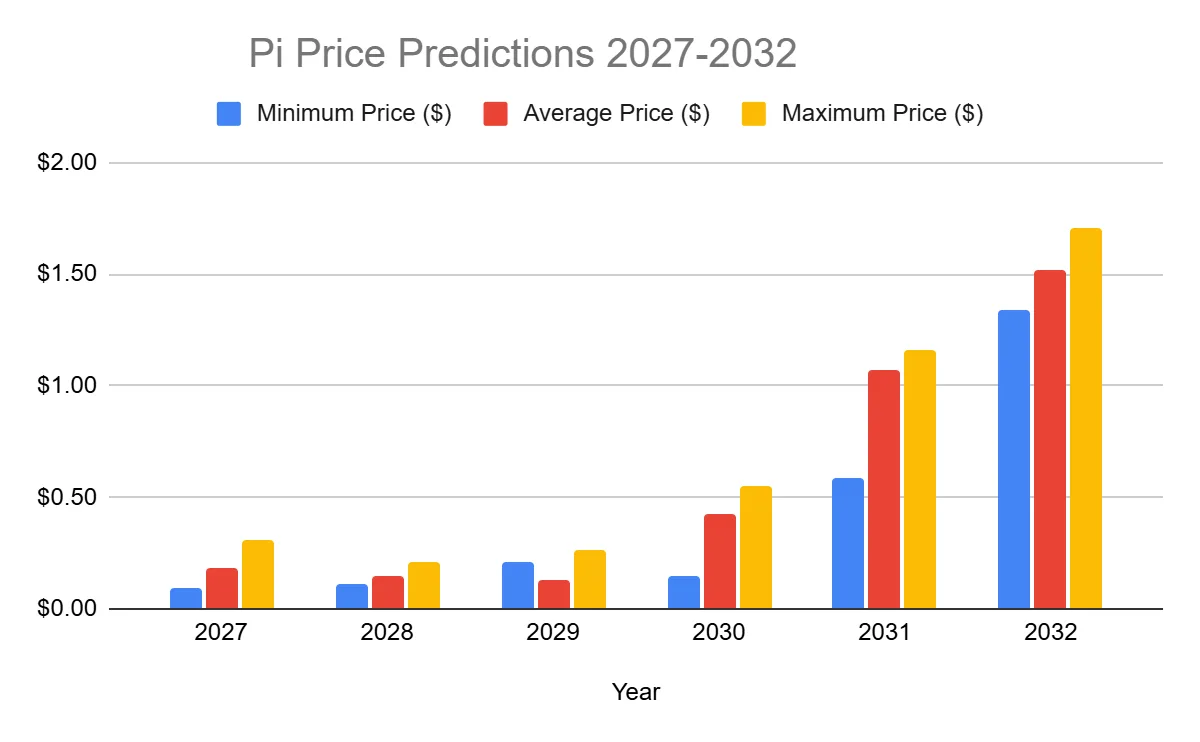
In 2027, the price of Pi is expected to reach a minimum level of $0.0897. The PI price could climb to a maximum of $0.3127, with an average trading price of $0.1814 throughout the year.
Pi Price Prediction 2028
In 2028, Pi is forecast to trade at a minimum value of $0.1078. The PI price may reach a maximum of $0.2074, while the average trading price could settle around $0.1462.
Pi Price Prediction 2029
In 2029, Pi’s price is projected to reach a minimum of $0.1296. The PI price could rise to a maximum of $0.2656, with an average trading price of $0.2124 during the year.
Pi Price Prediction 2030
In 2030, Pi is expected to trade at a minimum price of $0.1490. The PI price may reach a maximum of $0.5547, with an average forecast price of $0.4216.
Pi Price Prediction 2031
In 2031, Pi’s price is forecast to hold a minimum value of $0.5825. The PI price could climb to a maximum of $1.16, with an average trading value of $1.07.
Pi Price Prediction 2032
In 2032, the long-range Pi Network forecast points to a minimum price of $1.34. The PI price could rise to a maximum of $1.71, with an average value of $1.52.
Pi Network Price Prediction: Analysts’ Pi Price Forecast
Cryptopolitan’s Pi Price Prediction
At Cryptopolitan, we remain cautiously bullish on the long-term outlook for Pi Network despite recent volatility in the cryptocurrency market. Based on our Pi forecast, the current price could gradually recover as ecosystem adoption, trading volume, market capitalization, and utility continue to grow. Earlier pre-launch Pi values reflected derivatives-style trading rather than true price discovery.
In 2026, Pi Network (PI) is anticipated to trade between $0.06200 and $0.09600, leading to an average annualized price of around $0.0850. Based on Pi Network today, that estimated range from current market conditions implies both downside risk toward the low end and upside potential toward the high end from current levels if market sentiment and ecosystem growth improve during the years, and investor confidence may strengthen or weaken at this moment depending on ecosystem progress.
However, future price movements will depend on market sentiment, circulating supply growth, technical analysis indicators, and how Pi Network works in live market trading rather than enclosed-network conditions, while broader market trades and liquidity conditions can also influence its behavior in live trading, and user input should not replace independent analysis when interpreting forecast models;
Security circles support the network’s security model, and rewards are distributed based on participation, while the project also draws added credibility from Stanford University-linked founders, including Chengdiao Fan, whose backgrounds span distributed systems and anthropological sciences, as well as the network’s ability to attract users, developers, and real-world applications.
Disclaimer: This analysis, data, and figures are for informational purposes only and do not constitute financial or investment advice; crypto markets are highly volatile, so readers should do their own research before they buy Pi Network.
Pi Historic Price Sentiment
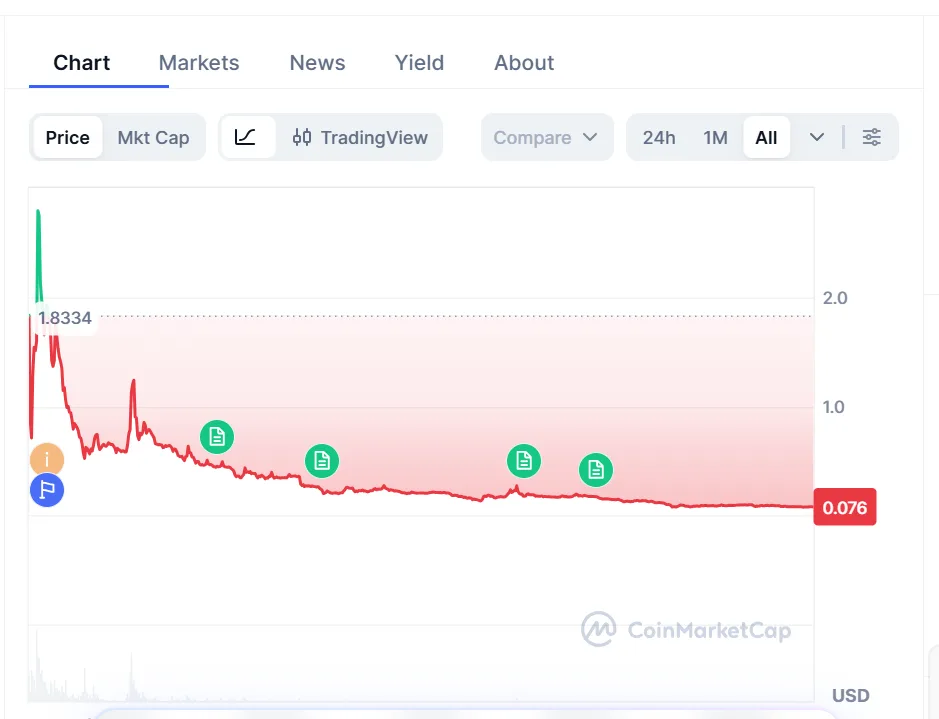
- Pi Network launched in 2019 as a mobile-first social cryptocurrency for everyday people, using mobile mining and operating on its own chain, though it was initially confined to a closed ecosystem with no official market price, as tokens couldn’t be traded externally.
- Its trust model and network life were designed around mobile accessibility rather than energy-intensive mining.
- Between 2023 and 2024, Pi remained unlisted, with speculative prices ranging between $0.60 and $1.00 in unofficial markets.
- In 2025, Pi Network surged to an all-time high of $2.98 in February before entering a prolonged decline, though it later peaked near $1.70 post-mainnet launch in live trading before weakness resumed, driving the price to $0.1585 by October. The token later stabilized between $0.20 and $0.26 toward the end of the year.
- From January to March 2026, Pi Network fell to a new all-time low of $0.1312 before recovering gradually toward the $0.17–$0.19 range as market stability improved.
- By May 2026, Pi Network declined from the $0.17–$0.18 range to around $0.1439, as weak market momentum and continued selling pressure weighed on the token throughout the month.
- Pi Coin’s circulating supply was around 820–830 million tokens, and roughly 174 million PI in monthly inflation created significant downward pressure and selling pressure on the price.
- By June 30, 2026, Pi Network hit a new all-time low of $0.1127.
- By July 2026, Pi Network plunged to a fresh all-time low of $0.1025, marking the period’s lowest price during the selloff as persistent selling pressure and weak market sentiment made it lose the key $0.11 support level.
- Pi Network launched in 2019 as a mobile-first social cryptocurrency for everyday people, using mobile mining and operating in a closed ecosystem with no official market price, as tokens couldn’t be traded externally.
- Between 2023 and 2024, Pi remained unlisted, with speculative prices ranging between $0.60 and $1.00 in unofficial markets.
- In 2025, Pi Network surged to an all-time high of $2.98 in February before entering a prolonged decline, pushing the price to $0.1585 by October. The token later stabilized between $0.20 and $0.26 toward the end of the year.
- From January to March 2026, Pi Network fell to a new all-time low of $0.1312 before recovering gradually toward the $0.17–$0.19 range as market stability improved.
- By May 2026, Pi Network declined from the $0.17–$0.18 range to around $0.1439, as weak market momentum and continued selling pressure weighed on the token throughout the month.
- By June 30, 2026, Pi Network hit a new all-time low of $0.1127.
- By July 2026, Pi Network plunged to a fresh all-time low of $0.1025, extending its prolonged downtrend as persistent selling pressure and weak market sentiment pushed the token below the key $0.11 support level.
- By the end of August 2026, Pi Network had recovered from its monthly low near $0.078 to around $0.0915, setting a baseline that traders may watch tomorrow for short-term momentum, though this is only one bit of evidence rather than a full trend reversal.
- By the end September 2026 neared its end, Pi Network traded around $0.0914, recovering from recent lows but remaining below May levels.
- Traders should focus less on the price chart alone and more on supply data, circulation trends, migrations, and major announcements when evaluating the trend.
- By the end of October 2026, Pi Network traded around $0.07689, reflecting continued weakness and remaining below its September levels.