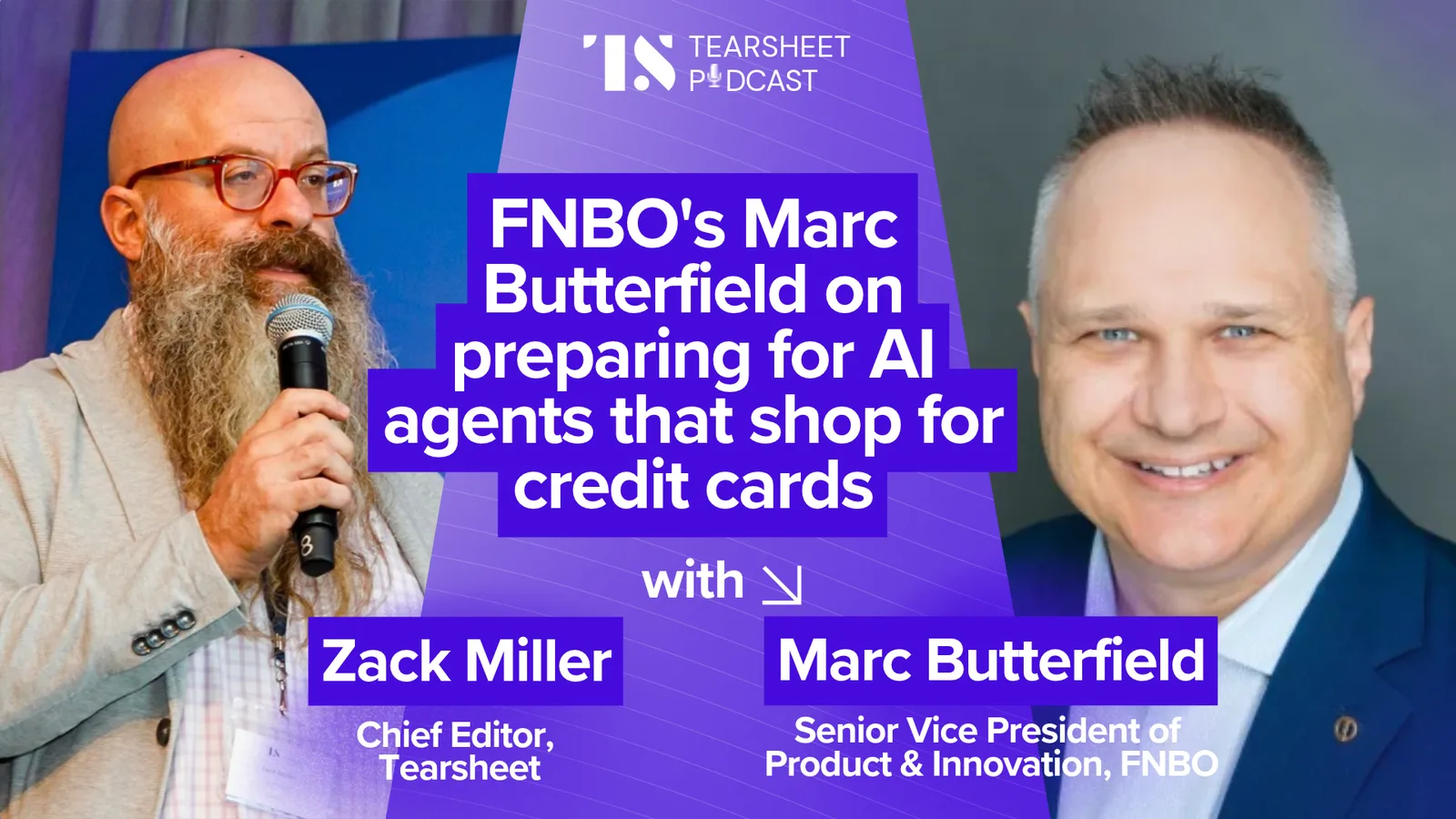
FNBO’s Marc Butterfield on preparing for AI agents that shop for credit cards
Six months ago, Marc Butterfield sat in Omaha and typed “best sporting goods credit card” into ChatGPT. A card co-brand partner of FNBO’s and the top result in a standard web search for the query, didn’t appear.
For Butterfield, Senior Vice President of Product and Innovation at FNBO, the result – or rather the lack thereof – meant there was a need for change. Over half of holiday shoppers last year started their search with a large language model.
Those shoppers carry an assumption with them: “100% of those customers assume their bank is protecting them,” he said. “We have a responsibility to do that, but that’s the burden that we welcome.”
FNBO, a Midwest super regional with about $35 billion in assets, is working on that responsibility across data, fraud, product design, and its own roadmap. In this episode Butterfield walks us through each on the Tearsheet podcast.
Watch the full podcast
Listen to the full podcast
Tearsheet Podcast · FNBO's Marc Butterfield on preparing for AI agents that shop for credit cardsSubscribe: Apple Podcasts I SoundCloud I Spotify
Banks need to give the models better data
“It’s more wild, wild west,” Butterfield said of the sources models use today, which include Reddit, Wikipedia, and publisher sites. Retailers have addressed this by building product catalog APIs, and some of FNBO’s co-brand partners now have direct relationships with the model providers. Butterfield wants banks to do the same, though a shared catalog across competing issuers is harder to arrange.
“It’s just reformatting it to a new world order of LLMs,” he said. FNBO is also extending its SEO work, talking with vendors that specialize in what he calls “LLM management,” a “whole new cottage industry.” The bank has not yet picked one.
Identifying the agent comes first in protecting the customer
The payment rails for agentic transactions largely already exist; the open question is identification. “Do we know if it’s an agent or not? Well, in some cases, we don’t,” Butterfield said. The networks and companies such as Google have set standards, but the market keeps evolving. “I don’t think it’s a big problem to solve, but it is a concern that we’re flagging early on.”
FNBO’s authorization and fraud teams noticed agents hitting the bank’s systems and asked Butterfield to make purchases with FNBO cards through agents so they could observe the activity. Ownership of the topic is shared across several teams, but he thinks banks benefit from assigning at least one person to explore and test.
Product value and loyalty still matter
Issuers have gotten better over the past five years at identifying value and charging for it, Butterfield said. Shoppers now ask an LLM for a card that bundles Global Entry, TSA PreCheck, and a DoorDash membership. Customer needs are fragmenting, so a traveler who wants lounge access may also want 3% back on electric vehicle charging.
“It really gets back to Marketing 101,” he said. “Who’s your customer target, how do you want to engage them, and what features do they need?” Most FNBO cards are issued through brand partners, which makes partner relevance part of the equation. Loyalty gains weight in this setting and Butterfield thinks “the agent is a jumping off point.”
Outcomes give a long roadmap a shape
FNBO is moving its roadmap from feature lists to business outcomes. About 68% of FNBO customers bank on their phones, and matching the web experience can become a build trap, a long list of things to ship. Asking what the bank ultimately wants leads to a simpler, easier, and more helpful digital experience. For 2027, FNBO is finalizing four top outcomes.
The change, however, met resistance from business partners waiting on features. “I was too spiritual and religious about wanting to focus on outcomes,” Butterfield said. He now delivers some requested work to build credibility while questioning each item’s value. Unlike a fintech, whose mix of new work shrinks as it grows, FNBO starts at scale. “We have millions of customers,” he said. When the bank built new teams, about half the members came from inside.
Optimism about what agents can do for consumers
For Butterfield, tools that protect consumers, such as an agent that screens the scam calls his mother receives, have to emerge alongside the bad actors.
His own example involved a flight home for his daughter. He told an agent to stay under $400. It came back with a $414 nonstop option and suggested she would appreciate the extra $14. “It actually didn’t use my hard rule of $400, and actually assumed that I’d be willing to pay 14 more dollars for nonstop both ways,” he said. He bought the ticket.
The post FNBO’s Marc Butterfield on preparing for AI agents that shop for credit cards appeared first on Tearsheet.